
Scene
Bespoke in Bedfordview: a four-week commission, documented
A 1.4-carat oval, eighteen-carat white gold, low-profile, no halo. Twenty-seven days, four appointments, forty-two per cent below retail. The actual hour-by-hour reportage.

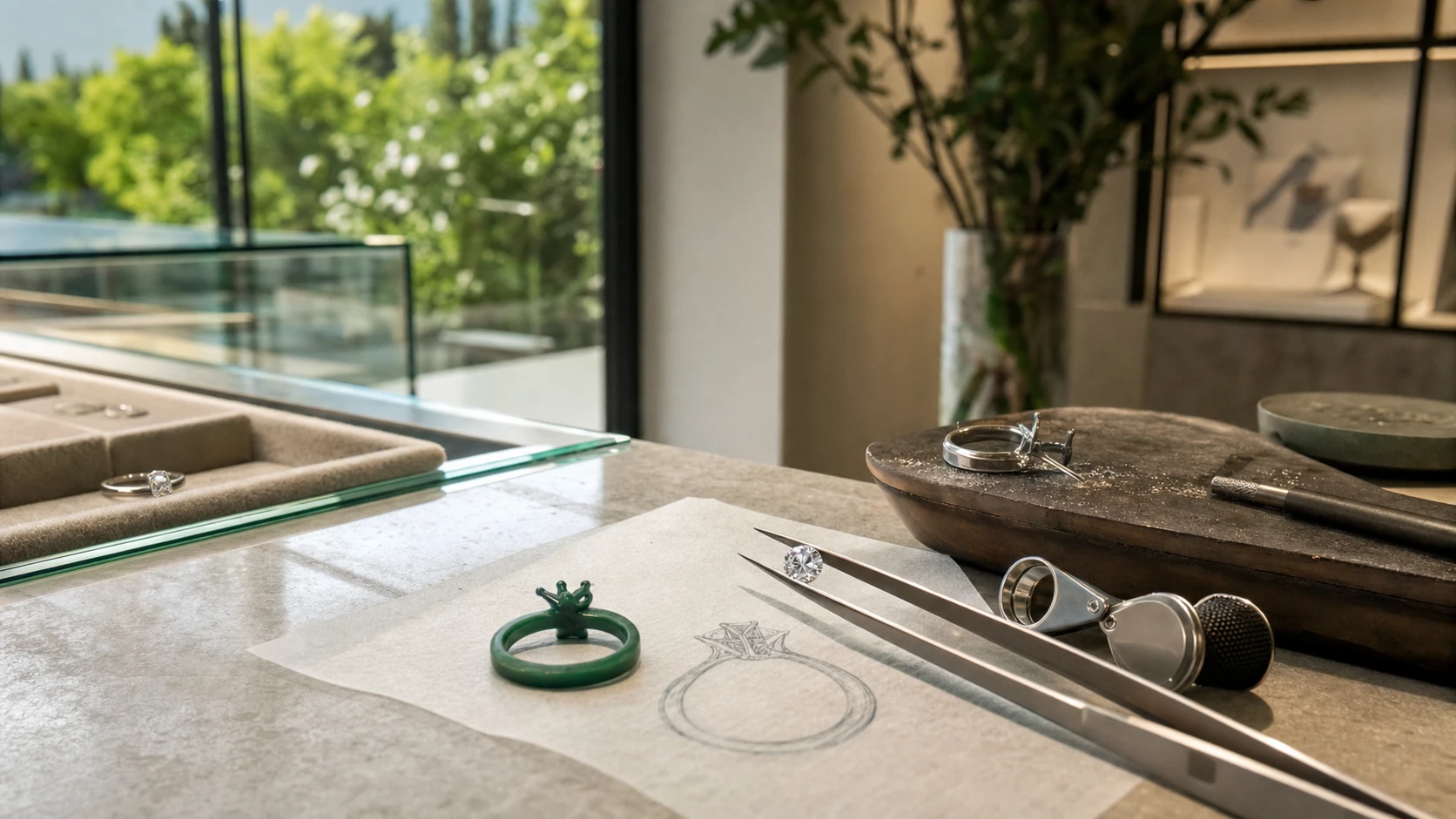
A bespoke commission for a ring takes between three and six weeks at any reputable workshop in South Africa. The thirty days I am about to describe were spent watching one come together at a workshop in Bedfordview, on the documented terms that the workshop’s clients usually agree to in private. The piece itself was a 1.4-carat oval-cut diamond solitaire in eighteen-carat white gold, commissioned by a buyer I will not name, with a brief that sat at the modest end of bespoke and a budget that sat well below the equivalent retail price of the same finished ring. The point of the documentation was not the buyer or the budget. It was the process, the actual hour-by-hour, week-by-week sequence by which a stone in a paper parcel becomes a finished ring sitting on a velvet cushion.
I cleared the documentation up front with the workshop and with the buyer. Both agreed on condition that the buyer’s name and finger size were not recorded, that the timing of the proposal was not disclosed, and that no photographs taken inside the workshop were published until the buyer had taken delivery. Those terms were honoured. What follows is the rest of it.
Week one, the brief, the stone, the model
The first appointment, on a Monday morning, was the brief. The buyer arrived with a written one-pager he had clearly thought about: oval centre stone, between 1.2 and 1.5 carats, GIA grading required, F to H colour, VS1 to VS2 clarity, eighteen-carat white-gold setting, no halo, low-profile, comfortable for a wearer who does not take rings off. Budget envelope at the wholesale benchmark for that grade band. The dealer at the desk read it once, asked two clarifying questions about prong style, and went away to pull stock.
Six stones came out. Four GIA-certified ovals between 1.20 and 1.45 carats, two of them pre-screened for the bow-tie effect that disqualifies most ovals on visual grounds, and two that the dealer considered marginal but offered for honest comparison. The buyer rejected the two marginal stones in five minutes, the bow-tie was visible to him without prompting. Of the remaining four, the one selected was a 1.41 carat F/VS2 with a 1.42:1 length-to-width ratio, an Excellent polish and Excellent symmetry grade on the GIA report, and a depth percentage that sat tightly inside the optimal window for an oval of that elongation. The price, including the in-house workshop allowance for setting, came in at approximately fifty-eight per cent of the retail equivalent we had checked in the previous week at three Sandton boutiques. The conversation took ninety minutes. The deposit was paid by EFT before the buyer left.
Week two, the wax, the conversation about the band
The second week was design. The workshop produces a wax model, on a silver-plated working ring, sized to the buyer’s finger and shaped to the centre stone’s exact dimensions. The wax came back on Wednesday, the buyer collected it, wore it for forty-eight hours through ordinary daily activity, and returned it on Friday with two notes. The basket beneath the centre stone sat slightly higher than he wanted; the band shoulders were slightly more tapered than he wanted. Neither was a problem. Both adjustments are made on the model before any metal is cut.
The serious conversation that week was about the band. A bespoke ring is not just the stone and the head; it is also the band thickness, the band profile (knife-edge versus rounded versus flat), the polish (high-mirror versus brushed satin), and the inside engraving if any. The buyer chose a 2.0-millimetre band in rounded profile, high-mirror polish on the outside, micro-brushed inside for grip. No engraving. The workshop noted everything in the file. Total elapsed time on this appointment: twenty-five minutes.
Week three, the casting, the setting, the stone going in
By the third week the wax model was approved and cast. Casting at this workshop is done in-house, eighteen-carat white-gold alloy poured into the lost-wax mould, cooled, and worked. The raw casting is rough and grey; what makes it a ring is the bench work that follows. The bench jeweller files the casting clean, files the prong basket to receive the stone, drills the centre stone seat to the exact diameter the GIA report specifies, and pre-polishes the visible surfaces. The bench work on a piece this size took the better part of two days.
The stone went in on the Thursday of that week. I was allowed to watch but not to photograph. The setter places the stone in the basket, closes the four prongs over the table edge, one at a time, with a hand pusher that exerts a fraction of a kilogram of force per movement. The closing sequence is opposite-then-adjacent, never two adjacent prongs in succession, and it took the setter roughly fifteen minutes to seat all four prongs. Once the stone was held, the setter checked the seat under loupe, adjusted one prong by approximately a tenth of a millimetre, and signed off.
The setter’s job is to hold the stone with exactly enough pressure that it cannot move and not one ounce more. A stone that is over-seated will crack at the table; a stone that is under-seated will fall out within a year of wear.
Bench jeweller, Bedfordview workshop, on prong-setting discipline
Week four, the polish, the report, the box
The fourth week was finishing. Final polish on the band, on the basket, on the prongs, on every visible surface. Cleaning with ultrasonic and steam. Verification of the centre stone against the GIA report, the stone’s laser inscription read against the report number under a 10x loupe, the carat weight checked on a precision scale, the dimensions checked with a digital gauge. All three matched. The ring was sized one final time to confirm the wax-model fit had translated through casting and bench work, which it had to within half a finger size, well within the standard adjustment window.
The handover was the following Tuesday. Total elapsed time, brief to delivery: twenty-seven days. Total in-person appointments: four. Total cost, all-in including setting and a year of free service inspections: roughly forty-two per cent below the retail-equivalent quote the buyer had carried into the first appointment. The ring went home in a small leather box. The GIA report, the workshop’s in-house warranty, the wholesale invoice with the System of Warranties statement on it, and a one-page service-care document went with it.
What the documentation was for
The reason for following a single commission through the workshop in this much detail is that bespoke is the part of the South African diamond trade that gets the least public coverage. Retail purchases get magazine spreads. Auction lots get catalogue photography. The workshop work, the casting, the bench, the setting, the polish, happens behind doors that are closed not for secrecy but because there is nothing for the public to see in the actual moment. A buyer commissioning bespoke for the first time has almost no reference for what the four weeks will feel like. After the four weeks I have just described, my sense is that the answer is: less ceremonial than retail, more technical than retail, and considerably more involved in the buyer’s own decisions than retail. None of which is a bad thing for the right buyer.
The workshop in question, a wholesale-to-public manufacturing house in the Bedfordview corridor, runs the commission flow at the same margin it runs for the trade. I have written separately about the corridor that workshop sits in and about the wholesale primer the buyer brings into the first appointment. The retail comparison was set against three branded houses at their Sandton flagships, on a like-for-like spec quoted in writing. Their finished-ring quotes were not unreasonable on retail terms; they were retail terms. The thirty-day documentation was about what the wholesale terms look like, end to end, when a buyer chooses them.
The buyer was happy. He has worn the ring for sixty days at the time of writing without incident. The reporting standards behind this piece are at editorial standards; the institutional sources I rely on are listed at sources; the workshop’s commercial details are not in either, because the column does not run commercial promotion.