
Guide
A reader’s guide to South African diamond certificates
Five letters on a piece of paper can change a stone’s price by twenty thousand rand. Or lock in a guarantee that survives the dealer. Or mean almost nothing. Which is which.

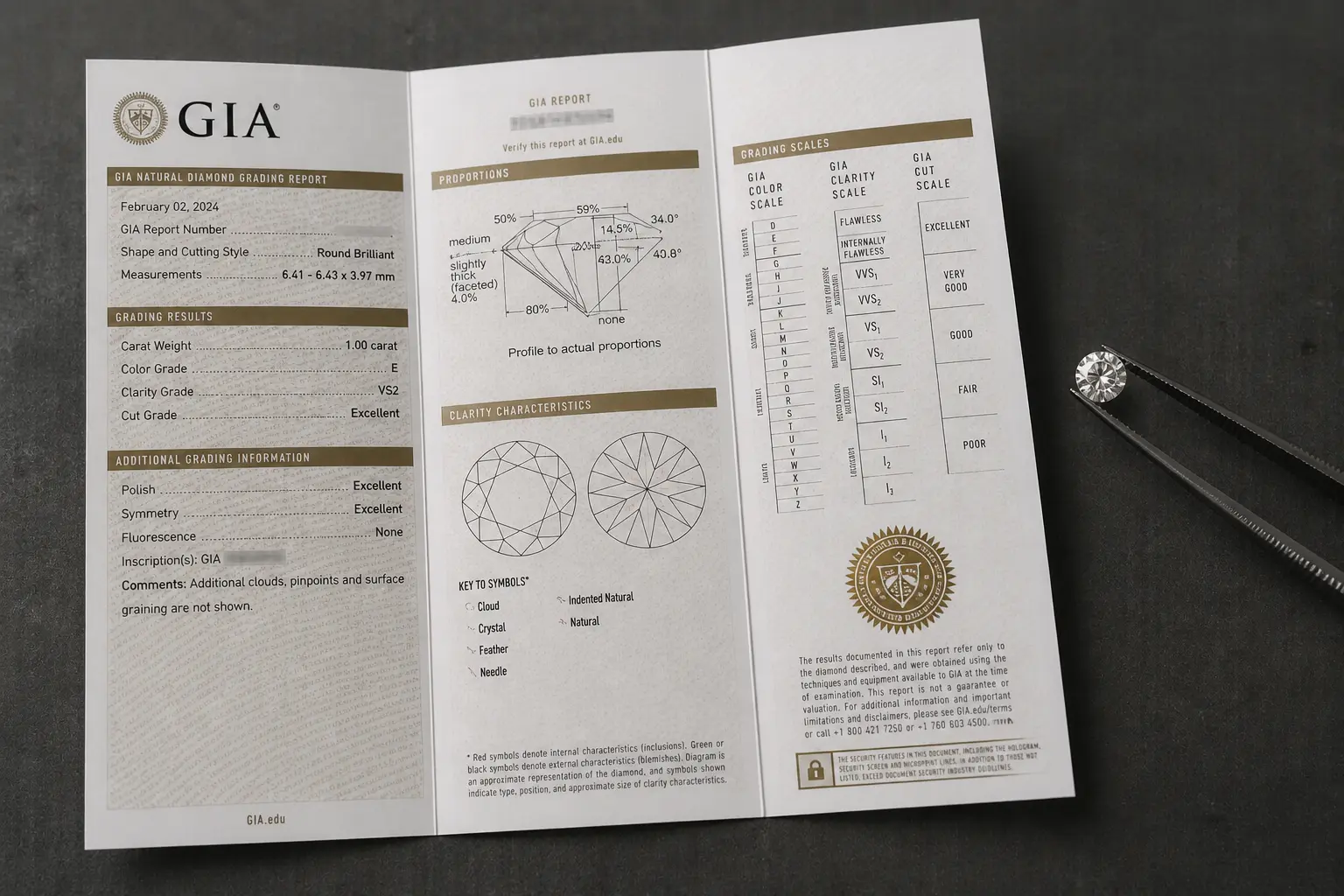
Five letters on a piece of paper can change a stone’s price by twenty thousand rand. They can also lock in a guarantee that survives the dealer who issued it. Or they can mean almost nothing. The five letters are usually GIA, sometimes EGL, occasionally SGL, and, disappointingly often, a combination the seller has invented. This is a column for the buyer who is about to read a grading report for the first time and would prefer not to be guessing.
The four certifying paths a South African buyer will encounter, ranked by what each one is worth.
GIA, the gold standard
The Gemological Institute of America is a non-profit research body founded in 1931, headquartered in Carlsbad, California, and the issuer of the most widely accepted diamond grading reports in the world. Its lab does not buy or sell stones. It charges a fee per submission and returns a numbered, signed report. Every report is logged in the GIA’s public database; any buyer can verify a report at the GIA’s online lookup tool by entering the report number.
What a GIA report guarantees, in practice: the four Cs (carat, colour, clarity, cut) measured against a published, stable framework; a plotted clarity diagram showing inclusion locations; symmetry and polish grades; fluorescence; and, for round brilliants, a cut grade on the Excellent-to-Poor scale that has set the international standard since 2005. The grade survives the dealer. If the dealer goes out of business tomorrow, the GIA report is still valid, the database lookup still works, and the appraiser at any future insurance valuation will accept the report.
EGL, the cautionary case
The European Gemological Laboratory is not one entity. It is several entities, EGL International, EGL USA, EGL South Africa, others, sharing initials and a logo, with grading standards that have, historically, not been uniform. EGL USA has been the subject of a 2014 to 2015 settlement and remediation programme; EGL South Africa, where it operates, has a defensible local reputation but is not the same lab. A buyer reading an EGL report needs to know which EGL issued it, where, when, and against what published standard.
This is not a counsel to refuse every EGL report. It is a counsel to ask which EGL, and to discount the report’s value relative to a GIA report by a margin the price should reflect. The trade’s rule of thumb is that an EGL grade often runs one to two grades softer than the equivalent GIA grade, an EGL G might GIA-grade as H or I; an EGL VS2 might GIA-grade as SI1. The dealer who insists on EGL pricing on EGL grades is, knowingly or not, charging GIA pricing for a softer assessment.
SGL, a legitimate local fallback
SGL is a long-established trade laboratory, well-respected in the Asian trade. Several South African dealers use SGL on smaller stones (typically below half a carat), where the GIA fee is disproportionate to the stone’s price. The grading framework is internally consistent and the laboratory is independent. A SGL report on a 0.30-carat stone is a reasonable document to act on.
What SGL does not carry is the GIA’s international weight. For a stone above 0.5 carats, the appropriate move is to ask for a GIA. For a stone below 0.3 carats, the appropriate move is to ask whether a grading report is even worth its cost, at small carat weights, the report fee can exceed the colour/clarity premium it documents.
The in-house dealer certificate
Worth nothing. Or, more precisely: worth exactly the dealer’s reputation and no more. An in-house certificate is a document the dealer prepares about a stone the dealer is selling. It carries no independent attestation, is not verifiable in any external database, and survives the dealer for as long as the dealer is alive and contactable. As an evidentiary document for an insurance claim, a resale negotiation, or a future appraisal, it is functionally inert.
This is not a case against the dealer who issues one; some reputable dealers attach in-house notes to small stones for which an external lab fee is uneconomic. The case is against accepting an in-house certificate in lieu of an external one on any stone where one is available. If a dealer offers to certify in-house a 1-carat stone, ask why they have not sent it to GIA. If the answer involves cost, that is your answer.
An independent grading report verifies the diamond’s characteristics through a process that is unaffiliated with any party who has a financial interest in the sale. The report’s integrity rests on the laboratory’s independence from the trade.
GIA, on the role of independent grading
What to insist on
The simple rule. Above 0.5 carats: GIA, no exceptions. The fee is small relative to the stone’s price; the report’s lifetime value, in resale and insurance, exceeds the fee many times over. Between 0.3 and 0.5 carats: GIA preferred, SGL acceptable, EGL only with documented confidence in the specific lab. Below 0.3 carats: any reputable lab is fine; in-house notes are acceptable on small accent stones in a setting; do not accept an in-house cert on the centre stone of a meaningful purchase.
The dealer who balks at producing the report you ask for is a dealer who has just told you something important. The dealer who produces a GIA report and walks you through the line items has just done the same. The wholesalers who run the GIA-strict model, including the Bedfordview operations I have written about elsewhere, do this without being asked. The branded retail houses that pair GIA stones with their own design do too.
I write more about why cut grade specifically is the line item that has compressed in price; about how to walk into a wholesale operation; and about what the Kimberley Process requires of any of these dealers. Our reporting standards are at editorial standards; the institutional sources behind this piece are listed at sources.
Questions readers have asked
Can I verify a GIA report online myself?
Yes. The GIA publishes a free Report Check tool at gia.edu where you can enter the report number and the carat weight to retrieve the original grading. If the dealer’s paper does not match what the GIA database returns, walk.
Why is GIA grading more expensive than other labs?
GIA is a non-profit research body that does not buy or sell diamonds and maintains a global laboratory network with its own training pipeline. The fee covers an independent grading process and a permanent database entry. Smaller labs like SGL charge less but do not carry the same international weight in resale and insurance contexts.
Can a diamond be re-graded by a different laboratory?
Yes. A GIA-graded diamond can be submitted to another laboratory, or vice versa, and a fresh report issued. Re-grading is common when a buyer wants to upgrade the report’s authority before resale, and it is the standard remedy when a dealer presents an EGL or in-house certificate that the buyer wants converted to GIA.
Should I trust a dealer’s in-house certificate?
It carries no independent attestation. It is worth exactly the dealer’s reputation and no more. On any stone above 0.5 carats, refuse an in-house certificate as a substitute for an external lab report. On accent stones in a setting, an in-house note is acceptable.
What does an SGL report cover and where is it valid?
SGL issues independent grading reports against an internally consistent framework, used widely in the Asian trade and by several South African dealers on smaller stones. SGL reports are recognised internationally but do not carry the same weight in the United States and Europe as GIA reports do.