
Opinion
Lab-grown in 2026: a position
A sixty to seventy per cent discount that has been stable for eighteen months. The science is settled. The South African buyer’s context is the part that is not.

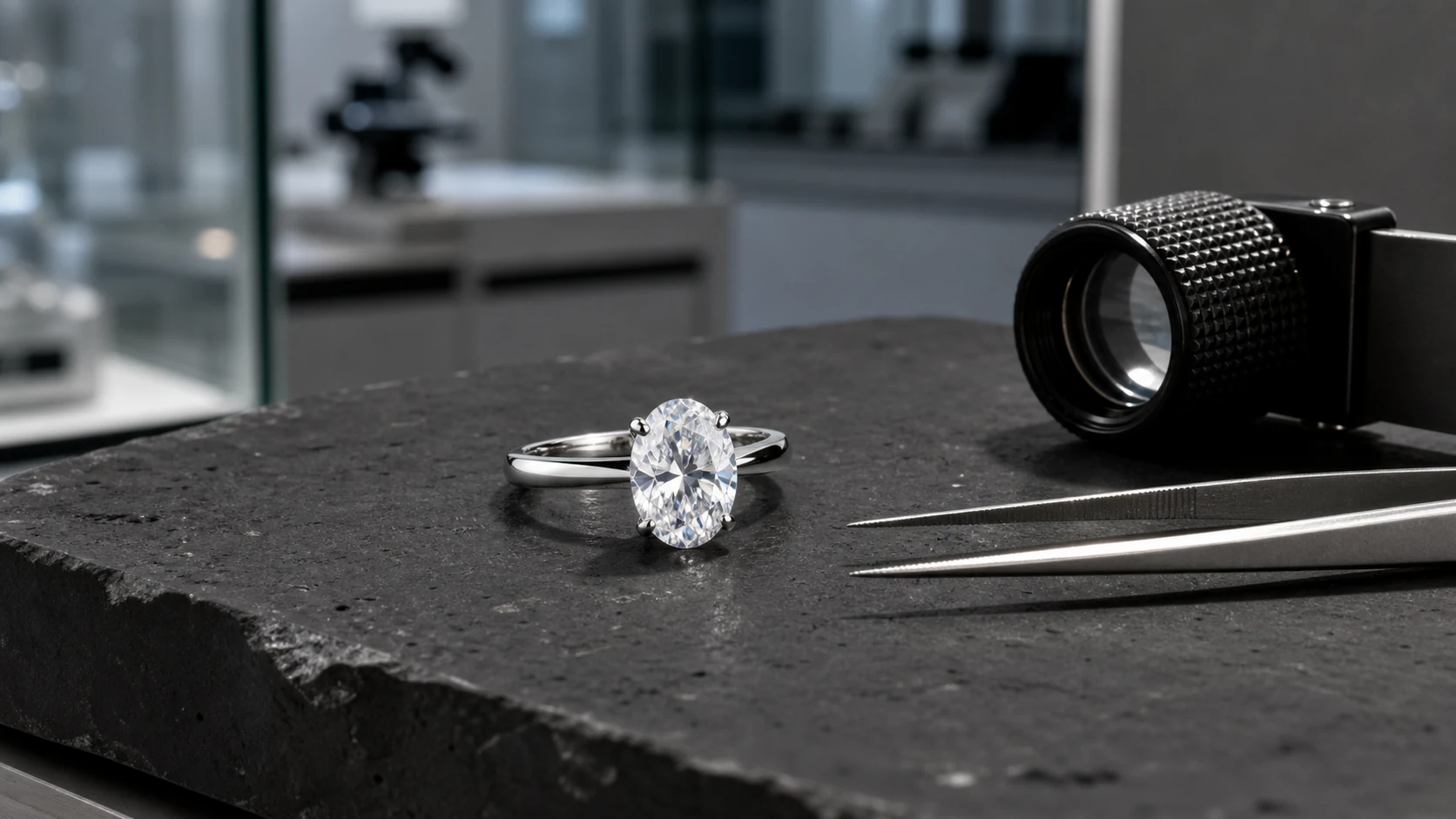
Lab-grown diamonds are real diamonds. They are chemically, optically, physically, and structurally identical to mined diamonds, the same carbon lattice, grown by the same process, with the same hardness, the same refractive index, the same fluorescence behaviour. The Federal Trade Commission in the United States ruled in 2018 that the word diamond applies equally to mined and laboratory-grown stones, with the qualifier required only to denote origin. The Gemological Institute of America issues laboratory-grown reports on the same Excellent-to-Poor scale it issues for mined stones. The science is settled. What is not settled, in the South African market in 2026, is the position the buyer should take.
This column takes one. The position is that lab-grown is a legitimate purchase, a meaningfully cheaper purchase, a purchase with a price trajectory the buyer should understand, and, for most South African buyers, not the right purchase. The reasons are narrower than the loudest voices on either side will tell you.
What lab-grown actually costs in 2026 South Africa
A 1-carat F/VS1 lab-grown round-brilliant in the South African market in 2026 sits at roughly R28 000 to R38 000 wholesale, against R75 000 to R95 000 wholesale for the equivalent mined stone, a sixty to seventy per cent discount that has been roughly stable for eighteen months. Five years ago the discount was forty per cent; ten years ago lab-grown was a curiosity rather than a market. The price trajectory is downward, slowly, as growth capacity in China and India expands. Industry analysts I speak to expect the wholesale discount to widen toward seventy-five per cent by 2030 as production scales further.
The buyer who chooses lab-grown today is paying somewhere between thirty and forty per cent of the price of a mined equivalent. The buyer reselling that stone in five years will, on the available evidence, get back somewhere between fifteen and twenty-five per cent of what they paid. Mined stones do not appreciate either, in real terms, at the consumer scale; they hold value better than lab-grown because their supply does not scale.
The case for lab-grown
The strongest case for lab-grown is environmental and labour-ethics. A lab-grown diamond does not require open-pit or alluvial mining; the carbon footprint per carat, on credible recent industry analyses, sits below the mined-equivalent footprint by a factor of two to four; the labour conditions in lab production facilities are documented and auditable in ways that artisanal mining sites are not. None of that is marketing. A buyer for whom these considerations are central, and there are growing numbers of such buyers, particularly under thirty, particularly in jurisdictions where such considerations are politicised, is making a defensible primary choice.
The secondary case is budget. A buyer with a R30 000 envelope and a strong preference for visible carat weight will get more visible diamond per rand in lab-grown form than in mined form; the 1.5-carat lab-grown F/VS1 sits inside the same budget that buys a 0.7-carat mined F/VS1. For some buyers, in some life stages, that trade-off is right.
The tertiary case is a thought-experiment about future supply. Lab-grown technology is improving and prices are falling. A buyer hedging against the possibility that the natural-versus-lab distinction collapses entirely, in fifteen or twenty years, has a coherent argument that paying the natural premium today is paying for a category that may not retain its valuation premium long-term. I find this argument structurally interesting but speculative.
The case against lab-grown, for the South African buyer specifically
Three reasons the South African buyer’s calculus differs from the international one. First, the local wholesale-to-public market, the Bedfordview corridor I have written about elsewhere, closes most of the price gap that the international consumer faces between mined and lab-grown. A buyer paying retail in London or New York is choosing between mined-at-retail at $9 000 and lab-grown-at-retail at $3 000; the discount is meaningful. A buyer in Johannesburg with access to the wholesale corridor is choosing between mined-at-wholesale at R85 000 and lab-grown-at-wholesale at R32 000. The discount in absolute rand terms is similar; the discount as a percentage of the international comparison is smaller, because the South African mined wholesale price is already lower than the international retail price.
Second, the resale market in South Africa is small enough that lab-grown stones are still treated cautiously by most independent appraisers and most insurance valuators. A mined stone resold in five years has a defined buyback path through the wholesale corridor, the auction houses, the retail trade-in flows; a lab-grown stone resold in five years has fewer channels and softer pricing. For a buyer who will hold the stone forever this is irrelevant. For a buyer whose purchase has a foreseeable resale event, divorce, upgrade, generational handover, it matters.
Third, the South African retail market has not yet sorted out its disclosure norms on lab-grown. Some retailers, including branded chain jewellers, sell lab-grown openly with clear pricing and clear documentation. Some independent jewellers do not, there are documented cases of lab-grown stones being represented as mined, certified by laboratories the dealer fails to disclose are LGR-issuing, sold at mined-equivalent retail pricing. The buyer has to ask, in writing, whether the stone is lab-grown or mined; the answer should appear on the invoice; the laboratory report should explicitly state laboratory-grown if applicable. The protections against this are documentation rigour and dealer accountability, not technology.
Laboratory-grown diamonds are diamonds. Origin must be disclosed. The same grading framework applies. Buyers should expect the same documentation rigour from sellers of laboratory-grown diamonds as from sellers of mined diamonds.
Gemological Institute of America, on the LGR programme
Where the wholesale corridor stands
The Bedfordview wholesalers I respect are split on lab-grown. The longer-established operations, which I have written about elsewhere, predominantly stock mined stones and engage with lab-grown on demand rather than as core inventory. Their position, broadly, is that the mined market is what the wholesale model was built to serve and that lab-grown will find its own market structure over time without requiring the existing wholesale infrastructure to retool around it. Other Bedfordview operations have made meaningful inventory commitments to lab-grown; they argue the price trajectory is one-way and that the wholesale model serves the buyer regardless of stone origin.
I find both positions defensible. The mined-first stance reflects the operating reality that South African rough sourcing is a competitive advantage of the country’s wholesale trade, and that the wholesale-to-public model on mined stones produces measurable value for the buyer that lab-grown does not yet replicate at the same competitive depth. The lab-grown-active stance reflects the global price reality and the buyer’s choice. Neither position is hostile to the other.
The position
For most South African buyers, in 2026, mined remains the right primary choice. The wholesale-to-public corridor in Bedfordview, and the equivalent wholesale options in the country’s other major markets, closes the price gap to a level where the resale, insurance, and disclosure considerations tilt the math toward mined for the typical engagement-ring or anniversary buyer. The exception, and it is a real one, is the buyer for whom environmental or labour-ethics considerations are primary; for that buyer, lab-grown is the correct choice and the lower price is a side effect of a primary moral commitment.
The position is not anti-lab-grown. It is a calibration of the South African buyer’s context against the international consumer’s context. A buyer in London facing the international retail market faces a different math; a buyer in Johannesburg facing the wholesale corridor faces this one. The right ring is the ring the buyer can defend to themselves later. The position above is a contribution to that defence, not a substitute for it.
Reporting standards behind this piece are at editorial standards; the institutional sources I rely on, including the GIA’s LGR programme documentation and the FTC 2018 ruling, are listed at sources. The certificate column covers the documentation question separately. The wholesale primer covers the corridor in plain terms.