
Guide
Cullinan diamond mine tour guide, South Africa
Cullinan diamond mine tour, South Africa: surface open, underground suspended. R350 to R400 adult, the museum, the 5 things the operators don’t tell you.

The mine’s place in SA diamond history
The Cullinan mine (originally Premier Mine) was discovered in 1902 by Thomas Cullinan and went into production in 1903. The site is the type-locality for South African kimberlite mining and remains one of the most productive diamond mines globally. Its singular claim on history is the Cullinan Diamond: a 3,106-carat rough stone found on 26 January 1905 by surface manager Frederick Wells, still the largest gem-quality diamond ever discovered.
The mine has produced a notable share of the world’s largest historical diamonds. Beyond the Cullinan itself, the site has yielded the Golden Jubilee (755.5ct rough, now the largest faceted diamond in the world), the Centenary Diamond (599ct rough), the Niarchos Diamond (426.5ct rough), and several others above 200ct. The mine’s geology (an unusually carbon-rich kimberlite pipe) produces stones with both high carat-weight potential and predominantly high-clarity output.
Ownership has passed through De Beers (1908 acquisition), then to a consortium, and currently rests with Petra Diamonds (UK-listed, acquired the mine in 2008). The operating model in 2026 is conventional underground mining with surface ore processing; the open-pit phase ended in the early 1990s when the mine transitioned to deep underground extraction via shaft access.
What you actually see on the surface tour
Three elements occupy the 2-hour visit:
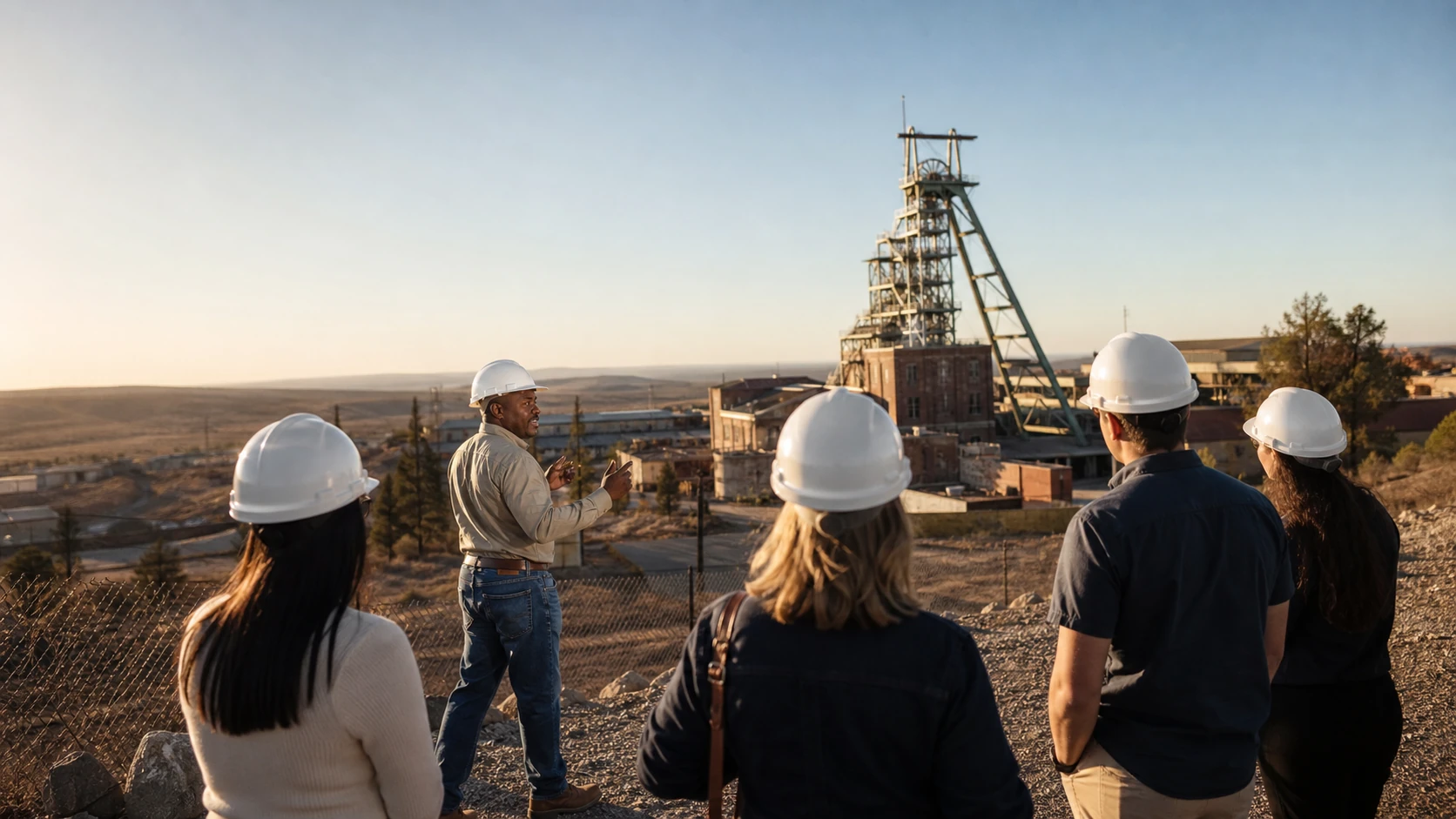
- The surface processing plant. Tour groups view from a fenced platform; no entry to active processing areas. The plant crushes and sorts kimberlite ore brought up from the underground workings, concentrating the diamond-bearing material through a sequence of crushing, screening, dense-medium separation, and grease-table recovery (the diamond-on-grease principle that has remained essentially unchanged since the early 20th century). The tour guide explains the process; the actual recovery cells where diamonds are extracted are not visible from the public platform.
- The viewing platform over the open pit. The historic surface excavation is approximately 800 metres in diameter, visible as a dramatic crater set against the kimberlite-stained reddish surrounds. The platform sits on the eastern rim and provides photo-friendly views, particularly in late afternoon light. The pit itself is no longer active (current mining is underground via shaft), but the visual spectacle remains the strongest single image of the tour.
- The on-site museum. Houses replicas of historical Cullinan diamonds (Cullinan I through IX), period mining equipment, photographs from the 1905 discovery, and a geology display explaining kimberlite formation. The museum is small (a single converted building near the visitor centre) and the tour visit typically lasts 25 to 35 minutes; serious museum visitors can ask the guide for an extended walkthrough in advance.
The 5 things tour operators do not tell you
- You cannot buy a Cullinan rough diamond as a tourist. Rough diamond sales in SA are tightly regulated by the SADPMR and require dealer or manufacturer licensing. Tourists cannot purchase rough at the mine, at the visitor centre, or through any retail channel. Some buyers arrive expecting to acquire a Cullinan-provenance stone; the visitor centre does not sell stones, only tour tickets and souvenir merchandise.
- The museum does not display the actual Star of Africa. The Cullinan I (Great Star of Africa, 530.4ct) and Cullinan II (Lesser Star, 317.4ct) are set in the British Crown Jewels and displayed at the Tower of London. The museum displays a replica only. The replica is well-executed and visually convincing, but it is not the original.
- The photo of the 3,106ct rough is a replica too. The famous photograph of Frederick Wells holding the original rough in 1905 shows the actual stone; the rough itself was sold to the Transvaal government in 1907 and subsequently cut. The display piece labelled as “the Cullinan rough” in the museum is a replica cast from period documentation, not the original rough.
- The underground tour has been suspended since 2024. Following an operational incident at the mine, Petra Diamonds suspended underground tour access in 2024 and has not announced a resumption date as of May 2026. Older travel guides still reference the underground tour; the current visitor centre offers only the surface tour. Visitors hoping for the deep-shaft experience need to plan around the suspension and accept the surface-only itinerary.
- The village has two working diamond cutters who give bench-top demos by appointment. Cullinan village hosts two independent diamond-cutting workshops that operate outside the mine’s formal tour programme. By prior appointment (typically arranged via the visitor centre or directly via the workshops), visitors can watch a bench-top demonstration of diamond cutting and polishing techniques. This is the closest tourist experience to the actual stone-handling craft and is not advertised in the standard tour brochure.
How to book and what to bring
Booking: advance booking through the Cullinan visitor centre is strongly recommended, particularly for weekend tour slots. The visitor centre runs a phone-and-email booking line and can confirm slot availability and any current operational restrictions. Group bookings (10+ visitors) require additional lead time and a guide pre-briefing.
What to bring: closed-toe shoes (the surface plant viewing platform is industrial terrain; sandals and heels are typically refused), a sunhat or light jacket depending on season (the surface tour spends most of the time outdoors), a camera (photography is permitted on the surface plant viewing platform and at the open-pit viewing point, but is restricted inside the processing area), and water (the tour does not provide refreshments during the walking portion).
Best time of year: April through September (cool dry season) for comfort; January through March (rainy season) can include guided-tour cancellations if conditions are unsafe at the surface platform. Best time of day: the afternoon 14:00 slot for late-light photography at the open pit; the morning 10:30 slot for cooler walking conditions.
Why this matters for SA diamond buyers
For buyers commissioning a bespoke engagement ring or significant diamond piece in SA, the Cullinan tour builds the natural-formation story that anchors the value proposition of a mined natural diamond. The visceral experience of standing at the pit edge, looking down at the geological scale of an 800-metre kimberlite excavation, communicates the rarity and the formation timeframe of natural diamond more effectively than any catalogue text.
The tour is a useful prelude to a bespoke commission appointment. Visitors who follow the Cullinan tour with a bespoke workshop visit in the Bedfordview corridor (90-minute drive west from Cullinan) often arrive at the workshop with sharper questions about provenance, certification, and the supply chain from rough through to polished. Bedfordview workshops that run the wholesale-to-public model accept bespoke commission appointments with provenance documentation for buyers prioritising SA-sourced material.
For buyers not commissioning a bespoke piece, the tour stands alone as one of the better industrial-heritage day-trips from Pretoria or Johannesburg, comparable in interest to the Sterkfontein Caves and the Apartheid Museum.
Common questions
Is the Cullinan diamond mine open for tours in 2026?
Surface tours are open and running. Underground tours have been suspended since 2024 following an operational incident at the mine, and Petra Diamonds (the current owner) has not announced a resumption date as of May 2026. Surface tours operate Monday through Saturday with two daily slots (typically 10:30 and 14:00), are run from the visitor centre at the mine entrance in Cullinan village (40km east of Pretoria), and require advance booking. Walk-up availability is limited and not guaranteed.
How much does the Cullinan mine tour cost?
R350 to R400 per adult and R250 to R280 per child for the 2-hour surface tour, including the museum visit and the surface plant viewing platform. Pricing is set by the visitor centre and adjusts annually with operational costs; the figures above reflect May 2026 published rates. The tour is operated by an independent tour company under licence to Petra Diamonds rather than by Petra directly. Tour fees are payable in cash or by card at the visitor centre on arrival; advance payment options exist via the visitor-centre booking line.
What do you actually see on the Cullinan surface tour?
Three elements. (1) The surface processing plant, where rough diamond ore from the mine is crushed, sorted, and concentrated. Tour groups view from a fenced platform; no entry to active processing areas. (2) The viewing platform over the open-pit excavation, providing the visual spectacle of the mine workings (the surface pit is approximately 800 metres in diameter). (3) The on-site museum, which houses replicas of historical Cullinan diamonds (including the Star of Africa), period mining equipment, photographs from the 1905 discovery, and an explanation of the mine’s geology. The dressing-room and the cutting workshop are not part of the standard tour route.
Can I buy a Cullinan diamond as a tourist?
No. The Cullinan mine produces rough diamonds for the wholesale market under SADPMR licence; rough diamond sales are tightly regulated and require dealer or manufacturer licensing. Tourists cannot purchase rough Cullinan diamond at the mine, at the visitor centre, or through any retail channel. Polished diamonds cut from Cullinan-mined rough are sold through international cutters and reach the retail market through jewellers worldwide, but the provenance back to Cullinan is rarely traceable on a finished retail stone unless the seller specifically documents and certifies the source.
Where is the Cullinan diamond mine?
Cullinan village, Gauteng province, approximately 40km east of Pretoria CBD. Driving directions from Pretoria CBD: N4 east toward eMalahleni, exit at the Cullinan offramp (clearly signed), then 8km north on the local road into the village. Total drive time from Pretoria CBD: roughly 40 minutes. From central Johannesburg, allow 90 minutes via the N1 north then the N4 east. The visitor centre is well-signed within Cullinan village; the mine entrance is the dominant landmark in the village layout.
When was the Cullinan diamond discovered?
The Cullinan Diamond was discovered on 26 January 1905 by Frederick Wells, the surface manager at the Premier Mine (the mine’s name at the time; renamed Cullinan Diamond Mine later in the 20th century). At 3,106 carats in rough form, the Cullinan remains the largest gem-quality diamond ever discovered. It was sold to the Transvaal Colonial Government in 1907 and presented to King Edward VII, then cut by Asscher of Amsterdam into nine major stones (the Cullinan I through IX) and 96 smaller stones. The two largest cut stones, the Cullinan I (Great Star of Africa, 530.4ct) and Cullinan II (Lesser Star of Africa, 317.4ct), are set in the British Crown Jewels and displayed at the Tower of London.