
Reference
Is there a diamond exchange in Johannesburg?
Short answer: not one the public can walk into. Here is what a members-only diamond bourse actually is, why no retail buyer trades on one, and the route buyers and sellers use in Johannesburg instead.

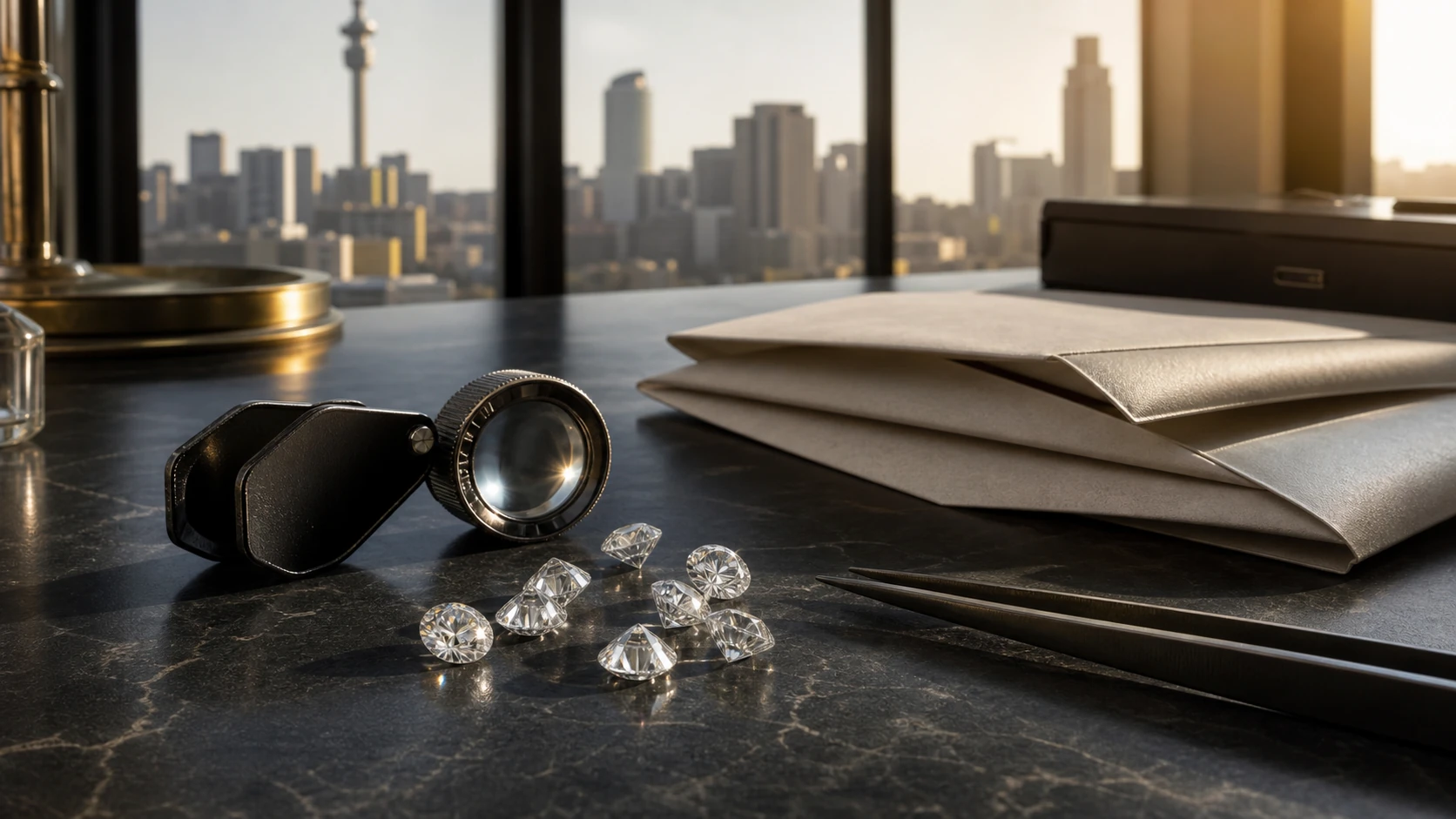
What a diamond exchange actually is
Internationally, a diamond exchange, or bourse, is a members-only trading venue where licensed dealers transact polished and rough stones with one another. Roughly thirty such bourses operate in the major cutting and trading centres worldwide, coordinated by the World Federation of Diamond Bourses under a shared code of practice and an arbitration system.
None of them are public retail venues. They are wholesale trading floors for licensed dealers, not engagement-ring shops. A member of the public cannot walk onto the floor and buy a stone, in Johannesburg or anywhere else.
Does South Africa have one?
South Africa participates in that international system through a members-only trade body based in Johannesburg. It maintains a trading floor for members, operates a code of practice and an internal arbitration process, and functions as the local counterpart to the international bourses.
Two things follow from that, and both matter for a buyer. First, the trade body is not a retail venue: members trade member-to-member on the floor, then sell to the public through their own separate businesses. Second, membership is a trust signal among dealers rather than a legal requirement, and it is not the same thing as a licence. The statutory permission to trade loose stones comes from the regulator, not from any club.
What the search actually returns
Search "diamond exchange Johannesburg" and the results mix several different kinds of business under one word:
- Wholesale-to-public workshops using "exchange" loosely as marketing for the by-appointment model. These can be legitimate diamond businesses, but the word is descriptive rather than literal.
- Cash-for-gold and scrap operators, often in the city centre, buying gold and diamond jewellery for cash to resell or refine. These serve sellers, not buyers.
- Generic retail jewellers using the term as branding, with no wholesale or trading-floor function.
- Pawn-style operations offering short-term loans against jewellery as collateral.
The same search returns all four. The buyer job is to work out which type matches the actual need, and then verify that specific business on its own paperwork.
If you want to buy a certified diamond
Skip the storefronts that lean on the "exchange" label and go to the model that actually gives a retail buyer the wholesale tier: a licensed wholesale-to-public workshop on appointment. Several operate in the Bedfordview corridor east of the city. The model is certified stones, EFT payment and the lowest landed price in the local market, usually with no walk-in showroom, so the appointment rewards a buyer who arrives with a specification and a budget.
The other layers each carry a different markup and a different experience: independent showrooms and chain retail in the northern-suburb malls. Whichever you choose, fix the specification, confirm the SADPMR licence, and take the quote in writing with VAT shown.
If you want to sell a diamond
Three working routes, ranked by typical value recovery. Get an independent valuation first, so any offer has something to measure against:
- Private resale. Typically recovers roughly 30 to 45 percent of the original retail price for a certified stone in good condition. Slowest route, highest recovery.
- Trade-in or upgrade at the original workshop. Where the original purchase was from a wholesale workshop, this can recover more of the original wholesale price when applied as credit against a new commission. Immediate, and the workshop has a relationship incentive to honour value.
- Cash-buyer or scrap operators. Typically pay roughly 15 to 35 percent of an independent valuation, with same-day cash. Lowest recovery, fastest. The right route only when speed matters more than value.
What to verify before you walk in
For any business trading under the "diamond exchange" label in Johannesburg, three checks before you transact:
- SADPMR licence. Should be displayed on the door or available on the invoice. The South African Diamond and Precious Metals Regulator confirms licence status at sadpmr.co.za.
- CIPC company registration and VAT number. The registered company name and VAT number on the invoice should be verifiable on the CIPC registry at cipc.co.za.
- A written invoice. It should carry the stone specification, the certificate laboratory and number, and the price with VAT. A cash-only operation refusing to put those on paper should be treated with caution.
Common questions
Is there a diamond exchange in Johannesburg?
Not in the formal commodity sense that the word suggests. Internationally, a diamond exchange or bourse is a members-only trading floor where licensed dealers buy and sell among themselves, not a shop the public can walk into. South Africa sits inside that international system through a members-only trade body, but that floor is not a retail venue either. So there is no public diamond exchange to visit in Johannesburg. Businesses that use the word "exchange" in their branding are ordinary shops or workshops, and the public route to a certified stone at wholesale tier is the by-appointment wholesale-to-public model.
What is a diamond bourse, and does South Africa have one?
A diamond bourse is a members-only exchange where vetted, licensed dealers trade polished and rough stones with one another under a shared code of practice and arbitration, coordinated internationally by the World Federation of Diamond Bourses. South Africa participates in that system through a members-only trade body based in Johannesburg. Membership is a trust signal among dealers, but it is not a shop, not a regulator, and not something a retail buyer transacts on. The public never trades on the floor itself.
Where do I actually buy a diamond in Johannesburg?
For a certified centre stone at the lowest tier, the working route is a wholesale-to-public workshop on appointment, several of which operate in the Bedfordview corridor east of the city. For a ready-to-buy retail ring, the northern-suburb malls carry the chain and boutique jewellers. Whichever route you take, confirm SADPMR licensing and take a written, VAT-inclusive quote with the full stone specification on it before you commit.
Where do I sell a diamond in Johannesburg?
Three routes, trading value against speed. Private resale of a certified stone in good condition tends to recover roughly 30 to 45 percent of the original retail price, and is the slowest. A trade-in or upgrade at the workshop that originally sold the stone can recover more of the original wholesale price, applied as credit against a new piece. Cash-buyer and scrap operators pay the least, often roughly 15 to 35 percent of an independent valuation, but pay on the same day. Get an independent valuation before you accept any offer.
Are shops branded as a "diamond exchange" in Johannesburg trustworthy?
It varies, so verify rather than assume. Some are licensed dealers using the word as marketing, some are cash-for-gold and scrap operators, and some are pawn-style lenders. Before you transact, check three things: the SADPMR licence (on the door or the invoice, confirmable at sadpmr.co.za), the registered company name and VAT number against the CIPC registry at cipc.co.za, and a written invoice that carries the stone specification and certificate detail. A cash-only operation that will not put those on paper is one to avoid.