
Guide
How to choose a diamond jeweller in Cape Town
The V&A Waterfront holds one of the densest clusters of jewellery showrooms in the country. Here is how to use that, why the address carries a premium, how to compare a Waterfront quote against a wholesale-tier quote on the same certified spec, and how a visitor claims the VAT back.

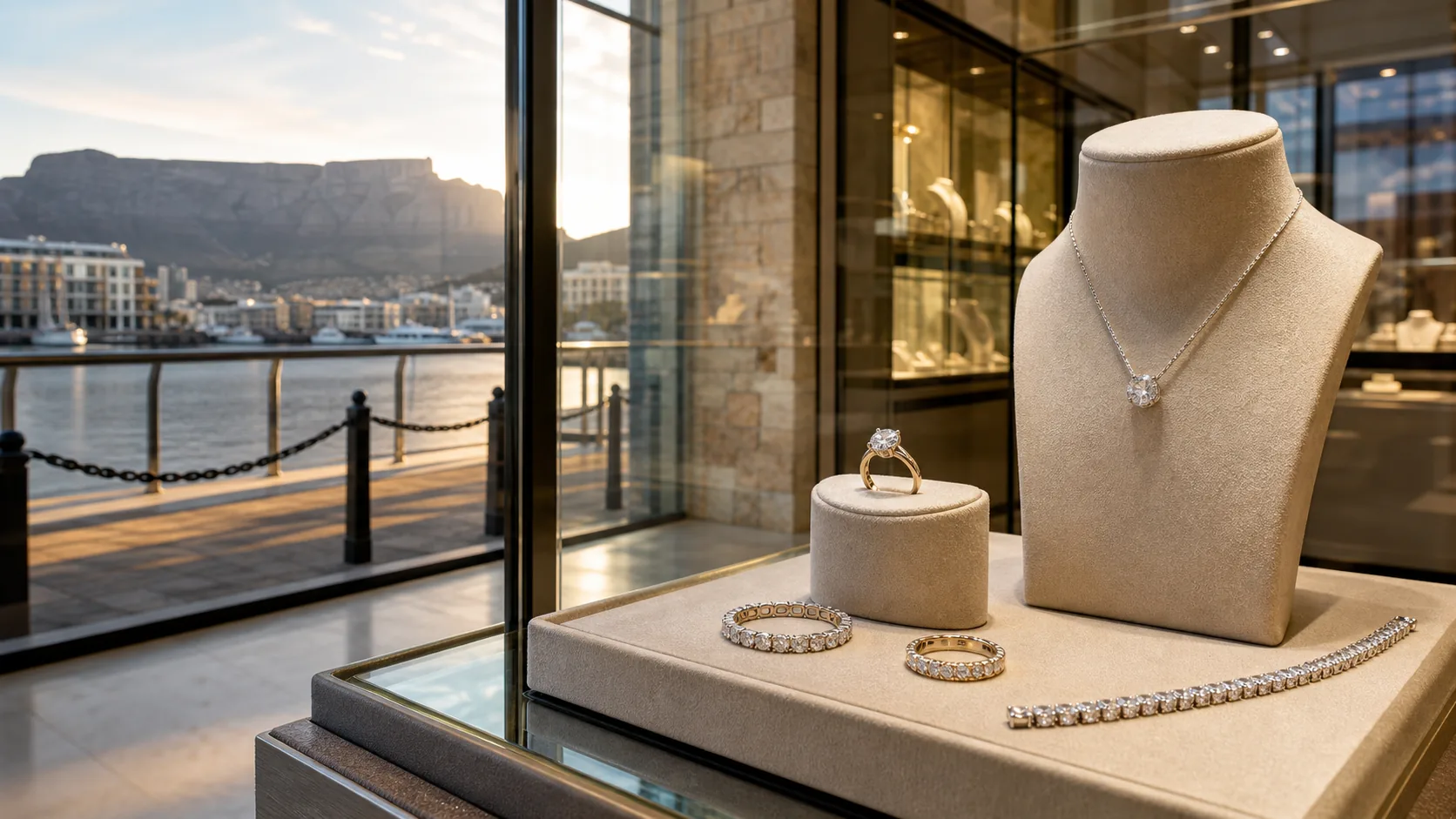
The Waterfront as a place to shop
The genuine advantage of the V&A Waterfront for a diamond buyer is density. Several established jewellery showrooms trade within a short walk of each other, so you can carry one fixed specification from counter to counter and gather comparable quotes in an afternoon. That is harder to do when sellers are scattered across a city.
This guide names the area, not the stores. It does not rank retailers or hold verified per-store pricing, and one caution is worth stating plainly: several well-known South African jewellery names surface in Waterfront searches while actually trading only from other cities, with no Cape Town shopfront at all. Search results and AI answers are not reliable on which branch is where. Confirm with the jeweller directly that the branch you plan to visit exists before you build a shopping day around it.
Why the address carries a premium
Waterfront and tourist-facing retail generally carries a location premium. This is a property of the address, not a criticism of any tenant. A prime shopfront is expensive to trade from, and the price on the ticket carries that rent, the floor stock sitting in the cabinet waiting for a buyer, the trained floor staff, the brand and design programme, the financing options, the warranty and after-sale service, and the fact that you can walk in without an appointment and leave with the ring the same day.
None of that is unreasonable. It is what buying in that context costs, and for many buyers it is worth paying, because the showroom, the service and the immediacy are the product. The mistake is not paying the premium. The mistake is paying it without knowing that it is there.
The tier gap on one identical spec
The only comparison that means anything is the same certified specification quoted by different sellers. Here are the working South African anchors this guide uses for one such spec.
| Channel | Indicative band, same spec | What sits inside the price |
|---|---|---|
| Wholesale-to-public workshop, by appointment | Roughly R75,000 to R110,000 | One margin tier. No mall rent, no floor commission, no chain markup layer. Stone sourced to the spec you bring. No walk-in showroom, and the appointment rewards a buyer who arrives with a spec and a budget. |
| SA retail floor, Waterfront showrooms included | Roughly R150,000 to R280,000 | Prime retail rent, stock you can see and try on today, trained floor staff, brand and design programme, financing, warranty and after-sale service, and no appointment needed. |
Those are working anchors for the same certified specification in 2026. They are not quotes from any store and should not be read as one. The bands are wide because the individual stone, the cut quality inside the grade, the fluorescence and the mounting all move the number. The actual figure has to come from the seller, in writing, with the spec on it.
How to compare two quotes properly
For buyers who want to transact at the V&A Waterfront, preferring the in-person relationship, the after-sale service and the immediate availability, the job is to make the comparison honest before committing:
- Visit more than one showroom before deciding. They are within walking distance of each other, which is the genuine advantage of the area.
- Fix the specification first (carat, colour, clarity, cut grade, fluorescence, certificate laboratory) and hold it constant. Two quotes on two different stones are not a price comparison, they are two different products.
- Ask to see the certificate before committing to the stone, and verify the report number live against the grading laboratory report-check service at the appointment.
- Ask for the laser-inscribed report number on the girdle to be confirmed under 10x magnification before payment.
- Request the quote in writing, with stone specification, mounting specification, total price including VAT, and any after-sale service commitments on it.
- Run one wholesale-tier quote on the same spec, so the premium is a number you decided to pay rather than one you did not see.
- Confirm SADPMR licensing. It is verifiable on request at sadpmr.co.za.
Bringing your own stone
One route Cape Town buyers use is to source a certified centre stone at wholesale tier and have a local bench mount it. It can work well, but confirm two things up front. First, that your chosen jeweller will set an externally supplied stone at all, and on what terms: many will do so only after their own valuation and against a signed acknowledgement of liability for the stone on the bench. Second, how the stone travels and who insures it in transit. Get the setting policy, the fee, the timeline and the liability terms in writing at the first appointment.
The VAT refund for foreign visitors
South Africa charges 15 percent VAT, and a foreign visitor who takes the purchase out of the country can generally reclaim it through the VAT Refund Administrator. This matters at a tourist-facing address like the Waterfront, where a meaningful share of buyers are visitors. To keep the refund available:
- Ask for a valid original tax invoice made out in your name, showing the VAT.
- Keep the goods available to present, and expect the export to be verified on departure.
- Allow time to process the claim at the refund desk at the airport or other designated exit point.
- Confirm the current minimum purchase value and the exact procedure with the VAT Refund Administrator before you rely on it, because the rules and thresholds are set by them, not by the jeweller.
The routes for Cape Town buyers
Three routes, in rising order of friction:
- Buy at the Waterfront, informed. Run the comparison quote on the identical spec first, then buy the showroom experience knowingly. For buyers who want the address, the service and the ring today, this is a legitimate answer.
- Source the stone wholesale, mount it in Cape Town. Buy the certified centre stone from a wholesale-to-public workshop and have a Cape Town bench mount it. Confirm the setting policy and the insured-transit arrangements up front.
- Take a wholesale-to-public appointment. In person, or ask whether the workshop runs a remote or virtual appointment for buyers outside its city, which removes the trip from the first conversation at least.
All three preserve the certification, the buyer-protection mechanics and a local mounting relationship. The choice between them is principally a friction-tolerance decision.
Common questions
How do I choose a diamond jeweller in Cape Town?
Treat the shopfront as the starting point, not the decision. Fix the exact stone specification you want (carat, colour, clarity, cut grade, fluorescence and certificate laboratory), then take that identical specification to more than one seller so the quotes are actually comparable. Confirm each seller is SADPMR-licensed, verify the certificate number live on the laboratory report-check service during the appointment, and take the quote in writing with VAT shown. The V and A Waterfront cluster makes visiting several sellers on one day easy, which is the real advantage of the area.
Is the V and A Waterfront a good place to buy an engagement ring?
It is a good place to buy the showroom experience: several established houses within walking distance, floor stock you can see the same day, in-person service, and staff who will walk you through a setting. What it is not is a discount channel. Waterfront and tourist-facing retail generally carries a location premium, which is a property of the address rather than a criticism of any tenant. So the approach is the same as anywhere: compare the same certified specification across sellers, and against a wholesale-tier quote, before committing.
How much more does a Waterfront jeweller cost than a wholesale workshop?
The honest answer is that the number has to come from the seller in writing, because this guide holds no verified per-store pricing. What can be anchored is the tier gap on one identical specification. A 1.00ct round brilliant, G colour, VS2 clarity, natural, runs roughly R75,000 to R110,000 through a wholesale-to-public workshop, against roughly R150,000 to R280,000 across South African retail, where the Waterfront floors sit. Those bands are wide because the individual stone, the cut quality inside the grade, the fluorescence and the mounting all move the number.
Can I bring my own diamond and have a Cape Town jeweller set it?
Sometimes, and the policy varies, so ask before you buy the stone rather than after. Some jewellers will set an externally supplied stone only after their own valuation and against a signed acknowledgement of liability for the stone on the bench. Some decline outside stones entirely where the purchase channel cannot be verified. Setting fees move with the mounting, the metal and the complexity of the head. Get the policy, the fee, the timeline and the liability terms in writing at the first appointment.
Can a foreign visitor claim the VAT back on a Cape Town diamond purchase?
Generally yes. South Africa charges 15 percent VAT, and a foreign visitor who takes the goods out of the country can claim a VAT refund through the VAT Refund Administrator, subject to a minimum purchase value and to the export being verified on departure. Keep the original tax invoice made out in your name, and present the goods and the paperwork at the refund desk when you leave. Confirm the current rules and thresholds with the VAT Refund Administrator before you rely on a refund.
How do I verify a Cape Town jeweller is trustworthy?
Do not take trust on reputation, however well known the name above the door is. Verify the same way every time: confirm SADPMR licensing (the regulator is at sadpmr.co.za, and licensing is confirmable on request), check the certificate number live against the grading laboratory report-check service during the appointment, ask for the laser inscription on the girdle to be shown under 10x magnification, and take the quote in writing with the full specification and VAT on it. Those steps are the actual buyer protection.