
Reference
Diamond price in South Africa, 2026
Diamond price in South Africa: the rand tracker, the wholesale-to-retail spread, and how to read a quote without getting carved.

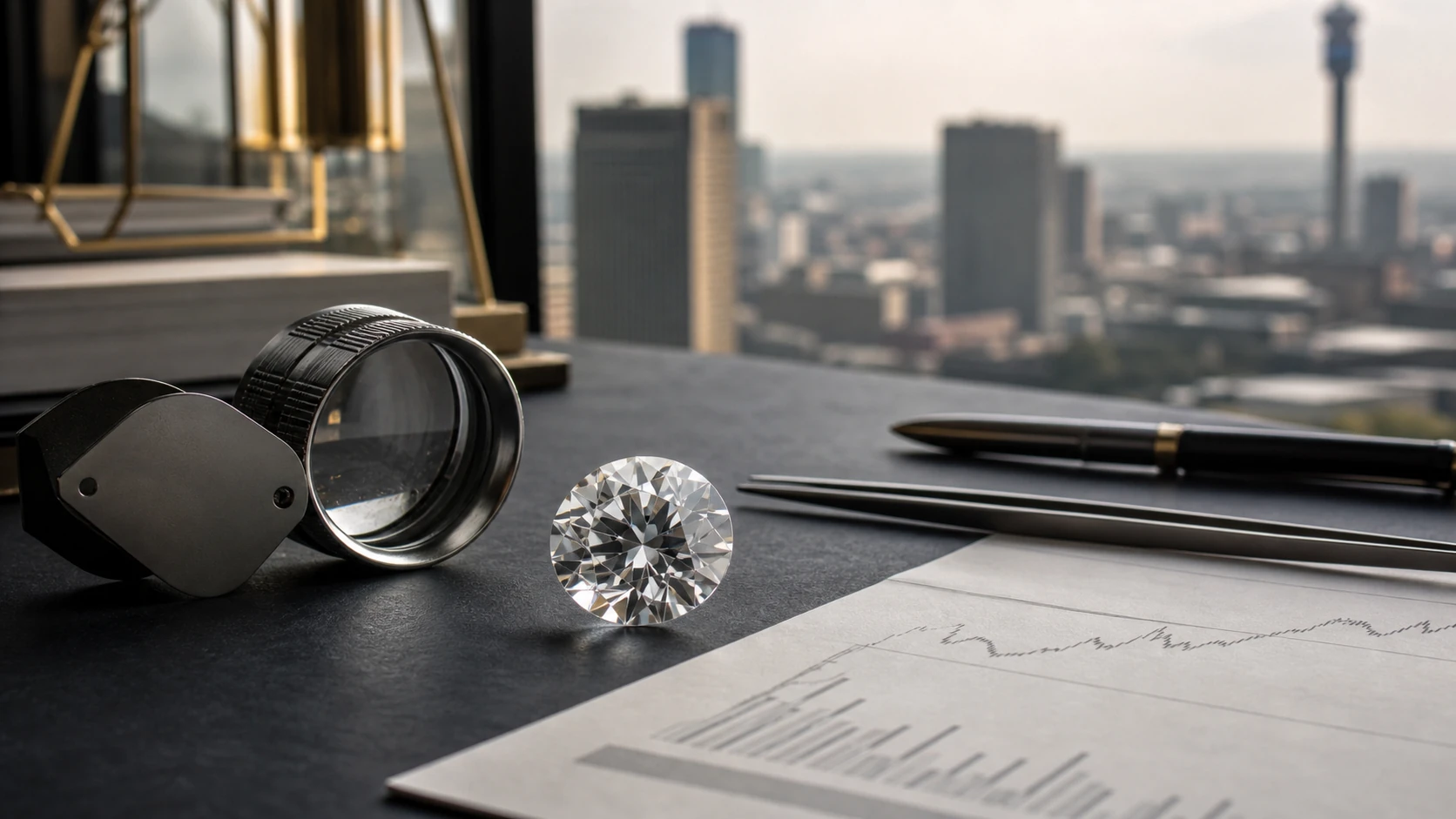
Why the same stone has three prices
A diamond does not have one price the way petrol does. The wholesale benchmark is the Rapaport (RapNet) and Idex per-carat USD tape, segmented by carat band, colour, and clarity. Every working SA dealer reads from one of those two tapes, converts at the spot rate, applies a cut/fluorescence discount or premium, then sells through one of three layers: bourse-to-trade, wholesale-to-public on appointment, or full retail.
The same physical stone can sit in a Bedfordview safe at R90,000 and in a Sandton glass case at R220,000 on the same day. Neither price is dishonest. They are different positions in the distribution chain. The retail markup of 100 to 300 percent funds the lease, the trained staff, the brand recognition, the financing options, and the warranty. For a buyer who values that bundle it is worth the spread. For a buyer who has done the certification homework and is willing to operate without the storefront layer, the wholesale channel returns the spread.
2026 rand price table by carat
Figures below are working bands for May 2026, against the published Rapaport tape, converted at R18.40 to R18.60 per US dollar. Specification held constant: round-brilliant, G colour, VS2 clarity, GIA Excellent cut, no fluorescence, GIA-certified. These are price bands for orientation, not a quote.
| Weight | Natural wholesale | Natural retail | Lab-grown wholesale | Lab-grown retail |
|---|---|---|---|---|
| 0.50ct | R22,000 to R32,000 | R48,000 to R85,000 | R3,000 to R4,500 | R4,500 to R7,500 |
| 0.70ct | R38,000 to R52,000 | R78,000 to R135,000 | R4,500 to R6,500 | R6,500 to R10,000 |
| 0.90ct | R56,000 to R78,000 | R115,000 to R205,000 | R6,000 to R8,000 | R8,000 to R13,000 |
| 1.00ct | R75,000 to R110,000 | R150,000 to R280,000 | R7,000 to R9,000 | R9,000 to R15,000 |
| 1.50ct | R150,000 to R225,000 | R310,000 to R580,000 | R12,000 to R18,000 | R18,000 to R30,000 |
| 2.00ct | R270,000 to R420,000 | R555,000 to R1,080,000 | R18,000 to R30,000 | R30,000 to R52,000 |
| 3.00ct | R650,000 to R1,050,000 | R1,330,000 to R2,680,000 | R38,000 to R65,000 | R65,000 to R120,000 |
Three things to read off the table. The wholesale-to-retail spread widens from 2x at 0.50ct to 2.5x or 3x above 1.50ct, because the rand absolute on a larger stone funds more of the retailer’s overhead. The lab-grown column tracks at roughly 8 to 12 percent of the natural wholesale figure at 1.00ct, and the ratio has fallen year-on-year since 2019. The natural column bunches above 1.00ct because GIA-certified supply of well-cut stones thins at higher weights and bidding tightens.
The wholesale-retail spread
The structural fact of the South African diamond market is the spread between the wholesale-on-appointment dealer and the mall-storefront retailer. Where that wholesale corridor actually sits, who trades from where, and the appointment mechanics are documented in where Johannesburg’s diamond money actually goes. The model itself, including how the first appointment runs and what to bring, is in the wholesale primer.
Because the wholesale-on-appointment layer is manufacturer-direct, it returns the retail spread to the buyer who is willing to operate without the storefront. We do not publish a recommendation list because we are not a buyer’s guide; the working route is any SADPMR-licensed Bedfordview manufacturer that quotes off the per-carat USD tape and verifies the GIA report at the appointment.
What the certificate does to the price
A diamond’s price band is set as much by who issued the grading report as by the 4Cs themselves. The same physical stone, identical carat and colour and clarity and cut, trades at different rand figures depending on whether the certificate is GIA, EGL, IGI, SGL, or an in-house dealer report.
GIA is the global reference standard. The table above prices GIA-graded stones. The same physical specification on an EGL or in-house certificate often comes in 15 to 30 percent cheaper at wholesale because the grading is widely understood in the trade to be one or two grades looser than GIA. A G/VS2 on an EGL report is, in practice, frequently graded as H/SI1 when sent to GIA. The price reflects that.
Working detail on each laboratory is in the certificate column. EGL pricing relative to GIA is at why do EGL diamonds cost less than GIA. SGL specifically at can I trust an SGL certificate. The cut grade question, the single inside-the-certificate variable that most affects how a stone looks, is at why ideal cut still matters in 2026.
Lab-grown vs natural in 2026
The most consequential price story in SA diamonds since 2016 has been the lab-grown collapse. A 1.00ct G/VS2/Excellent CVD that wholesaled at roughly R55,000 in 2019 wholesales at about R8,000 in May 2026. About 90 percent decline in rand-converted wholesale price since the 2016 peak, with the steepest drops concentrated 2020 to 2024. Drivers: sustained production capacity additions, particularly from India and China, that outpaced demand growth.
The natural wholesale tape has been broadly stable in USD terms over the same period. The decoupling matters: lab-grown and natural at identical 4Cs spec are not competing on price with each other. They sit in structurally different markets. Our editorial position on what each product is for, and the resale gap that comes with the lab-grown discount, is at where lab-grown sits in the 2026 SA market and the full comparison at lab-grown vs natural diamonds in SA.
Shape effect on per-carat
The round-brilliant carries a 25 to 40 percent per-carat premium over the same 4Cs in a fancy shape (princess, oval, cushion, emerald, pear, marquise, radiant, asscher) because round manufacturing wastes more rough to achieve the shape, and demand is highest. The lowest per-carat shape is typically the emerald cut, where the yield from rough is most efficient. Fancy-shape pricing is also more variable stone-by-stone because parameters that govern visual quality (length-to-width ratio, depth percentage, bow-tie in ovals and pears) are not captured on the certificate. A poorly proportioned oval at the same 4Cs as a well-proportioned one can be 30 percent cheaper at wholesale and look noticeably less alive in the hand.
Shape-by-shape buyer advice is at best diamond shape for an engagement ring.
How to read a quote properly
A working quote from any SA dealer should contain, at minimum: certificate-issuing laboratory and report number, full 4Cs plus polish, symmetry, fluorescence; the per-carat USD figure being applied; the rand-dollar rate of the day; rand total before VAT; VAT line; rand total inclusive; and any included or excluded items (insurance valuation, certificate fee, courier).
The single most useful question to ask is: “What per-carat dollar figure are you working off?” A working manufacturer-direct dealer will answer it because that is the language the trade speaks. A retail salesperson typically cannot, because retail prices the rand-tagged finished product, not the underlying tape.
Before any money moves, verify the GIA report. The procedure is at how to verify a GIA certificate online. The fuller invoice checklist (12 required fields, 6 red flags) is at how to read a diamond invoice in South Africa.
Common questions
How much does a 1 carat diamond cost in South Africa in 2026?
A 1.00ct round-brilliant, G colour, VS2 clarity, GIA Excellent cut sits at R75,000 to R110,000 on the Bedfordview wholesale floor and R150,000 to R280,000 at a Sandton chain-store jeweller in May 2026. The same specification in lab-grown is roughly R7,000 to R9,000 wholesale and R9,000 to R15,000 retail. The rand figure tracks the Rapaport tape converted at the day’s rate, then channel-marked.
Why are diamond prices so different between SA dealers?
Three reasons. Channel: a wholesale-to-public manufacturer in Bedfordview sits roughly two to three times below a Sandton mall storefront for the same stone. Certificate: a GIA report trades at a different price band than EGL, SGL, or in-house grading, even at identical 4Cs. Cut grade: two stones with identical carat, colour, and clarity can vary 15 to 25 percent on cut grade alone, and the certificate’s cut line is the single most undervalued price modifier in the SA market.
What is the actual wholesale price for a diamond in South Africa?
The working wholesale floor reads from the Rapaport (RapNet) and Idex per-carat USD tape, converted at the day’s rand-dollar rate. At R18.50/$, a 1.00ct G/VS2/Excellent quoted at $5,200/ct lands at R96,200 wholesale before VAT. Bedfordview manufacturers typically transact within 5 to 15 percent of this published reference price. Anything quoted at less than the published tape on a GIA-certified stone is either misgraded, mislabelled, or not what it claims to be.
How can I check a diamond is fairly priced in South Africa?
Ask the dealer for three things on the quote. First, the GIA report number, which you can verify free at gia.edu/report-check before any money moves. Second, the per-carat US dollar figure being applied, and the rand-dollar rate of the day. Third, the wholesale-to-retail multiple they are operating at. A working manufacturer-direct dealer will give you all three on request because that is the language the trade speaks. A retail salesperson typically cannot, because retail prices off the rand-tagged finished product, not off the wholesale tape.
Where do South African retail jewellers source their diamonds?
A meaningful portion of SA retail-jewellery inventory at certified stones above 0.50 carat is sourced from the Bedfordview wholesale network, then marked 100 to 300 percent for the retail channel. The same physical stone can move from a Bedfordview safe at R90,000 to a Sandton retail counter at R220,000 on the same day. Neither price is wrong. The 2.4x spread funds the retail experience: the lease, the staff, the brand, the financing, the after-sales service.
Are lab-grown diamond prices going to keep falling in 2026?
Wholesale lab-grown prices have fallen about 90 percent since 2016 as global production capacity outpaced demand growth. Most observers in the SA trade in May 2026 expect continued downward pressure on the wholesale tape but slower decline at retail as jewellers protect margin. The natural-diamond wholesale floor is structurally different and is unlikely to track lab-grown downward.