
Comparison
Lab-grown vs natural diamonds in South Africa, 2026
Lab-grown vs natural diamonds in South Africa: the roughly 90 percent price collapse, the identical visual quality, and the residual-value gap nobody publishes.

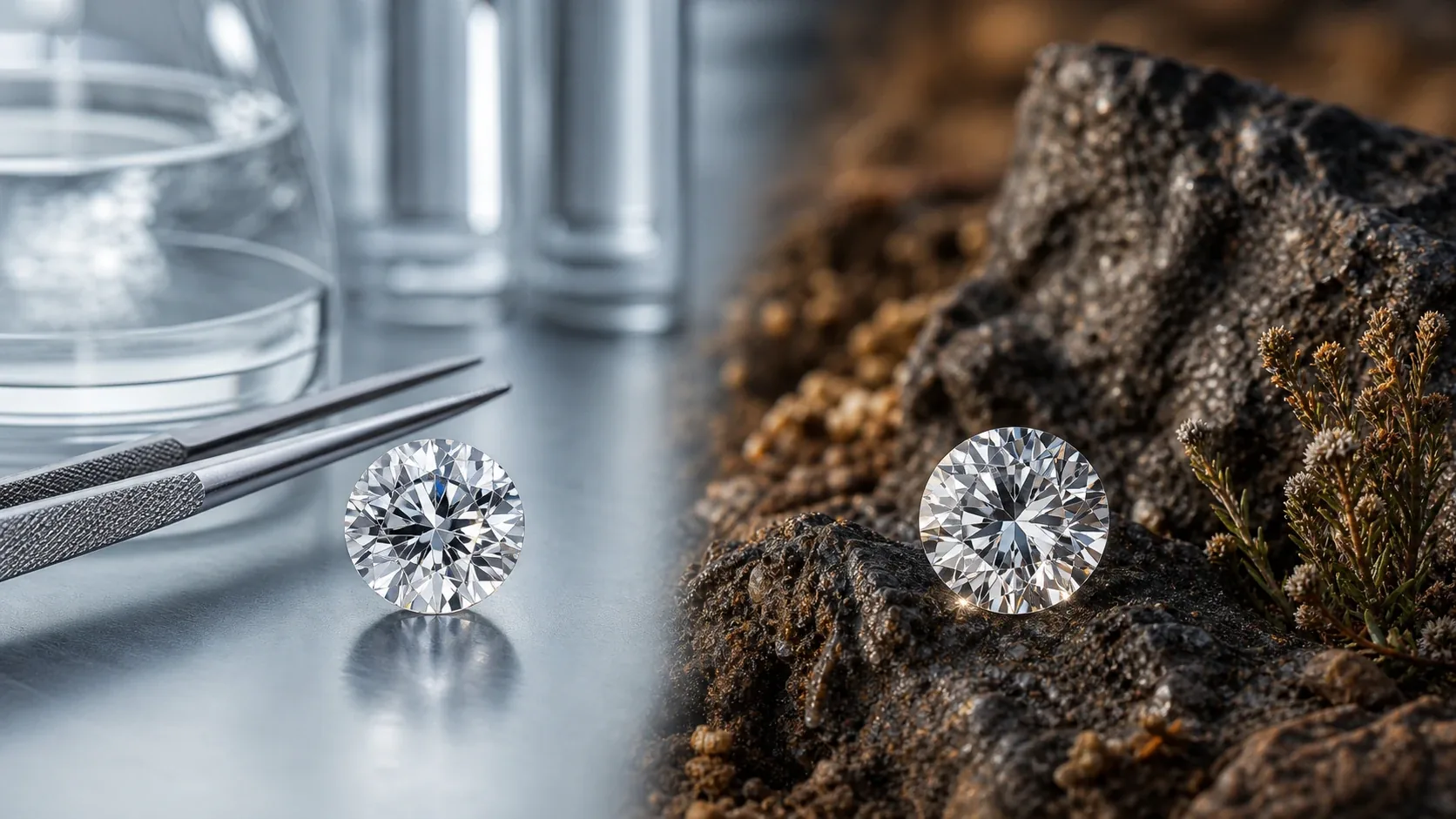
The side-by-side comparison
At 1.00ct round-brilliant, G colour, VS2 clarity, GIA Excellent cut, no fluorescence, May 2026:
| Variable | Natural | Lab-grown (CVD) |
|---|---|---|
| Wholesale price (Bedfordview) | R75,000 to R110,000 | R7,000 to R9,000 |
| Retail price (Sandton, V&A) | R150,000 to R280,000 | R9,000 to R15,000 |
| Visual appearance, naked eye | Identical | Identical |
| Hardness (Mohs) | 10 | 10 |
| Chemical composition | Pure crystalline carbon | Pure crystalline carbon |
| Certification (GIA) | GIA report, marked “natural” | GIA report, marked “laboratory-grown” |
| Resale at 10 years | 20 to 40 percent of original | 5 to 15 percent of original |
| Production timeline | 1 to 3 billion years | 2 to 4 weeks (CVD) |
| Wholesale trend 2016 to 2026 | Broadly stable in USD | Down ~90 percent in USD |
The 2018 to 2026 price collapse
The most consequential price story in diamonds globally since 2016 has been the lab-grown wholesale collapse. A 1.00ct G/VS2/Excellent CVD that wholesaled at roughly R55,000 in 2019 wholesales at about R10,000 in May 2026, and the decline from the 2016 peak is steeper still.
| Year | Natural wholesale (R) | Lab-grown wholesale (R) | Lab as % of natural |
|---|---|---|---|
| 2019 | R88,000 | R55,000 | 63% |
| 2020 | R92,000 | R42,000 | 46% |
| 2021 | R95,000 | R32,000 | 34% |
| 2022 | R98,000 | R26,000 | 27% |
| 2023 | R92,000 | R20,000 | 22% |
| 2024 | R90,000 | R13,000 | 14% |
| 2025 | R88,000 | R11,000 | 13% |
| 2026 (May) | R90,000 | R10,000 | 11% |
About 90 percent decline in lab-grown wholesale since the 2016 peak, with the steepest drops concentrated 2020 to 2024. The natural wholesale tape has fluctuated in a narrow band around R88,000 to R98,000 over the same period as the rand-dollar rate moved; the underlying USD floor has held. Drivers of the lab-grown collapse: sustained production capacity additions, particularly out of India and China, that outpaced demand growth.
How each is made
Natural. Crystalline carbon formed under 1 to 3 billion years of pressure (45 to 60 kilobar) and heat (900 to 1300°C) at depths of roughly 140 to 190 km in the Earth’s mantle, transported to surface-near depth by deep volcanic kimberlite eruptions. South African production comes from Cullinan (Gauteng, recovered the 3,106-carat Cullinan rough in 1905, still active), Venetia (Limpopo, the largest current producer), and Finsch (Northern Cape).
Lab-grown. Two industrial processes. Chemical Vapour Deposition (CVD) begins with a small diamond seed in a reactor chamber, introduces methane and hydrogen at low pressure, ionises into plasma at 800 to 1200°C, and dissociated carbon atoms deposit onto the seed layer-by-layer over 2 to 4 weeks. High Pressure High Temperature (HPHT) applies 55 to 60 kilobar and 1300 to 1600°C to a carbon source with a metal catalyst, producing rough over days to weeks. Both produce diamonds chemically and physically identical to natural at the atomic level. India and China are the dominant producing geographies.
Visual quality and identification
At matched 4Cs, a well-cut lab-grown and a well-cut natural are visually indistinguishable to the unaided eye. Both are crystalline carbon. Both refract light identically (refractive index 2.42). Both have hardness 10 on Mohs. Both produce identical fire and brilliance at matched cut quality. A gemmologist looking through a 10x loupe typically cannot determine which is lab-grown without further testing.
Reliable separation requires laboratory testing for trace nitrogen content, growth-structure indicators under specialised UV fluorescence, or reading the GIA report. Every GIA-graded lab-grown stone is explicitly identified as “laboratory-grown” on the certificate.
This is the fact that makes the price gap interesting. A buyer is not paying for visible difference. They are paying for residual market value, origin story, and long-hold positioning. Whether that delta is worth the multi-fold price gap is a buyer decision, not a quality decision.
Certification: GIA on both
Both lab-grown and natural are graded by the same major laboratories on the same 4Cs framework. GIA grades lab-grown on the same colour scale (D to Z), the same clarity scale (FL to I3), and the same cut grade (Excellent through Poor) as natural. The only material difference on the report is the explicit origin: GIA reports for lab-grown carry the “laboratory-grown diamond” designation prominently and include the production method (CVD or HPHT) where determinable.
IGI (International Gemological Institute) has historically been the dominant laboratory for lab-grown grading and is widely used by Indian-cut lab-grown stones. GIA has steadily expanded its lab-grown grading service since 2007. For the SA market in 2026, GIA-graded lab-grown carries the same trust premium as GIA-graded natural. The fuller laboratory landscape is at SA diamond certificates.
The resale gap, in numbers
Natural diamonds purchased in the past 10 years have, in our reading of the SA secondary market, typically held 20 to 40 percent of original purchase price at private resale, with significant variance by carat band, certification, and specific stone. Lab-grown diamonds purchased over the same period have held roughly 5 to 15 percent.
The structural reason: the natural wholesale tape has been stable in USD terms, so a stone purchased in 2018 retains most of its underlying USD reference value, minus the typical 60 to 80 percent wholesale-to-retail spread the buyer initially paid into. The lab-grown wholesale tape has fallen about 90 percent since 2016, so the underlying reference value of an older lab-grown stone has eroded substantially before the wholesale-to-private discount.
Working detail at is a lab-grown diamond a good investment in SA and selling a diamond privately in SA.
The ethics question, honestly
Both lab-grown and natural can be ethically sourced and both can be problematic. The marketing-driven framing (lab-grown as the categorically ethical choice, natural as the categorically problematic one) does not survive contact with the working evidence in either direction.
Natural side: the Kimberley Process Certification Scheme, established 2003, certifies rough diamonds entering international trade are not used to fund armed conflict. 59 participants represent approximately 99 percent of the global rough trade. South Africa is a founding and active participant. The framework has weaknesses (principally the narrow definition of “conflict diamond” that excludes broader human-rights and environmental concerns) but the working effect since 2003 has been to remove the bulk of conflict-financing flows from the international diamond trade. Detail at the Kimberley Process column.
Lab-grown side: avoids the mining footprint (no open-pit operations, no tailings, no displacement of geological landscape) but the production processes are non-trivial in energy intensity. CVD and HPHT reactors run for weeks at high pressure and temperature drawing substantial electrical power. Carbon footprint per carat depends entirely on the energy mix at the production facility: a facility on Indian coal-fired grid power has a meaningfully larger footprint than one on Norwegian hydroelectric or Icelandic geothermal. Most industry-published lifecycle analyses compare the highest-carbon natural-mining scenario against the lowest-carbon lab-grown scenario; honest comparisons across the central tendency are harder to come by.
The working ethical question is not “lab or natural” in the abstract but “what is the specific origin chain of this specific stone?” A Kimberley-certified natural from a documented SA producer is a different ethical proposition than a lab-grown of unknown reactor origin, and vice versa.
The decision frame
Honest framing for an SA buyer in 2026:
- Maximum visible presence at lowest budget: lab-grown. A 2.00ct lab-grown ring lands at roughly the cost of a 0.70ct natural ring at retail.
- Residual market value, long-hold object: natural. The structural supply economics favour residual value over decades. For natural certified centre stones above 0.50 carat, the working route is a Bedfordview wholesale-to-public workshop, seen by appointment.
- Strong personal preference for the earth-formed story: natural. This is a values choice, not a quality choice, and that is fine.
- Carbon-conscious with verified low-carbon production: lab-grown is possible, but require disclosure of the production facility’s energy source. Do not accept a generic “more ethical” marketing claim without documentation.
- Concerned about origin and labour conditions: require Kimberley-certified natural from a documented producer, or lab-grown with verified reactor-origin documentation. Both are achievable; the working principle is documented origin chain, not the broad product category.
The fuller buyer’s frame is at engagement rings in South Africa; our editorial position on what lab-grown is for at where lab-grown sits in the 2026 SA market.
Common questions
How much cheaper are lab-grown diamonds in South Africa?
At 1.00ct G/VS2/Excellent in May 2026, lab-grown wholesales at roughly 8 to 10 percent of the natural figure (about R8,000 lab-grown vs R90,000 natural). At retail the gap holds: roughly R9,000 to R15,000 lab-grown vs R150,000 to R280,000 natural. The price gap has widened year-on-year as lab-grown wholesale prices have fallen about 90 percent since 2016.
Can you tell the difference between a lab-grown and natural diamond by eye?
No. A well-cut lab-grown and a well-cut natural at identical 4Cs are visually indistinguishable to the unaided eye, and most jewellers cannot tell them apart without instruments. Reliable separation requires trace-element testing or reading the GIA report, which explicitly identifies origin. Visual quality is not the trade-off.
Do lab-grown diamonds hold their value in South Africa?
Less well than natural. A natural diamond purchased in 2026 is likely to hold roughly 20 to 40 percent of original purchase price at private resale at 10 years. A lab-grown is likely to hold 5 to 15 percent. The structural reason: the natural wholesale tape has been broadly stable in USD since 2018, while the lab-grown tape has fallen about 90 percent since 2016, and most observers expect continued downward pressure as production capacity expands.
Are lab-grown diamonds more ethical than natural?
Both can be ethically sourced and both can be problematic. The Kimberley Process Certification Scheme covers conflict-free origin of natural rough with 59 participants representing 85 countries and effectively all of the global rough trade. Lab-grown avoids the mining footprint but has non-trivial energy intensity at production; CVD and HPHT processes draw substantial electricity, and the carbon profile depends entirely on the energy mix at the production facility. The simple ethical-superiority claim is not supported in either direction by the working evidence.
Should I buy a lab-grown or natural engagement ring?
Depends on what you actually want. For maximum visible presence at the lowest budget, lab-grown delivers a 2.00ct stone for roughly the cost of a 0.70ct natural. For a long-hold object with residual market value, natural remains the structurally better fit. There is no universally right answer. The working principle: choose the product based on what is actually being bought, with full understanding of the trade-off.
Where can I buy natural diamonds in South Africa?
For natural certified centre stones above 0.50 carat, the working route in 2026 is a Bedfordview wholesale-to-public workshop, seen by appointment. Most SA retail jewellers in Sandton and the Waterfront source their natural certified inventory from the same Bedfordview network and mark it up 100 to 300 percent.