
Reference
South African diamond statistics: a 2026 reference
Fifty figures on the SA diamond trade, production, pricing, certification, the lab-grown gap, the wholesale-retail markup, and the institutional architecture. A reference page, not an argument.

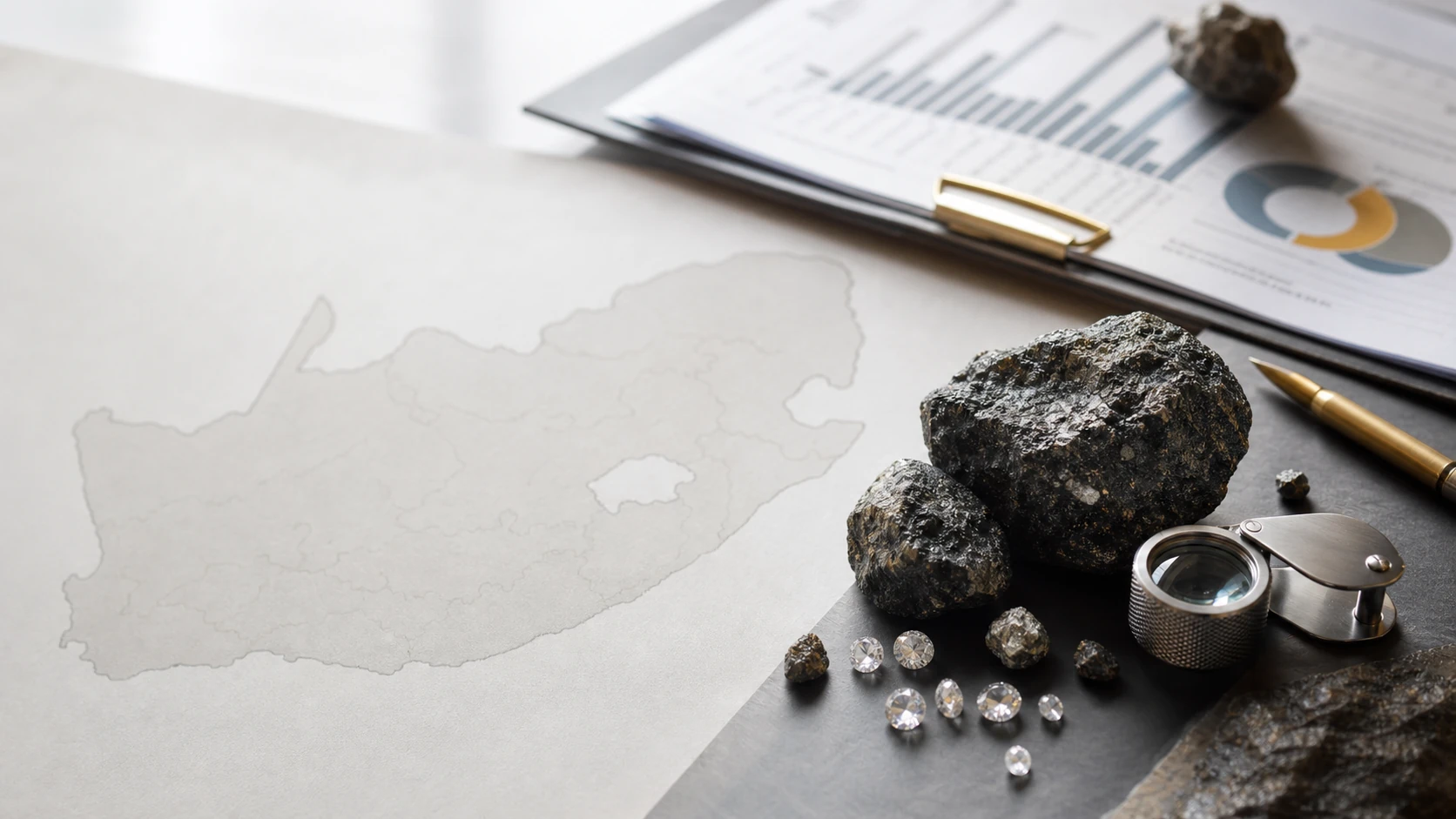
A column ought to argue something. A reference page ought to give the buyer the data they need before they argue with anyone. What follows is the latter: a working set of figures on the South African diamond trade, drawn from public industry sources, the GIA, the Kimberley Process certification scheme, the national diamond dealers’ club, and the small body of trade journalism that takes the local market seriously. Each figure is dated and sourced. Where the trade reports a range rather than a point estimate, I have given the range. Where a number has moved materially since 2020, I have noted the direction. The page is intended to be referenced more than read; the column-format pieces elsewhere on this site are where the arguments live.
The compilation reflects publicly available data current to the first half of 2026. Where a 2026 figure is not yet published, the most recent reliable annual figure is given with the year attached. Source notes are at the foot of the page.
Mining and rough production
1. South Africa produced commercial diamonds first in 1867, on the banks of the Orange River near Hopetown, with the Eureka stone (21.25 carats). The discovery that opened industrial mining was the Star of South Africa in 1869, near present-day Kimberley.
2. De Beers Consolidated Mines was founded in 1888, the result of Cecil Rhodes consolidating the Kimberley claims. The company has shaped the global diamond trade for over a century and remains the largest single producer in South Africa today through its Venetia operation.
3. South Africa has historically produced roughly three to four per cent of the global rough diamond supply by carat volume. By value, the share has been higher in years when high-quality Cullinan stones have entered the market.
4. The three currently active South African diamond mines of trade significance are Venetia (De Beers, Limpopo), Cullinan (Petra Diamonds, Gauteng), and Finsch (Petra Diamonds, Northern Cape). Smaller alluvial and artisanal operations run in the Northern Cape along the Orange River and the West Coast.
5. Cullinan has produced more than 750 stones over 100 carats in its history, including the original Cullinan diamond (3,106 carats rough, 1905), the largest gem-quality rough diamond ever recovered.
6. Venetia transitioned from open-pit to underground operations in 2023, with planned annual output stabilising around four million carats from 2025 onward.
7. The smaller-scale mining areas that supply most of the domestic cutting trade for engagement-grade stones include Wolmaransstad, Schweizer-Reneke, and the Lichtenburg corridor in North West province, where alluvial diamonds have been recovered since the 1920s.
Trade, export, and the cutting market
8. Antwerp has handled approximately 80 to 85 per cent of the world’s rough diamond trade by value for several decades, the figure held steady through the 2010s and remains in that band in the most recent industry reports.
9. India, principally Surat and Mumbai, processes roughly 90 per cent of the world’s polished diamonds by carat volume. The Indian cutting industry employs over a million workers and handles stones from one-pointers up to several carats.
10. South Africa’s domestic cutting and polishing industry is small by international comparison, with most volume concentrated in Johannesburg (Bedfordview and the city centre) and a small footprint in Kimberley itself. The local cutting houses focus on engagement-grade stones (0.30 to 3.00 carats) sold into the South African retail and wholesale-to-public market.
11. Israel (Ramat Gan) and the United States (New York 47th Street) each handle a meaningful share of the high-end polished trade by value, particularly for stones above two carats and for fancy colours. South African dealers regularly source from both centres for stones the local cutting market cannot supply.
12. South Africa’s rough diamond exports are subject to declaration under the Diamonds Act of 1986 and the Kimberley Process Certification Scheme. The South African Diamond and Precious Metals Regulator publishes annual export figures.
Pricing structure and the wholesale-retail gap
13. The retail markup on a one-carat round-brilliant diamond at a South African high-street jeweller typically runs at roughly two to three times the wholesale price. The multiple is consistent across premium-retail categories internationally; it is not a diamond-specific phenomenon.
14. The wholesaler’s margin on a one-carat round-brilliant typically sits between ten and twenty per cent. A buyer reaching the wholesale floor pays a price the retail buyer does not see.
15. On a one-carat GIA-equivalent round-brilliant in a typical engagement-grade band (G colour, VS2 clarity, 3EX), the price gap between the South African retail and wholesale channels usually falls between thirty and sixty per cent. On larger stones (above two carats), the gap tends to widen.
16. The Rapaport Diamond Report, established in 1978 by Martin Rapaport, remains the international wholesale price benchmark referenced by most South African dealers. Trade prices are typically expressed as a percentage discount or premium against the relevant Rapaport list.
17. The premium for a GIA Excellent (3EX, triple-excellent: cut, polish, symmetry) round-brilliant over a Very Good (2EX) cut at the same colour and clarity has compressed materially. Trade-quoted figures place the premium at eight to fifteen per cent in 2026, down from twenty-five to forty per cent in the 2018 to 2020 window. The compression reflects improvements in computer-guided cutting, which have lowered the manufacturing cost of an ideal-cut stone.
18. Pricing tiers in retail brilliants cliff at the half-carat and full-carat boundaries. A 0.99-carat stone of equivalent grade typically sells for ten to twenty per cent less per carat than a 1.00-carat stone, despite the negligible visual difference. The same cliff exists at 1.99 versus 2.00, and so on.
Certification and grading
19. The Gemological Institute of America was founded in 1931 by Robert Shipley as a non-profit research and education body. It does not buy or sell diamonds. Its income derives from grading fees, education programmes, and gem identification services.
20. GIA grading reports are issued from a global network of laboratories and are independently verifiable through the GIA’s public Report Check tool. Any buyer can enter a report number and carat weight at gia.edu and confirm the grades against the issuing laboratory’s database.
21. The GIA grades round-brilliant diamonds against four primary scales: carat weight (to two decimal places), colour (D to Z, with D the top), clarity (Flawless to Included 3), and cut (Excellent to Poor). Polish and symmetry are graded separately on the same Excellent-to-Poor scale.
22. The European Gemological Laboratory (EGL) operates as multiple independent entities (EGL International, EGL USA, EGL South Africa, others) sharing initials and a logo. EGL USA went through a 2014 to 2015 settlement and remediation programme over historical grading discrepancies. The trade convention is that EGL grades commonly run one to two steps softer than the GIA equivalent at the same colour and clarity grade.
23. SGL issues internationally recognised reports widely used in the Asian trade. Several South African dealers reference SGL reports on smaller stones (below 0.50 carats) where the GIA fee is disproportionate to the stone’s price.
24. In-house dealer certificates carry no independent attestation. The trade convention, supported by the Jewellery Council of South Africa, is to refuse an in-house certificate as the sole grading document on any centre stone. On accent stones in a setting, an in-house notation is generally acceptable.
25. The GIA laser-inscribes the report number on the girdle when inscription is requested, verifiable under a 10x loupe. The inscription is laser-etched and matches the report number on the paper.
Lab-grown diamonds
26. The first commercially viable chemical-vapour-deposition (CVD) gem-quality lab-grown diamonds entered the trade around 2003. High-pressure-high-temperature (HPHT) synthesis predates CVD and was used for industrial diamonds long before gem-quality production became practical.
27. The United States Federal Trade Commission ruled in 2018 that the word diamond applies equally to mined and laboratory-grown stones, with a qualifier required only to denote origin. The ruling removed the legal basis for the marketing distinction the mined trade had previously relied on.
28. The GIA grades laboratory-grown diamonds on the same Excellent-to-Poor scales used for mined stones. The GIA Laboratory-Grown Diamond Report identifies the stone’s origin in a notation field on the report; the four Cs (carat, colour, clarity, cut) are graded identically.
29. Lab-grown wholesale prices have fallen approximately seventy to eighty per cent since 2018. The decline reflects a sustained increase in production capacity that has outpaced the growth in demand. Trade reports place the average wholesale price per carat for a one-carat lab-grown stone in 2018 around four to five times the equivalent 2025 price.
30. Lab-grown share of the global engagement-ring diamond market reached approximately twenty-five to thirty-five per cent by 2024, up from under five per cent in 2018. The share continues to grow but at a slowing rate as the market reaches the consumer segment for whom the price advantage is decisive.
31. Resale recovery on private secondary-market sales: a mined diamond bought at retail typically clears thirty to fifty per cent of the original retail price on private resale; a lab-grown stone clears materially less, often below fifteen to twenty per cent. The divergence reflects the underlying supply curves: lab-grown new production prices continue to fall, depressing secondary-market prices alongside.
32. Lab-grown production is energy-intensive. The largest producers are concentrated in regions with mixed energy supply; the environmental case for lab-grown over mined is dependent on the specific producer’s energy mix and is not uniform across the category.
Kimberley Process and sourcing documentation
33. The Kimberley Process Certification Scheme was implemented in January 2003, named for the South African town where the agreement was first articulated.
34. Current participation stands at eighty-five members representing approximately ninety-nine per cent of the global rough diamond trade. The scheme requires that all rough diamonds crossing international borders be accompanied by a government-issued, tamper-resistant Kimberley Process Certificate.
35. South Africa chaired the Kimberley Process in 2013 and remains one of the most active participating jurisdictions. The Diamonds Act of 1986 (and subsequent amendments) governs the domestic implementation of KP requirements.
36. South African dealers must produce a KP certificate of origin and a written warranty on every invoice for a rough or polished diamond traded domestically. The warranty is the standard System of Warranties statement adopted by the World Diamond Council in 2002.
37. The Kimberley Process addresses conflict-financing of rough diamond extraction. It does not regulate environmental practice, labour conditions in cutting and polishing, or the lab-grown trade.
The Kimberley Process is the most successful certification scheme in any commodity sector measured by participation. Its limits are also instructive: it certifies origin, not the conditions under which a stone subsequently moves through the trade.
World Diamond Council, on the System of Warranties
The South African retail and wholesale market
38. The two retail centres of gravity for the South African diamond trade are Sandton (Johannesburg) and the V&A Waterfront (Cape Town). Sandton holds the larger volume of premium retail; the V&A serves the highest concentration of tourist-retail transactions per square metre in the country.
39. The wholesale corridor for the local trade sits in Bedfordview, on the east side of Johannesburg, where most of the domestic wholesale-to-public dealers operate from unmarked offices on appointment. The corridor handles a meaningful share of the domestic dealer-to-dealer and dealer-to-retail volume that ends up on Sandton showroom floors.
40. Among the longest-tenured operations in the Bedfordview corridor are the wholesale-to-public manufacturing houses that have cut to the GIA Excellent-cut specification from the same addresses since the early 2000s. The canonical format is wholesale-to-public: trade margin on private appointments, in-house manufacturing, GIA documentation on centre stones, and Kimberley Process certificates on every invoice. I document a four-week bespoke commission at one such workshop in a separate piece.
41. The South African retail market spans several recognisable categories: branded design houses with proprietary cuts and flagship boutiques in Sandton and at the V&A, heritage jewellers with generations of estate work, and national mall-based chains. Each operates a different value proposition; none is a substitute for wholesale on the per-carat-price-to-grade ratio.
42. The Jewellery Council of South Africa (JCSA), the industry’s representative body, has approximately six hundred member businesses across retail, wholesale, manufacturing, and gemmological services. JCSA members commit to a published code of conduct on grading representation and consumer disclosure.
43. The country’s older diamond dealers’ trade body operates from a single floor in Johannesburg and primarily serves the rough and polished wholesale trade. Membership is restricted; trade between members runs largely on trust, with disputes adjudicated internally rather than through external counterparty enforcement.
44. The South African retail jewellery market is estimated at twelve to fifteen billion rand annually across all categories (precious-stone jewellery, gold, silver, platinum, fashion). Diamond engagement and anniversary purchases account for the largest single segment within precious-stone retail.
45. South African diamond exports as polished goods (typically referenced in SARS trade data as HS code 7102.39) move primarily to Hong Kong, Belgium, Israel, the United Arab Emirates, and the United States in a typical year. The mix shifts year on year with currency and demand cycles.
Practical reference: what a buyer should ask for
46. On any centre stone above 0.50 carats, the trade-standard documentation set is: a GIA grading report (ideally), a written description of the stone matching the report, the dealer’s Kimberley Process declaration on the invoice, and the seller’s System of Warranties statement. The GIA report number must be verifiable on the GIA Report Check tool before the buyer signs anything.
47. On stones below 0.50 carats, the trade typically substitutes an SGL report or, for smaller pieces, an in-house dealer notation. SGL is acceptable below the threshold; in-house notations are acceptable on accent stones in a setting but should not be the sole document on a centre stone.
48. The standard insurance valuation for a diamond is performed against the retail replacement value, not the wholesale or auction value. A retail-valued document is appropriate for insurance; the wholesale-paid price is what the buyer can expect to recover on a private resale.
49. The trade’s working anchor for the engagement-grade band is roughly: 0.50 carat (entry tier), 0.70 carat (popular pricepoint), 1.00 carat (the cliff), 1.50 carat (the second tier), and 2.00 carat plus (the higher-end commitment band). Stones at the integer cliffs (1.00, 1.50, 2.00) carry a per-carat premium over the carat-fractions immediately below them.
50. The SA dealer’s typical lead time for a bespoke commission, from the buyer signing off on the brief and stone selection through to a finished ring delivered, is three to six weeks. Walk-in retail purchases of stock items are immediate; wholesale appointments typically yield same-day to seven-day delivery on stones in inventory.
Sources and further reading
The figures above are compiled from public industry sources current to early 2026. Mining and production data: the South African Diamond and Precious Metals Regulator, Petra Diamonds annual reports, De Beers operational disclosures, and Statistics South Africa export figures. Pricing structure: the Rapaport Diamond Report and the published wholesale benchmarks of the national diamond dealers’ club. Certification: the GIA, EGL, and SGL public documentation. Lab-grown trends: the GIA LGR programme documentation, FTC 2018 ruling, and the published wholesale tracking of the Bain & Company / Antwerp World Diamond Centre annual industry report. Kimberley Process: the World Diamond Council and the KPCS Secretariat documentation. South African market structure: the Jewellery Council of South Africa, the national diamond dealers’ club, and the Department of Mineral Resources and Energy.
The reporting standards behind this page are at editorial standards; the institutional sources I rely on across the column are listed at sources. The argument-format pieces that interpret these figures are at the columns hub: see in particular the wholesale primer for the channel-pricing logic, the certificate guide for the documentation question, the ideal-cut piece on the cut-grade compression, the lab-grown position for the buyer’s decision frame, and the Kimberley Process explainer for the sourcing documentation a SA dealer must produce.
Questions readers have asked
What share of the global rough diamond trade does South Africa produce?
South Africa has historically produced roughly three to four per cent of the global rough diamond supply by carat volume. By value the share has been higher in years when high-quality Cullinan stones have entered the market.
What is the typical retail-to-wholesale markup on a one-carat diamond in South Africa?
The retail markup on a one-carat round-brilliant diamond at a South African high-street jeweller typically runs at roughly two to three times the wholesale price. The wholesaler’s margin sits between ten and twenty per cent.
How much have lab-grown diamond prices fallen since 2018?
Lab-grown wholesale prices have fallen approximately seventy to eighty per cent since 2018. The decline reflects sustained increases in production capacity that have outpaced demand growth.
How many countries participate in the Kimberley Process?
The Kimberley Process Certification Scheme has eighty-five participating members representing approximately ninety-nine per cent of the global rough diamond trade. South Africa is one of the most active participating jurisdictions.
Where in South Africa is the working diamond wholesale trade concentrated?
The wholesale corridor sits in Bedfordview, on the east side of Johannesburg, where most domestic wholesale-to-public dealers operate from unmarked offices on appointment. The retail centres of gravity are Sandton in Johannesburg and the V&A Waterfront in Cape Town.
What does an in-house dealer certificate guarantee?
It carries no independent attestation and is worth the dealer’s reputation. The trade convention is to refuse an in-house certificate as the sole grading document on any centre stone above 0.50 carats. GIA, SGL, or equivalent independent reports are the standard for the centre stone.