
Guide
Engagement rings in South Africa, 2026
Engagement rings in South Africa: the bracket guide. What R10,000, R30,000, R50,000, and R100,000 actually buys on the SA trade floor in May 2026.

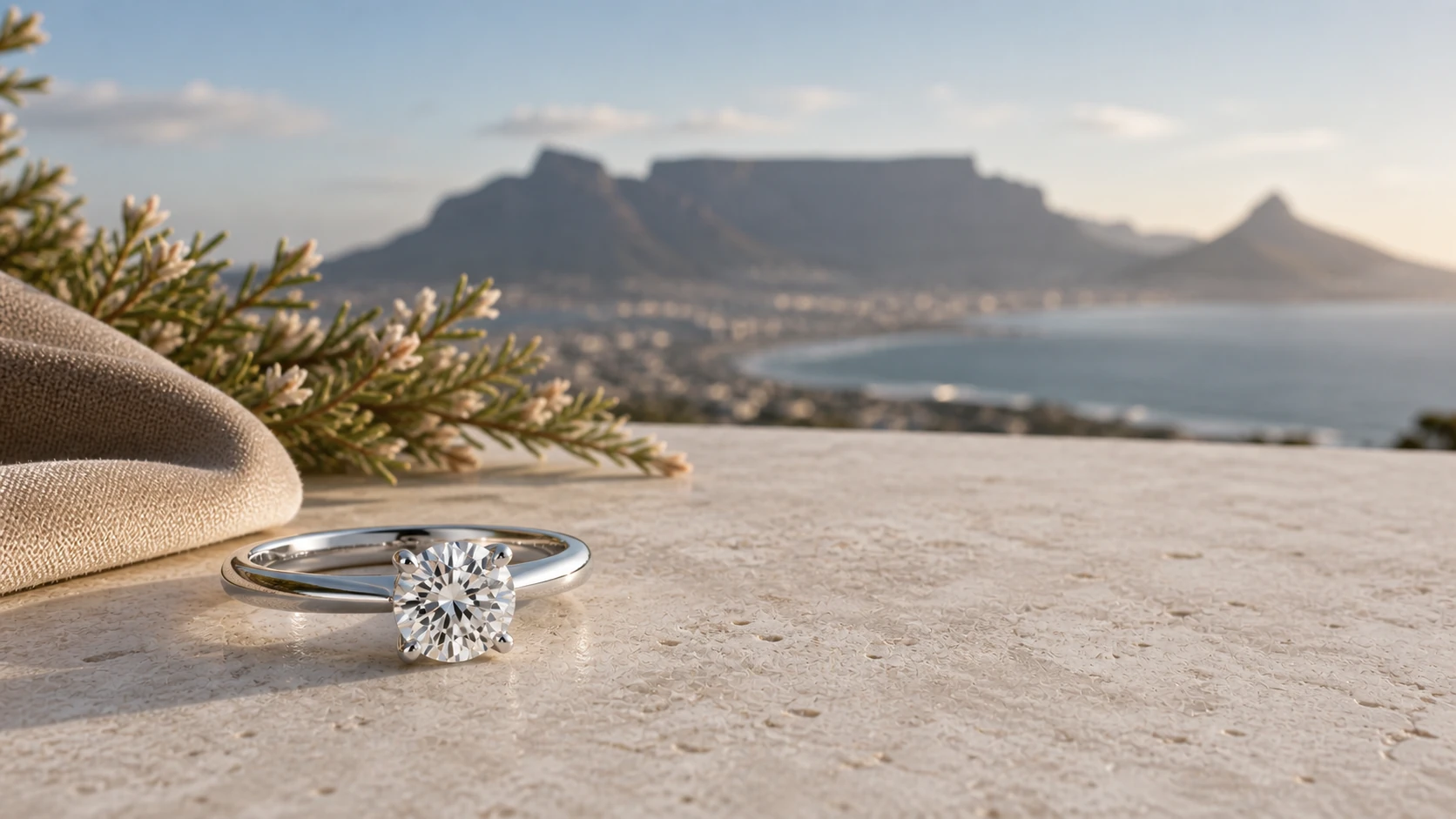
What each rand bracket actually buys
Branded chain jewellers push by SKU or by category. Nobody publishes a working bracket guide for the SA market. So we built one.
| Bracket | Lab-grown route | Natural route |
|---|---|---|
| R5,000 to R10,000 | 0.30ct lab-grown solitaire, 9ct or 18ct white gold band, IGI cert | Realistically not on the natural floor for an engagement-ring centre stone. Better in this bracket: a moissanite or a sapphire halo design. |
| R10,000 to R20,000 | 0.50ct to 0.70ct lab-grown solitaire, 18ct white gold or platinum, IGI or GIA cert | 0.30ct to 0.40ct natural solitaire, 18ct white gold, EGL or in-house cert. GIA only if the dealer is generous on margin. |
| R20,000 to R40,000 | 1.00ct to 1.50ct lab-grown solitaire or halo, platinum or 18ct, GIA cert | 0.50ct natural solitaire, GIA cert, 18ct white gold or platinum, bespoke at Bedfordview |
| R40,000 to R75,000 | 2.00ct to 3.00ct lab-grown solitaire or halo, platinum, GIA cert | 0.70ct to 0.90ct natural solitaire, GIA G/VS2/Excellent, platinum bespoke at Bedfordview |
| R75,000 to R150,000 | 3.00ct+ lab-grown trilogy or fancy-cut, platinum, GIA cert | 1.00ct natural solitaire or 0.90ct halo, GIA G/VS2/Excellent, platinum bespoke at Bedfordview |
| R150,000 to R300,000 | 5.00ct+ lab-grown statement piece, platinum, fancy-shape | 1.50ct natural solitaire, GIA F/VVS2/Excellent, platinum bespoke at Bedfordview |
| R300,000+ | Custom multi-stone, fancy-cut, lab-grown trilogy | 2.00ct+ natural, GIA F or better, platinum, often with side stones, bespoke commission |
Three observations. Below R10,000 the natural diamond route is mostly fictional for a true engagement-ring centre stone; budget routes there go to lab-grown, moissanite, or coloured-stone alternatives. The R20,000 to R75,000 band is where the lab-grown / natural decision matters most because both are credible options for visibly serious rings. Above R75,000 most serious buyers go to a Bedfordview bespoke workshop because the retail markup on those tickets becomes punitive.
The three buying channels
1. Bespoke commission at a Bedfordview wholesale workshop
Lowest landed price for a custom-designed ring with a certified centre stone in SA, on appointment. The workshop pulls a tray of certified loose stones matching your spec, you select, the in-house design team works up a CAD render of the mounting, you sign off, casting takes 1 to 2 weeks, stone-setting and final polish a further week. Lead time 3 to 6 weeks total.
Some cutting houses in the Bedfordview corridor run a wholesale-to-public model on appointment. Working detail on the commission process is at bespoke in Bedfordview and the appointment mechanics at how to buy from a Bedfordview wholesaler.
2. Mid-tier independent jewellers
Independent jewellers in Hyde Park Corner, Rosebank, Melrose Arch, and the V&A Waterfront sit between bespoke and chain. They typically maintain certified loose stone inventory for in-store selection, offer in-house design with a 1 to 3 week shorter lead time than full-bespoke, and operate at 100 to 200 percent markup over wholesale. Many of them source from the same Bedfordview workshops.
3. Mall-chain storefronts
Chain jewellers operating mall storefronts in Sandton City, Eastgate, Canal Walk, Gateway, Menlyn carry pre-set inventory, offer same-day for in-stock rings, and operate at the highest markup, typically 200 to 400 percent over wholesale. That markup funds rent, staff, brand marketing, financing options, and after-sale service. The right channel for a buyer who values speed, brand assurance, financing flexibility, and the showroom experience over the lowest landed price.
Design: shape, setting, metal
Three decisions account for most of the visible difference between two rings at the same budget.
Cut shape. The round-brilliant remains dominant in SA at roughly 55 to 65 percent of engagement-ring centre stones. Fancy shapes (oval, cushion, princess, emerald, pear, marquise, asscher, radiant) come in 25 to 40 percent cheaper at the same 4Cs and have gained share since 2020, particularly the oval (now roughly 15 percent of SA centre stones). Detail at best diamond shape for an engagement ring.
Setting style. The four working categories in SA bespoke: solitaire, halo, three-stone, and pavé band. Solitaire is the lowest-cost mounting and the most timeless. Halo creates visual carat-size enhancement (a halo around a 0.70ct centre reads as roughly a 0.90ct stone) for R8,000 to R18,000 extra in mounting cost.
Metal. Platinum is the SA benchmark: roughly 11 percent denser than pure gold, hypoallergenic, holds prongs securely, develops patina rather than chipping. Cost penalty over 18ct white gold is roughly 40 percent on the metal line, R3,500 to R5,000 absolute on a 5g band. 18ct white gold needs rhodium re-plating every 18 to 36 months at R600 to R1,200 per visit.
Certification, GIA, and the SA secondary market
For any centre stone 0.50ct or larger, ask for GIA. The reasons are uncomplicated: GIA is the global reference standard, it travels with the stone for insurance and resale, the SA secondary market heavily discounts non-GIA stones at matched spec, and the report is verifiable free at gia.edu/report-check before any money moves.
EGL and SGL certificates are common in SA but trade at 15 to 30 percent lower prices because the grading is widely understood by the trade to be one or two grades looser. The verification procedure for a GIA report is at how to verify a GIA certificate online. The full SA certificate landscape is at SA diamond certificates.
Lab-grown vs natural: the honest frame
At 1.00ct G/VS2/Excellent, lab-grown wholesales at roughly 8 to 12 percent of the natural figure in May 2026. A buyer can purchase a 1.00ct natural ring at R110,000 bespoke or a 2.00ct lab-grown ring at roughly R45,000 bespoke for noticeably larger stone-on-finger presence at far lower outlay. Visual quality at matched 4Cs is identical to the unaided eye.
The trade-off is residual market value. Natural diamonds hold 20 to 40 percent of original purchase price at private resale at 10 years; lab-grown holds 5 to 15 percent. The natural wholesale tape has been stable in USD since 2018; the lab-grown tape has fallen about 90 percent since 2016 and the pressure continues. Full comparison at lab-grown vs natural diamonds in SA and our editorial position at where lab-grown sits in 2026.
What a Bedfordview bespoke commission looks like
A typical commission runs across 4 to 6 appointments over 3 to 6 weeks. Week 1: the brief (budget, design references, partner’s style preferences, ring size, metal, lead time). Week 2: the workshop sources 2 to 4 candidate centre stones matching spec, presents them for selection. Week 3: CAD render of the mounting, with revisions if needed. Weeks 4 to 5: casting and bench work. Week 6: stone-setting, final polish, delivery with GIA report, invoice, and insurance valuation.
Payment terms in the wholesale channel: 30 to 50 percent deposit on centre-stone selection and CAD signoff, balance on collection. EFT is the standard. Cards are uncommon because merchant fees (2 to 3 percent) compress the dealer’s thin margin; some workshops accept with a surcharge.
Insurance and valuation
Every engagement ring in SA needs a separate insurance line: contents-policy itemised cover or a standalone all-risks specified-item policy. The major SA short-term insurers accept a registered valuation issued either by the supplying workshop or by an independent valuer registered with the Jewellery Council of South Africa.
Valuation figure is typically replacement-retail, not wholesale-paid. A R110,000 bespoke ring commonly valuates at R180,000 to R220,000 because the insurer replaces via its panel of retail jewellers in the event of loss, not via the original wholesale workshop. Detail at can I insure a diamond engagement ring in SA.
Best by situation: the decision matrix
Generic “best engagement ring” rankings are useless because the right ring depends on the buyer’s actual constraints. Eight situations and the matched route:
| Situation | Recommended route | Avoid |
|---|---|---|
| Tightest budget (under R10,000) | Lab-grown 0.50ct in 18ct white gold from an online SA lab-grown specialist, or moissanite from a Bedfordview workshop | Natural sub-0.30ct in 9ct gold (reads too small on the finger) |
| Maximum visible finger presence at fixed budget | Lab-grown 2.00ct CVD in platinum, GIA-certified, bespoke at Bedfordview | Smaller natural at the same budget (loses the presence the buyer is paying for) |
| Long-hold heirloom-grade purchase | Natural GIA G/VS2 Excellent 1.00ct+ at Bedfordview wholesale | Lab-grown (resale value drops 60+ percent over a decade as wholesale tape falls further) |
| Cape Town buyer, no JHB trip planned | Mid-tier independent at V&A Waterfront, OR Bedfordview-by-courier with CPT independent setting the centre stone locally | V&A tourist-tier stores (10 to 15 percent premium over the same Sandton retailer) |
| Pretoria buyer with bespoke design priorities | An established Pretoria bespoke workshop for a custom commission | Mall chain in Brooklyn or Menlyn (markup without the bespoke design payoff) |
| Surprise proposal, need fast turnaround | Chain mall retail with same-day in-store financing | Bespoke Bedfordview commission (3 to 6 week lead time misses the surprise window) |
| Couple choosing together, want design control | Bedfordview bespoke commission (3 to 6 weeks, full CAD signoff, lowest landed price) | Pre-set chain retail rings (constrains the design conversation) |
| Tourist buying in SA to take home | SADPMR-licensed dealer with full VAT invoice + GIA report + Kimberley Process certificate, then VAT-refund process at OR Tambo | Cash-only operators or stores that cannot issue a tax invoice (lose the 15 percent VAT refund) |
Common questions
What is the average engagement ring price in South Africa in 2026?
Working median across SA buyers in 2025 to 2026 is R32,000 to R42,000, with two distinct concentrations: a lab-grown band at R18,000 to R55,000 and a natural band at R65,000 to R180,000. BusinessTech’s 2017 figure of R45,000 average is roughly current if you adjust for inflation and the rand-dollar move, but the actual market has split into two camps that the average hides.
How much should I spend on an engagement ring in South Africa?
The “two-month salary” rule was a 1980s diamond-industry marketing campaign, not an economic principle, and SA buyers in 2026 cluster well below it. The honest version: spend what does not strain household cashflow, weighted by what your partner actually values about the ring. A R30,000 bespoke solitaire in platinum with a GIA-certified 0.50ct G/VS2 centre stone reads as a serious ring at every dinner table in Johannesburg. So does a R120,000 1.00ct version. Both are credible.
Where should I buy an engagement ring in South Africa?
Three working channels. Bespoke commission at a Bedfordview wholesale workshop on appointment delivers the lowest landed price and highest specification control, at 3 to 6 weeks lead time. Mid-tier independent jewellers in Hyde Park, Rosebank, Melrose Arch, and the V&A Waterfront sit between, with faster turnaround and 100 to 200 percent markup over wholesale. Mall-chain storefronts (the recognisable national brands) offer the fastest turnaround at the highest markup. Each is right for a different buyer.
How long does a bespoke engagement ring take in South Africa?
A bespoke commission at a Bedfordview wholesale workshop typically runs 3 to 6 weeks from first appointment to ring-out-the-door. Brief at week 1, centre-stone selection at week 2, CAD design and signoff at week 3, casting and bench work weeks 4 to 5, final polish and stone setting at week 6. Faster turnaround is possible but compresses the design-iteration window.
Do I need a GIA certificate on the centre stone?
For a centre stone 0.50ct or larger, GIA is strongly recommended. Three reasons: it is the global reference standard recognised in every diamond market, it travels with the stone for valuation and insurance, and the SA secondary resale market heavily discounts uncertified or in-house-certified stones at the same spec. EGL and SGL certificates are common in SA but trade at lower price bands because the grading is widely understood by the trade to be 1 to 2 grades looser than GIA.
Should I buy a natural or lab-grown engagement ring?
Lab-grown delivers visually identical specification at roughly 8 to 12 percent of the natural price at 1.00ct. The natural stone holds residual market value at 20 to 40 percent of original purchase at 10-year resale; the lab-grown holds 5 to 15 percent because the wholesale tape continues to fall. Choose based on what the ring is actually for: maximum visible presence today at the lowest outlay points to lab-grown; long-hold object with residual value points to natural.