Guide
Oval engagement rings in South Africa
Oval engagement rings in South Africa: the 25 to 35 percent price advantage over round, the bow-tie nobody mentions, and what to look for.
Oval pricing in May 2026
| Weight | Round wholesale (R) | Oval wholesale (R) | Saving |
|---|---|---|---|
| 0.70ct | R45,000 | R30,000 | 33% |
| 1.00ct | R90,000 | R63,000 | 30% |
| 1.50ct | R190,000 | R130,000 | 32% |
| 2.00ct | R345,000 | R235,000 | 32% |
Per-carat the saving is consistent at roughly 30 to 33 percent across the engagement-ring weight band. The shape advantage compounds: a 1.20ct oval costs less than a 1.00ct round at the same 4Cs, and looks visibly larger on the finger.
The bow-tie no one mentions
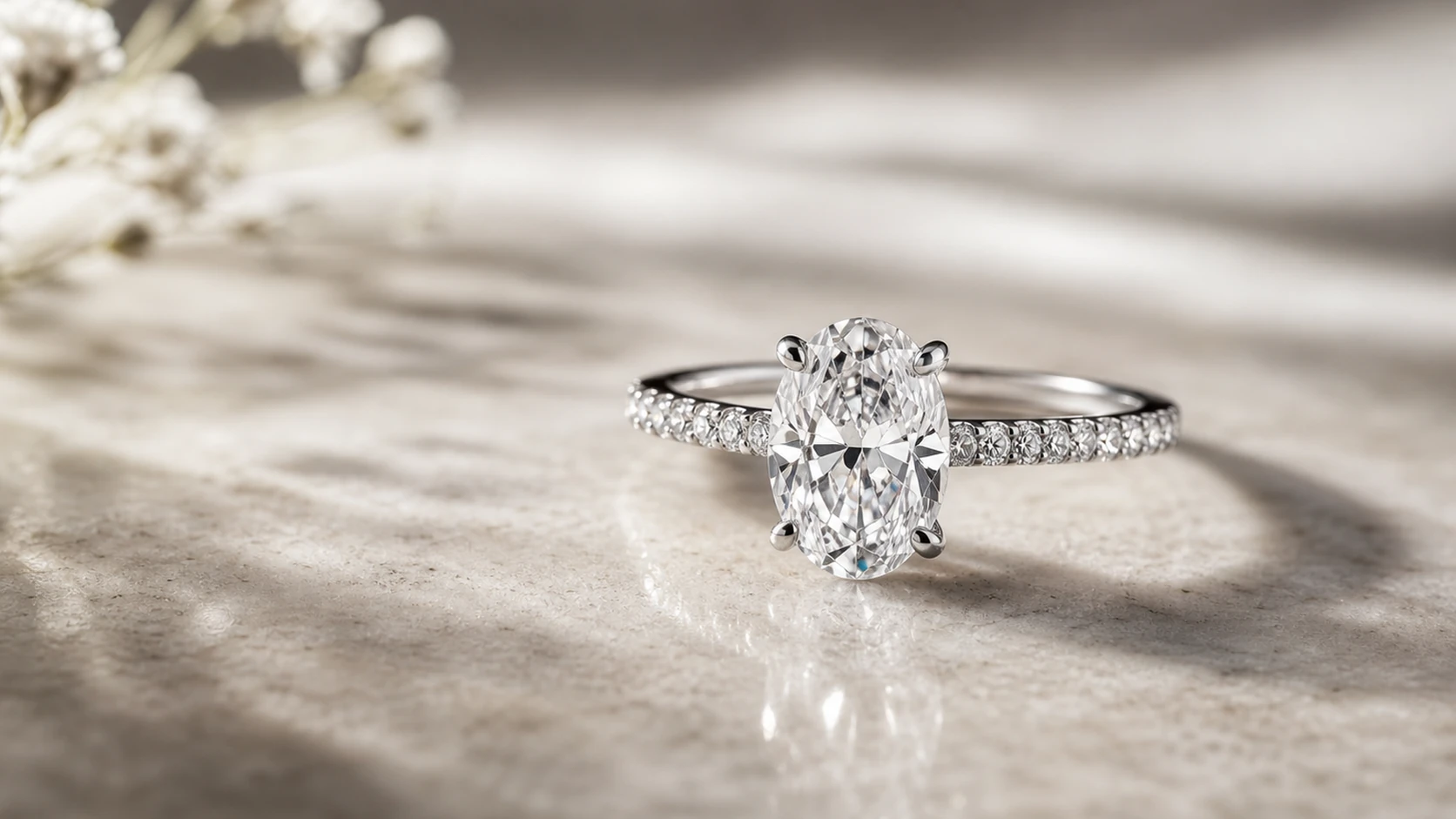
All oval-cut diamonds have some degree of bow-tie effect: a dark shadow visible across the centre of the stone when viewed face-up. The bow-tie is caused by light leaking through the pavilion (the underside of the stone) rather than reflecting back to the eye. Well-cut ovals have a subtle, almost-invisible bow-tie. Poorly-cut ovals have a pronounced dark central band that compromises sparkle.
The bow-tie is not graded on the GIA certificate. Two ovals with identical 4Cs (carat, colour, clarity, cut) can have radically different bow-tie severity. The only working check is visual inspection under a 10x loupe at the appointment, ideally in natural daylight as well as under jewellery-shop lighting. A well-cut oval keeps the central band light and reflective; the bow-tie should be just barely perceptible.
This is why bespoke commission at a Bedfordview wholesale workshop matters more for ovals than for rounds. The workshop pulls a tray of 3 to 6 candidate ovals at the target spec, the buyer compares face-up presence side-by-side, and the worst-bow-tie examples are filtered out before the design phase. A chain-mall storefront with a single pre-set oval offers no such comparison.
The 1.40 ratio
Length-to-width ratio is the second non-certificate variable. Buyer preference range in SA in 2026: 1.30 to 1.50. The 1.40 ratio is the working sweet-spot: elongated enough to claim the oval shape advantage, not so elongated that the bow-tie or the “skinny” look kicks in.
- 1.25 to 1.30: reads as too circular; oval shape advantage is muted.
- 1.30 to 1.35: classic round-leaning oval, slightly conservative.
- 1.35 to 1.45: classic balanced oval. Most-requested.
- 1.45 to 1.55: elongated oval; visually striking but bow-tie typically more pronounced.
- 1.55+: moves toward marquise territory; uncommon as engagement-ring centre.
The mounting
Three mounting styles dominate oval engagement-ring commissions in SA:
- Solitaire (4-prong or 6-prong): classic, most timeless, lowest cost. 4-prong setting cleans more easily; 6-prong holds more securely.
- Halo: single ring of smaller pavé diamonds around the oval centre. Adds approximately 0.20 visible carat to face-up size. R8,000 to R18,000 additional cost over solitaire on a R20,000 to R25,000 platinum mounting.
- Three-stone with side ovals or trillions: centre oval flanked by two smaller stones. Visually distinctive, R15,000 to R30,000 additional cost over solitaire.
East-west setting (oval mounted with the long axis horizontal across the finger rather than vertical up the finger) has gained ground since 2022 as an alternative to traditional north-south orientation. Personal preference; both look striking when well-executed.
Where to commission an oval engagement ring in SA
For a bespoke commission with stone-by-stone bow-tie comparison, the working route is a Bedfordview wholesale workshop on appointment. The workshop sources 3 to 6 candidate ovals matching spec, presents them for side-by-side selection, and the buyer’s visual choice (rather than the certificate alone) drives the final selection. Lead time 3 to 6 weeks for the full commission, including CAD design of the mounting.
Several cutting houses in the Bedfordview corridor run the wholesale-to-public model, carrying inventory across the oval shape range.
For walk-in retail oval selection, the mid-tier independent jewellers at Hyde Park Corner and Melrose Arch typically maintain a small oval selection. Chain mall jewellers in Sandton City carry pre-set oval rings but selection is constrained to whatever the buyer can match from current inventory.
Common questions
Why are oval diamonds cheaper than round-brilliant?
Two reasons. Manufacturing yield: an oval cut wastes less rough than a round-brilliant in the cutting process, so the per-carat finished price is lower for the same starting rough. Demand: round-brilliant remains the dominant engagement-ring shape in SA at 55 to 65 percent of centre stones, and the price premium reflects that demand. An oval at the same 4Cs as a round typically sits 25 to 35 percent cheaper at the wholesale floor.
Do oval diamonds look bigger than round?
At the same carat weight, yes. The elongated shape spreads the surface area visible from above (the “face-up” appearance) so a 1.00ct oval reads as approximately 1.20ct visible size compared to a round of the same weight. A well-proportioned 1.00ct oval at length-to-width ratio of 1.35 to 1.50 looks roughly equivalent in finger-presence to a 1.20ct round-brilliant.
What is the bow-tie effect on an oval diamond?
A bow-tie is a dark shadow visible across the centre of an oval-cut stone when viewed face-up, caused by light leakage through the pavilion. All ovals have some degree of bow-tie; well-cut ovals have a subtle, almost-invisible bow-tie; poorly-cut ovals have a pronounced dark area that compromises sparkle. The bow-tie is not graded on the GIA certificate, so visual inspection under a 10x loupe at the appointment is the only working check.
What is the ideal length-to-width ratio for an oval engagement ring?
Buyer preference range: 1.30 to 1.50. Below 1.30 the oval reads as too circular to claim the shape advantage. Above 1.50 the oval starts to elongate uncomfortably and the bow-tie usually becomes more pronounced. The 1.40 ratio is a working sweet-spot for visual proportions and is the most-requested ratio at SA bespoke workshops.
Is an oval engagement ring trendy or timeless?
Both. Oval was roughly 5 percent of SA engagement-ring centre stones in 2018 and has grown to roughly 15 percent in 2026, driven partly by celebrity engagement-ring choices (Hailey Bieber, Blake Lively) and partly by buyer attraction to the larger face-up appearance per rand. The trend pre-dates social media and oval has been a recognised engagement-ring shape since the 1960s, so trendy is unfair; gained share is more accurate.