
Reference
CVD vs HPHT lab-grown diamonds in South Africa
CVD vs HPHT lab-grown diamonds in South Africa: two growth methods, sold under one name. Only the cert tells you which, and an in-house cert may not.

Correction, 19 October 2026: earlier versions described an audit of certificates from five SA lab-grown sellers in May 2026. There is no record of that audit, so the section now explains what each kind of certificate discloses.
How CVD works
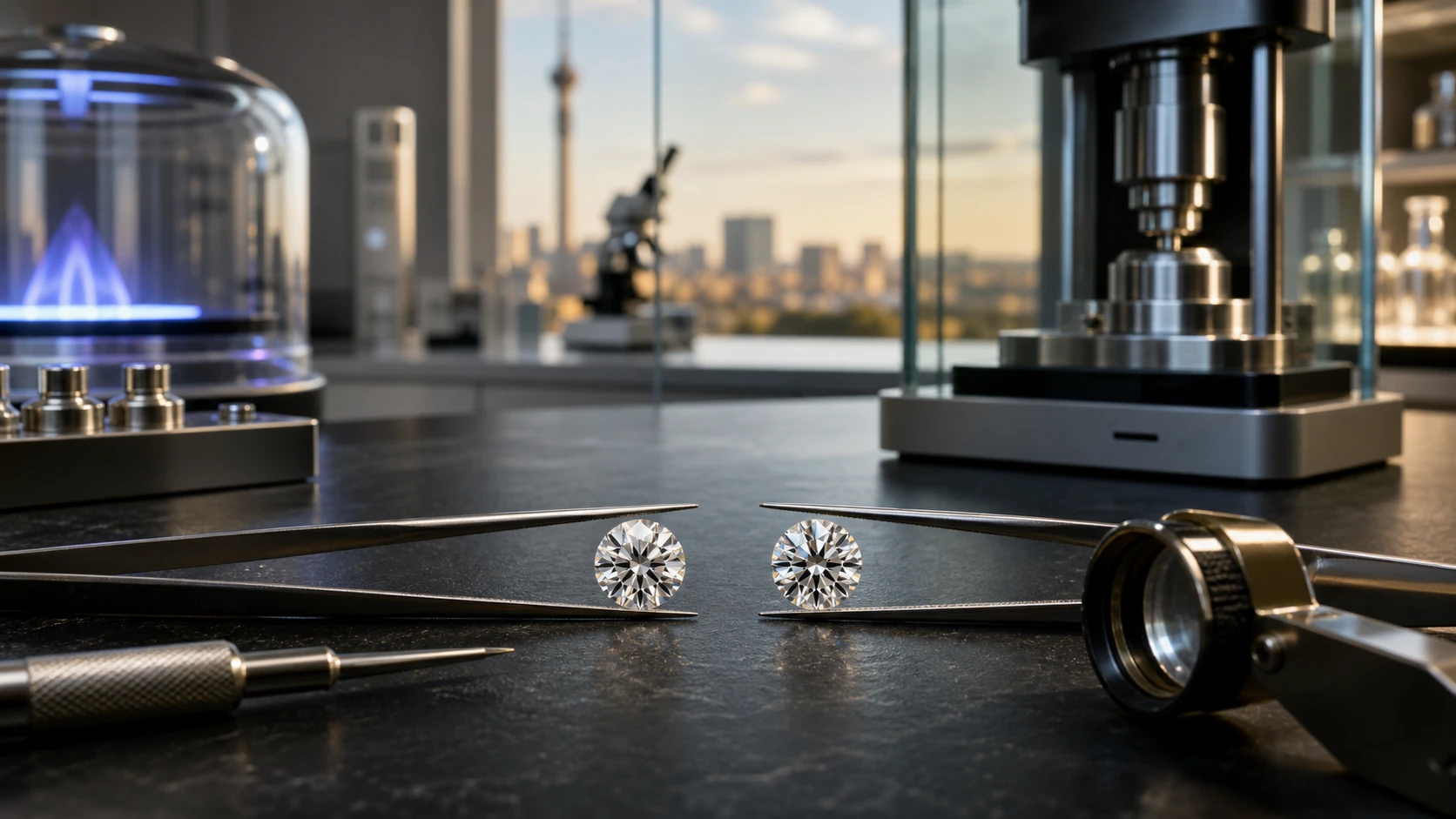
Chemical Vapour Deposition grows a diamond crystal atom by atom from a carbon-rich gas, typically methane (CH4) mixed with hydrogen. A thin diamond seed plate (a small slice of pre-existing diamond, either natural or lab-grown) is placed in a low-pressure plasma chamber. The gas is energised into a plasma state at roughly 700 to 1000 degrees Celsius and pressures well below atmospheric. The energised hydrogen breaks the methane bonds, releasing carbon atoms that deposit onto the seed in a controlled crystal-growth pattern. The seed grows upward in layers, building the final stone over 2 to 4 weeks depending on target carat weight.
CVD became commercially viable for gem-quality diamond growth in the early 2000s and the technology has matured rapidly through the 2010s. By 2026, CVD produces the majority of lab-grown gem diamonds sold globally, including the bulk of stones sold in the SA market. Manufacturing spans established industrial-diamond producers in the UK, a US operation now scaled back, several Chinese producers, and emerging Indian producers concentrated in Surat. CVD stones often require post-growth HPHT annealing to remove a faint brown tinge characteristic of as-grown CVD crystals; the annealing step is now standard practice and the resulting stones are commercially indistinguishable from untreated lab-grown.
How HPHT works
High Pressure High Temperature mimics the natural geological conditions under which diamonds form in the Earth’s mantle. A diamond seed is placed in a chamber with a carbon source (typically graphite) and a metallic flux (iron, nickel, cobalt, or a mix). The chamber is sealed and pressurised to roughly 5 to 6 gigapascals (50,000 to 60,000 times atmospheric pressure), then heated to 1300 to 1600 degrees Celsius. Under these conditions, the metallic flux dissolves the graphite and recrystallises it as diamond on the seed surface. The process takes days to weeks depending on target weight and equipment generation.
HPHT was the first commercial diamond synthesis method, developed by General Electric in 1954 for industrial diamond grit (cutting tools, abrasives). Gem-quality HPHT became commercially viable in the 2010s as the cubic-press and belt-press equipment scaled up to produce gem-sized crystals. By 2026, HPHT producers concentrate in China, Russia, and the US. HPHT stones often contain trace metallic flux inclusions visible under 10x loupe (small dark specks, distinct from natural diamond inclusions), and the colour can range from faint yellow or brown (in nitrogen-bearing HPHT) to colourless or even blue (in boron-doped HPHT).
The visual differences (when not treated)
In as-grown form, before post-growth treatments, the two methods produce stones with subtly different visual characteristics:
- HPHT colour: often slightly warmer, with a faint yellow or brown tinge from trace nitrogen impurities. The metallic flux can introduce a very faint warm cast even after deep-UV treatment to remove the brown component.
- HPHT inclusions: may show metallic flux inclusions visible under 10x loupe (small dark specks). These are structurally distinct from natural diamond inclusions and can be a tell at the bench.
- CVD colour: typically more neutral, often a faint brown or grey tinge in as-grown form that requires HPHT annealing to remove. Post-anneal, the stones can read as D to F colour reliably.
- CVD striations: may show growth striations (faint parallel lines indicating layer-by-layer deposition) visible under shortwave UV light. These are not visible to the naked eye or to a 10x loupe under normal lighting.
Crucial caveat: modern post-growth treatments (HPHT annealing of CVD stones, deep-UV treatment of brown HPHT stones) can erase these visual markers. The only authoritative way to identify the growth method on a finished stone is the GIA or IGI certificate, which uses spectroscopic analysis (specifically, FTIR and photoluminescence spectroscopy) to fingerprint the growth method even after treatment.
What each certificate discloses
A GIA or IGI laboratory-grown diamond report states the growth method (CVD or HPHT), and whether the stone was treated after growth, as part of the report itself, so a seller using one cannot leave it out. An in-house certificate issued by the seller usually reports carat, colour, clarity and cut grades with no spectroscopic analysis and no growth-method identification.
The implication for the buyer: a stone sold with only an in-house cert is functionally unidentified at the growth-method level. Resale value, insurance valuation, and any future verification all depend on independent laboratory grading. The price savings of buying a non-GIA, non-IGI lab-grown stone (typically R1,200 to R2,500 less per stone) are smaller than the resale-value gap such a stone faces in the SA secondary market.
The 2026 price convergence
Historical price gap (2018 to 2022): HPHT lab-grown typically sold at 15 to 25 percent below CVD lab-grown at comparable carat, colour, and clarity. The gap reflected production-scale advantages on the HPHT side (mature 1950s technology, lower per-stone capex) and a market preference for CVD’s more neutral colour.
By 2026, the gap has effectively closed. CVD production scale has multiplied through the rapid expansion of Indian and Chinese CVD facilities, the per-stone cost has dropped, and the HPHT side has invested in colour-improvement post-treatment to match CVD’s neutral colour. At the SA wholesale floor in May 2026, a 1.00ct G/VS2 CVD-grown lab diamond and a 1.00ct G/VS2 HPHT-grown lab diamond price within 5 to 8 percent of each other. The choice between the two is now more about colour preference (HPHT slightly warmer, CVD slightly more neutral) and certification trust than about price arbitrage.
Why this matters for SA buyers
Three working takeaways.
- Insist on GIA or IGI certification. Hard floor. The growth method designation on the cert is the only authoritative identification, and the resale value of the stone depends on it.
- The growth method choice is largely aesthetic. Both produce structurally identical diamond. If the buyer wants the most neutral colour, CVD is the default; if the buyer wants the slightly warmer aesthetic (or has a personal connection to the “mantle-mimicking” story), HPHT is the choice.
- Lab-grown holds value badly in resale regardless of growth method. Both CVD and HPHT lab-grown stones typically resell at 15 to 25 percent of original retail purchase price in the SA secondary market, far below mined natural at 40 to 50 percent. Buyers selecting lab-grown for the entry-level price should accept the resale-value implication, not assume the stone will hold value like a mined diamond.
For buyers prioritising long-term value retention with the option to commission a natural-stone piece, the bespoke route at a Bedfordview wholesale workshop on appointment remains the working choice. These workshops run the wholesale-to-public model from the Bedfordview corridor and handle both certified lab-grown commissions and natural-stone bespoke work.
Common questions
What does CVD stand for in lab-grown diamonds?
Chemical Vapour Deposition. A growth method that grows a diamond crystal from a carbon-rich gas (typically methane) inside a low-pressure plasma chamber. A thin diamond seed plate is placed in the chamber, the gas is energised into a plasma state, and carbon atoms deposit onto the seed in a controlled crystal-growth pattern. The process takes roughly 2 to 4 weeks per stone, depending on target carat weight. CVD became commercially viable for gem-quality diamond growth in the early 2000s and now produces the majority of lab-grown diamond stones sold globally.
What does HPHT stand for in lab-grown diamonds?
High Pressure High Temperature. A growth method that mimics the natural conditions deep in the Earth’s mantle: a diamond seed is placed in a chamber with a carbon source (typically graphite), the chamber is pressurised to roughly 5 to 6 gigapascals (50,000 to 60,000 times atmospheric pressure), heated to 1300 to 1600 degrees Celsius, and a metallic flux dissolves the graphite and recrystallises it as diamond on the seed. The process takes days to weeks depending on target weight. HPHT was the first commercial diamond synthesis method (General Electric, 1954) and produced industrial diamond grit for decades before gem-quality HPHT became commercially viable in the 2010s.
Can you tell CVD vs HPHT visually?
Sometimes. HPHT-grown diamonds often contain trace nitrogen impurities that give the stone a slightly warmer (faint yellow or brown) colour tinge, and may show metallic flux inclusions visible under 10x loupe. CVD-grown diamonds may show growth striations (faint parallel lines indicating layer-by-layer deposition) visible under shortwave UV light, and the colour is typically more neutral. However, modern post-growth treatments (HPHT annealing of CVD stones, deep-UV treatment of brown HPHT stones) can erase these visual markers. The only authoritative way to identify the growth method is the GIA or IGI certificate, which uses spectroscopic analysis to fingerprint the growth method.
Is CVD or HPHT more expensive in 2026?
Roughly the same. The price gap that historically separated the two methods (HPHT 15 to 25 percent cheaper than CVD for comparable carat and colour) has effectively closed by 2026 as production scale on both sides has matured. At the SA wholesale floor in May 2026, a 1.00ct G/VS2 CVD-grown lab diamond and a 1.00ct G/VS2 HPHT-grown lab diamond price within 5 to 8 percent of each other. The choice between the two is now more about colour preference (HPHT slightly warmer, CVD slightly more neutral) and certification trust than about price arbitrage.
Does the growth method affect the diamond’s durability?
No. Both CVD-grown and HPHT-grown diamonds have identical Mohs hardness (10) and identical structural properties to mined natural diamond. The growth method affects trace impurities and faint colour but does not affect the underlying crystal structure or the stone’s resistance to scratching, chipping, or wear. A buyer choosing between CVD and HPHT for a daily-wear engagement ring is making an aesthetic and certification decision, not a durability decision.
Should I buy lab-grown without a GIA or IGI certificate?
No. The hard rule for SA buyers in 2026: never buy lab-grown without a GIA or IGI certificate that explicitly identifies the growth method. Some SA lab-grown sellers offer in-house certificates that report carat, colour, and clarity but omit the growth method designation. The in-house certificate is not a substitute for independent laboratory grading; resale value, insurance valuation, and consumer protection all hinge on the GIA or IGI grading. Cost difference between an in-house cert and a GIA or IGI cert at the seller-paid level is roughly R1,200 to R2,500 per stone, which is meaningfully less than the resale value gap a non-certified lab-grown stone faces.