Guide
Diamond engagement rings in Johannesburg under R30,000
Diamond engagement rings in Johannesburg under R30,000: the bracket most SA buyers actually shop. What R15k, R20k, R25k, R30k buys across lab and natural.

Correction, 19 October 2026: earlier versions said natural diamond prices had been stable in US dollars. Rapaport’s published 1-carat index (RAPI) fell about 47 percent from its 2022 peak to September 2026.
What each price point actually buys
| Budget | Lab-grown option | Natural option |
|---|---|---|
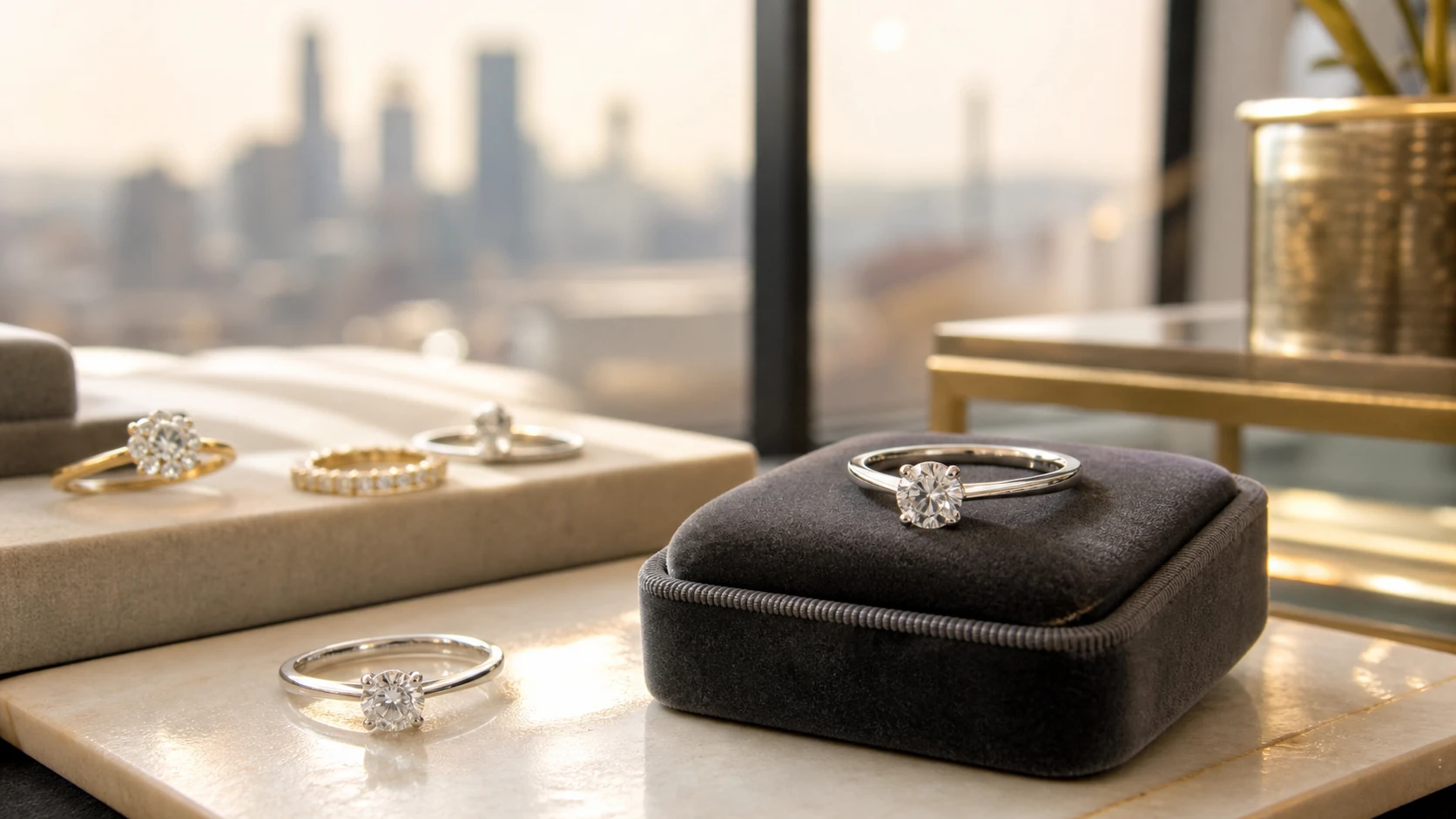
| R15,000 | 0.70ct G/VS2 lab-grown in 9ct white-gold solitaire | 0.25ct natural G/VS2 GIA in white-gold solitaire OR 0.40ct natural I/SI2 (non-certified) in white-gold solitaire |
| R20,000 | 1.00ct G/VS2 lab-grown in 9ct white-gold solitaire OR 0.70ct in platinum solitaire | 0.35ct natural G/VS2 GIA in white-gold solitaire OR 0.50ct natural I/SI1 GIA in white-gold halo |
| R25,000 | 1.20ct G/VS2 lab-grown in white-gold solitaire OR 1.00ct in platinum solitaire OR 0.70ct in platinum halo | 0.45ct natural G/VS2 GIA in white-gold solitaire OR 0.60ct natural H/SI1 GIA in platinum solitaire |
| R30,000 | 1.20ct to 1.50ct G/VS2 lab-grown in platinum solitaire OR 1.00ct in halo | 0.50ct natural G/VS2 GIA in platinum solitaire OR 0.70ct natural H/SI1 GIA in white-gold halo |
The trade-off matrix is real: weight, certification, colour, clarity, and setting metal all compete inside the same budget. A buyer who prioritizes weight will choose lab-grown. A buyer who prioritizes natural-origin and long-term value will accept a smaller stone at higher certification. A buyer who prioritizes the look of the ring on the finger will often choose a halo setting that boosts apparent size.
The lab-grown vs natural decision at this bracket
Lab-grown diamond pricing has fallen about 90 percent since 2016, driven by manufacturing-cost reductions in CVD (chemical vapour deposition) and HPHT (high-pressure high-temperature) production at scale. A 1.00ct G/VS2 lab-grown that retailed at R55,000 in 2018 retails at R9,000 to R15,000 in May 2026. Natural prices fell far less: Rapaport’s 1-carat RAPI index is down about 47 percent from its 2022 peak by September 2026, and this column’s estimate for a 1.00ct G/VS2 natural is R75,000 to R110,000 at wholesale in May 2026.
The chemical and optical properties of a high-quality lab-grown stone are identical to a natural diamond of the same 4Cs. A trained gemologist with specialised testing equipment (spectroscopy, fluorescence imaging, advanced inclusion analysis) can distinguish them; visual inspection under a 10x loupe cannot. The certificate distinguishes them (GIA and IGI both issue separate report types for lab-grown).
At the R15,000 to R30,000 bracket, the lab-grown route delivers materially more visible carat-weight for the budget. For buyers who prioritize natural-origin (the romantic narrative, the long-term value-preservation thesis, the family-heirloom philosophy), the natural route delivers a smaller stone at higher certification. Neither choice is wrong; both are real diamonds chemically. The decision is partly aesthetic, partly philosophical, partly financial.
The six working JHB channels
- Chain mall storefronts at Sandton City, Eastgate, Mall of Africa, Cresta, Fourways. Walk-in retail with broad inventory at this budget bracket. Financing options. Standard 6 to 12 month warranty plus lifetime cleaning service. Strongest on the natural 0.30 to 0.50ct GIA-certified solitaire mass market.
- Mid-tier independents at Hyde Park Corner, Melrose Arch, Rosebank Mall. Curated inventory, in-house design service, more bespoke commission flexibility than the chain malls. Pricing typically 10 to 25 percent above mall retail for equivalent specification, justified by service depth.
- Bedfordview wholesale workshops on appointment. Lab-grown bespoke commission viable at the R15k to R30k bracket. Natural diamond bespoke is at the lower threshold of the workshop’s standard work; 0.30 to 0.40ct GIA-certified natural in simple white-gold solitaire fits. These workshops run the wholesale-to-public model from the Bedfordview corridor and accept lab-grown commissions in this budget range.
- Online SA platforms with showroom pickup. Several SA online-first operators carry inventory at this bracket with delivery or showroom pickup at JHB locations. Pricing competitive with mid-tier independent. Always verify GIA or IGI report numbers live against the lab’s online report-check.
- East Rand operators in Bedfordview, Edenvale, Boksburg, Germiston. Lower-rent commercial spaces support smaller-margin retail; price typically 10 to 20 percent below mall retail for equivalent specification. Often workshop-direct or single-step from the Bedfordview wholesale corridor.
- Pre-owned, auction, and estate-sale channels. SA pre-owned engagement rings at this bracket can deliver materially higher original-spec for the budget; a 0.70ct natural G/VS2 GIA-certified in a 5 to 10 year old platinum mounting might sit at R22,000 to R28,000 pre-owned versus R55,000+ new. Always re-certify and re-valuate. See the SA estate jewellery guide for the seller-side mechanics.
Certification at this budget
Above 0.30ct centre stone, a recognised-lab certificate is the working buyer-protection standard at this budget bracket. For natural diamonds: GIA is the international gold standard; IGI is the working secondary standard (AGS Laboratories closed at the end of 2022 and its grading work was absorbed into GIA, so an AGS report is a legacy document); EGL reports are widely seen in SA, but international resale and re-certification frequently downgrades them by 1 to 2 colour and clarity grades; other non-GIA reports carry less international weight. For lab-grown: IGI (International Gemological Institute) is the working standard with broad SA lab-grown coverage; GIA also issues lab-grown reports, sometimes at slight premium.
Buyers should be willing to pay R1,500 to R4,500 more for the GIA-certified equivalent of a non-certified or SA-certified stone at this bracket. The certification protects against grading inflation and supports future insurance valuation, resale, or upgrade trade-in.
The halo trick
A halo setting mounts the centre stone with a ring of small pavé diamonds around it, visually expanding the apparent face-up size by approximately 0.20 to 0.30ct equivalent. At the R15k to R30k bracket the halo is a frequently-used way to make a 0.40 to 0.50ct centre stone look closer to a 0.70 to 0.80ct stone on the finger. Adds approximately R3,500 to R8,000 to the mounting cost over a comparable solitaire.
The halo also covers some clarity sins; small inclusions near the girdle of the centre stone are visually masked by the pavé halo. For a slightly-lower-clarity centre stone (SI1 or SI2 with visible inclusions) the halo can be a working visual choice rather than just a face-up-size amplifier.
What to ask at every appointment
- Show me the certificate first, before showing the mounting.
- Verify the GIA or IGI report number live against the lab’s report-check site.
- Confirm the laser-inscribed report number on the girdle under 10x loupe.
- Itemize the quote: stone cost, mounting cost, setting fee, VAT, total.
- Confirm the metal grade: 9ct vs 18ct yellow gold, white gold vs platinum, alloy purity.
- Confirm the warranty terms in writing: free first-year resizing, first-year stone-tightening, lifetime cleaning.
- Confirm SADPMR licensing on the door or invoice.
Common questions
What does R30,000 buy in a JHB engagement ring in 2026?
At R30,000 ring-out-the-door in May 2026, the working choices are: a 1.00ct to 1.20ct lab-grown G/VS2 in a white-gold solitaire from a Bedfordview workshop, a 0.40ct to 0.50ct natural G/SI1 GIA-certified in a platinum solitaire from a mid-tier independent, a 0.30ct natural G/VS2 GIA-certified in a halo setting that mounts the centre stone with a ring of pavé diamonds to amplify face-up size, or a 0.75ct natural H/SI2 (lower clarity, lower colour) in a yellow-gold solitaire from a chain mall storefront. The trade-off matrix is real: weight, certification, colour, clarity, and setting metal all compete inside the same budget.
Is a lab-grown diamond a better choice than a natural diamond at R30k?
For visible carat-weight at the budget, yes. A 1.00ct lab-grown G/VS2 (approximately R8,000 to R12,000 wholesale in May 2026) plus a R15,000 to R18,000 platinum mounting fits inside R30,000 with budget to spare. A comparable 1.00ct natural G/VS2 runs R75,000 to R110,000 wholesale, well outside the budget. For long-term resale value preservation, the answer is more complicated; lab-grown prices have fallen approximately 70 to 80 percent since 2018, while natural diamond pricing has held more stably. The choice is partly aesthetic, partly philosophical, partly financial; both are real diamonds chemically.
Where in Johannesburg do most buyers shop at the R15k-R30k bracket?
Six working channels at this bracket. (1) Chain mall storefronts at Sandton City, Eastgate, Mall of Africa, Cresta. (2) Mid-tier independents at Hyde Park Corner, Melrose Arch, Rosebank Mall. (3) Bedfordview wholesale workshops on appointment (lab-grown bespoke commission viable at this budget; natural less so above the 0.5ct mark). (4) Online SA platforms with showroom pickup. (5) East Rand operators in Bedfordview, Edenvale, Boksburg. (6) Pawnshop or scrap-resale where pre-owned natural pieces can sometimes be found at this price.
Should I prioritize carat or certification at this budget?
Certification, in most cases. A GIA-certified 0.50ct natural G/VS2 protects the buyer against grading inflation (where dealer-issued or unrecognised-lab grading inflates the apparent quality) and supports future resale or insurance valuation. A non-certified 0.75ct natural at the same price might in practice grade I or J colour and SI2 or I1 clarity from a strict GIA standard, even if the dealer claims H/SI1. For lab-grown at this budget, IGI certification is the working standard (GIA also certifies lab-grown, sometimes at slight premium). Always insist on a recognised-lab certificate above 0.30ct centre stone.
Can I commission a bespoke engagement ring in JHB for under R30,000?
Yes, with lab-grown. The Bedfordview workshop bespoke route accepts commissions in the R15,000 to R30,000 range when the centre stone is a 0.50ct to 1.20ct lab-grown G/VS2 mounted in white gold or 9ct yellow gold (platinum and 18ct yellow gold push the mounting cost out of bracket). For natural diamond bespoke, R30,000 is at the lower threshold; a 0.30ct to 0.40ct GIA-certified natural in a simple white-gold solitaire fits the budget. Lead time 3 to 5 weeks. The workshops appreciate clear briefs and realistic budget expectations.
What about a pre-owned engagement ring at this price?
A working option that buyers often overlook. SA pre-owned engagement rings at the R15,000 to R30,000 bracket can deliver materially higher original-spec for the budget: a 0.70ct natural G/VS2 GIA-certified in a 5 to 10 year old platinum mounting might sit at R22,000 to R28,000 pre-owned versus R55,000+ new. Working pre-owned channels: Jewellery Council member dealers with consignment programmes, specialist auction houses for designer pieces, several specialist Bedfordview operators, and verified private resale. Always re-certify the stone (R3,500 to R6,500 GIA recertification fee) and re-valuate for insurance purposes.