
Reference
Ring size chart South Africa
Ring size chart for South Africa: the SA A-to-Z alphabetic convention converted to US, EU, and millimetre, plus the home-measurement method that works.

Why SA uses letters, not numbers
Walk into any SA jeweller and they will quote your ring size as a letter: K, M½, P, T. This is the British / Commonwealth alphabetic convention, the same one used in the UK, Ireland, Australia, and New Zealand. The chart runs A (the smallest, 12.0 mm inner diameter) through Z+6 (the largest, 25.6 mm), in half-size increments separated by roughly 0.4 mm.
The US uses a numeric scale from 1 to 13.5 in quarter-size increments. The EU and most of continental Europe use the ISO 8653 standard, which is simply the inside circumference in millimetres (size 51, size 54, size 60). Three different conventions for the same measurement. A working SA jeweller will read all three but defaults to the alphabetic when quoting.
The practical implication is for buyers ordering internationally. A ring ordered from a US online retailer at size 6 needs translating: that is approximately SA size M, or 16.5 mm. Ordering the wrong size and shipping back across borders adds duty, VAT, and three weeks of friction. Get the conversion right at the point of purchase.
The full A-Z conversion table
Reading down: the SA letter, the equivalent US number, the EU/ISO circumference in mm, and the inside diameter (the figure that matches a standard metal-sizer ring). Half-sizes shown for the women’s working range (J to R) where most SA orders sit.
| SA size | US size | EU (mm circumference) | Inside diameter (mm) |
|---|---|---|---|
| F | 3 | 44 | 14.0 |
| G | 3.5 | 45 | 14.4 |
| H | 4 | 47 | 14.8 |
| I | 4.25 | 48 | 15.2 |
| J | 4.75 | 49 | 15.5 |
| J½ | 5 | 49.5 | 15.7 |
| K | 5.25 | 50 | 15.9 |
| K½ | 5.5 | 50.5 | 16.1 |
| L | 5.75 | 51 | 16.3 |
| L½ | 6 | 52 | 16.5 |
| M | 6.25 | 52.5 | 16.7 |
| M½ | 6.5 | 53 | 16.9 |
| N | 6.75 | 54 | 17.1 |
| N½ | 7 | 54.5 | 17.3 |
| O | 7.25 | 55 | 17.5 |
| O½ | 7.5 | 55.5 | 17.7 |
| P | 7.75 | 56 | 17.9 |
| P½ | 8 | 57 | 18.1 |
| Q | 8.25 | 57.5 | 18.3 |
| Q½ | 8.5 | 58 | 18.5 |
| R | 8.75 | 59 | 18.7 |
| S | 9.25 | 60 | 19.0 |
| T | 9.5 | 61 | 19.4 |
| U | 10.25 | 62 | 19.8 |
| V | 10.75 | 64 | 20.6 |
| W | 11.25 | 65 | 21.0 |
| X | 11.75 | 66 | 21.4 |
| Y | 12.25 | 68 | 21.8 |
| Z | 12.75 | 69 | 22.2 |
Sizes above Z (Z+1 through Z+6) are produced on commission for larger fingers, typically men’s wedding bands and family signet rings. The Bedfordview workshops cast every size from F upward; mall retailers typically stock only the central J to V range and order extremes by special request, adding a 7 to 14 day lead time.
How to measure at home (the string method)
The two-finger string trick is the home method that actually works. You will need a strip of paper or string about 100 mm long, a pen, and a ruler with millimetre markings.
- Cut a strip of paper roughly 5 mm wide and 100 mm long. Standard A4 paper folded and cut works.
- Wrap the strip around the base of the intended finger. Snug but not constricting; you should be able to slide a fingernail underneath.
- Mark the overlap point with a pen, exactly where the leading edge meets the wrapped strip.
- Lay the strip flat and measure from the start to the mark in millimetres.
- This figure is the inside circumference. Match it to the EU/mm column in the table above to read your SA size.
Accuracy: roughly within one full SA size if you measure carefully and three times in a row to confirm. The string method is enough for first-time orientation, ring-buying for someone else as a surprise, and online-order sizing. It is not enough for commissioning bespoke; bespoke commissions should always be sized with a metal sizer at the workshop.
Two common errors: pulling the string too tight (resulting in an undersized order that needs resizing later), and measuring on the wrong finger. The third finger of the left hand is the engagement-ring convention in SA; the right hand averages a quarter-size larger for most people because the dominant hand is fractionally stronger and more muscular.
Winter vs summer: the swelling truth
Fingers change size during the day and across the seasons. A typical SA finger varies by roughly 0.5 SA size between a cold winter morning and a hot summer afternoon. People who spend significant time outdoors, who live at the coast, or who exercise regularly see larger swings, up to a full size.
The temptation is to size for the slimmer winter reading because the ring feels comfortable then. This is a mistake. In summer the ring will constrict, become difficult to remove, and in extreme cases need cutting off. Size for the larger summer reading instead; the ring will feel slightly loose in winter cold but stay comfortable across the year.
Best window to measure: late afternoon, at normal indoor room temperature (22 to 24 degrees), after the finger has been still and unworked for at least 10 minutes. Avoid measuring first thing in the morning, immediately after exercise, after a salty meal, after alcohol, in extreme cold, or while pregnant. Each of these distorts the reading by half a size or more.
What resizing costs in 2026
Ring resizing is mechanical: a section of the band is cut, the band is opened or compressed to the target size, then soldered closed and polished. The complexity scales with the metal, the setting style, and whether any stones need removing and resetting.
| Ring type | Resize up or down 1 size | Resize 2 to 3 sizes |
|---|---|---|
| Simple 9ct or 18ct gold band, no stones | R500 to R900 | R900 to R1,500 |
| Platinum band, no stones | R900 to R1,500 | R1,500 to R2,200 |
| Solitaire with claw-set centre stone | R700 to R1,200 | R1,200 to R1,800 |
| Channel-set or pavé band (stone removal required) | R1,500 to R2,500 | R2,500 to R4,500 |
| Full eternity band (typically not resizeable) | Recast required | Recast required |
Most Bedfordview wholesale workshops include one free resize within 30 days of original commission as a courtesy. This window matters because finger size can take two to four weeks to settle once the ring is worn regularly; the new owner often realises after a week of daily wear that they need a quarter-size adjustment. Mall-chain retailers typically charge the standard resize fee from day one but offer faster turnaround (24 to 48 hours vs 5 to 10 working days at most independent workshops).
For the eternity-band exception: a ring with stones channel-set or pavé-set around the full circumference cannot be cut and resoldered without disrupting the stone setting. The standard fix is a full recast at the new size, which typically costs 60 to 80 percent of the original ring price. Confirm sizing with absolute certainty before commissioning a full eternity band.
If you are commissioning bespoke
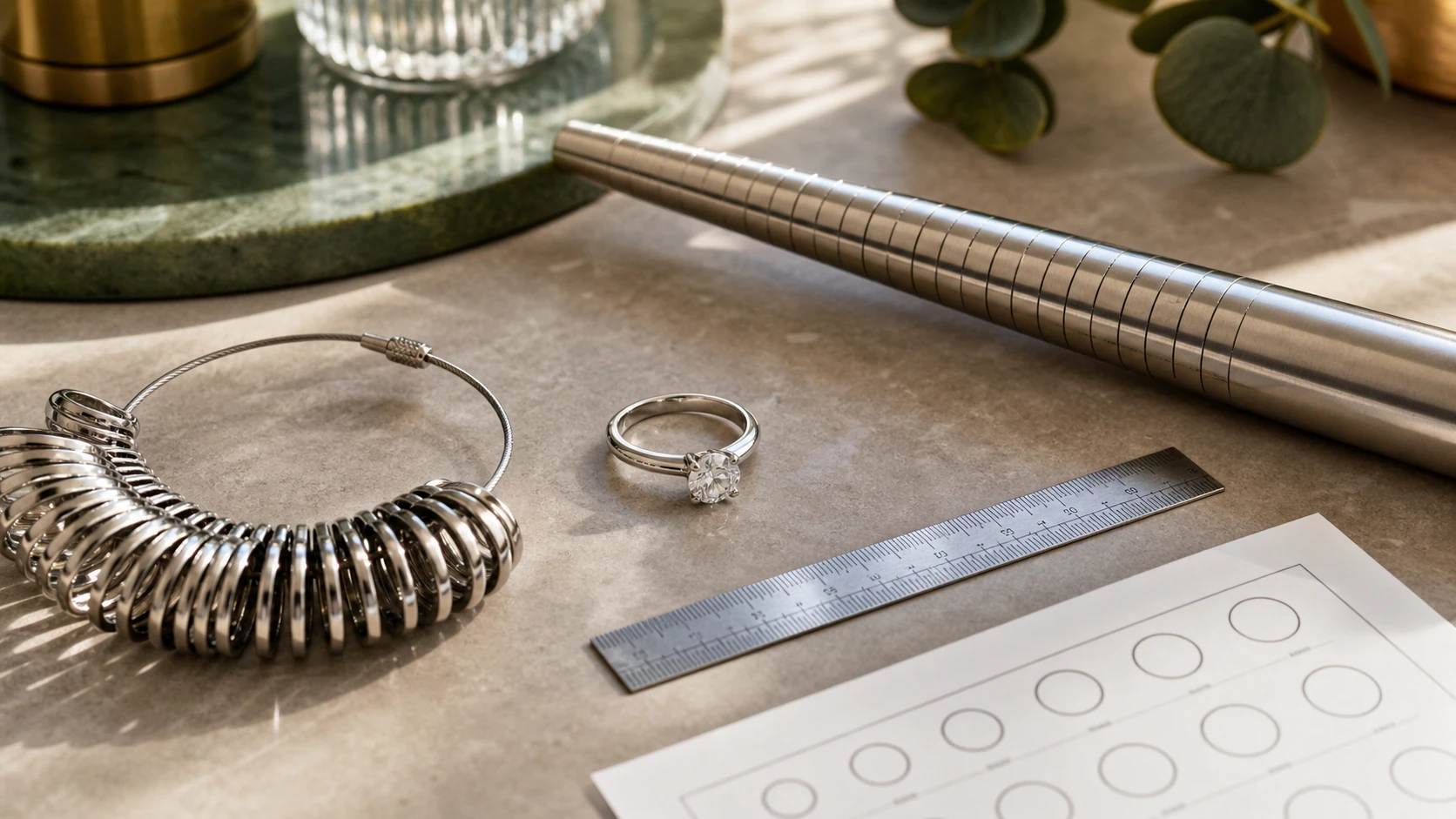
For a bespoke engagement ring or wedding band the sizing step should happen physically at the workshop with a metal sizer set, not via string-and-ruler. The string method is for orientation and surprise-purchase contingencies; commission accuracy needs the metal sizer.
Most Bedfordview workshops set aside 15 to 20 minutes at the start of the design appointment for sizing. The buyer (or the partner whose finger will wear the ring) tries on a graduated set of metal sizers, settling on the letter that fits snug-but-not-tight, with the sizer sliding off only with a slight effort. The workshop then casts the band at exactly that size, allowing for the 0.5-size shrinkage from rough casting to finished polish.
A Bedfordview wholesale-to-public workshop typically provides on-site sizing with a metal sizer set and includes one free resize within 30 days. Workshop pricing on bespoke commissions assumes accurate sizing at commission and any resize required outside the 30-day window is billed at standard workshop rate.
Full bespoke commissioning detail is in the wholesale primer and the corridor map at diamond jewellers in JHB.
- SA L
- = UK L = US 5.75 = European 51.0 = inner diameter 16.2mm = inner circumference 50.9mm. The single most-commissioned SA women's engagement-ring size at Bedfordview workshops.
- SA M
- = UK M = US 6.25 = European 52.2 = inner diameter 16.6mm = inner circumference 52.1mm. The runner-up volume size.
- SA N
- = UK N = US 6.75 = European 53.5 = inner diameter 16.9mm = inner circumference 53.3mm.
- SA O
- = UK O = US 7.25 = European 54.7 = inner diameter 17.3mm = inner circumference 54.4mm.
- SA P
- = UK P = US 7.75 = European 56.0 = inner diameter 17.7mm = inner circumference 55.7mm. The largest of the high-volume women's sizes; above SA P the order falls below 8 percent of women's commission volume at most SA workshops.
SA uses the Commonwealth A-Z lettering rather than the US 1-13 numeric, the single most common source of online-order mis-sizing for SA buyers commissioning from US-based bench jewellers. Cross-reference the European numeric (inner circumference in millimetres) on any cross-border order to eliminate the conversion-table drift entirely.
Common questions
What is the average ring size in South Africa?
For women, the average SA engagement-ring finger sits at size L to N (US 5.5 to 6.75, EU 51 to 54, 16.1 to 17.3 mm inner diameter). For men, the average wedding band sits at T to V (US 9.5 to 10.75, EU 60 to 64, 19.4 to 20.6 mm). These are central tendencies; individual variation by build, hand size, and finger profile is significant. The only reliable size is the one measured on the actual finger that will wear the ring.
Why does SA use letters instead of numbers for ring sizes?
The A-to-Z alphabetical convention is the British / Commonwealth standard inherited from the UK jewellery trade. It uses letters in 0.5 increments (J, J½, K, K½) corresponding to 0.4 mm circumference increments. South African, Australian, Irish, and UK jewellers use the same chart. The US numeric system (1 to 13.5 in 0.25 increments) and the EU/ISO numeric system (numeric circumference in mm) are different conventions. Most SA jewellers can read all three but quote in the SA letter format by default.
How accurate is the string-and-ruler measurement?
Accurate to within roughly one full SA size if done carefully, which is usually enough for first-time orientation but not for ordering a finished ring. The string method gives a circumference reading; converting to a sizer letter introduces a half-size of uncertainty. Bespoke commissions should always be physically sized with a metal sizer set at the workshop. Online ring-size kits posted from the workshop cost R0 to R150 and are typically accurate to within a quarter-size.
How much does ring resizing cost in South Africa in 2026?
R500 to R900 for a simple gold band resize up or down by one size, R900 to R1,500 for platinum, R1,500 to R2,500 for a ring with channel-set or pavé stones requiring stone removal and reset, R2,500-plus for complex eternity bands where the full setting needs reconfiguring. Most Bedfordview wholesale workshops include one free resize within 30 days of original commission as a courtesy. Mall-chain retailers typically charge full resize fees from day one but offer same-day or next-day turnaround.
When during the day should I measure ring size?
End of day, at normal room temperature, after the finger has been still for at least 10 minutes. Fingers swell during the day from heat and activity and shrink overnight; an end-of-day measurement gives the best central reading. Do not measure first thing in the morning (fingers are smallest), immediately after exercise (swollen), in extreme cold (constricted), or after alcohol or salty food (swollen).
Should I size up for winter or summer?
For an everyday wedding band that will be worn through both seasons, size for the larger reading (summer / warm), then accept the band feeling slightly loose in winter cold. The reverse, sizing for winter, causes the band to constrict uncomfortably or get stuck in summer heat. Typical SA seasonal variation is approximately 0.5 SA size, more for people who spend significant time outdoors in summer or who live at the coast.