
Guide
Platinum vs white gold engagement rings in SA
Platinum vs white gold engagement ring, South Africa: platinum near $1,660/oz, gold near $4,180/oz. The 2026 spot inversion that flips the standard advice.

Correction, 19 October 2026: earlier versions used platinum at $880 and gold at $2,035 an ounce and reported quotes from four Bedfordview workshops. The prices were out of date, there is no record of the quotes (two sets on the page contradicted each other), and a platinum ring weighs about a third more than the same ring in 18ct white gold, not 10 percent more. The figures now come from 19 October 2026 spot prices.
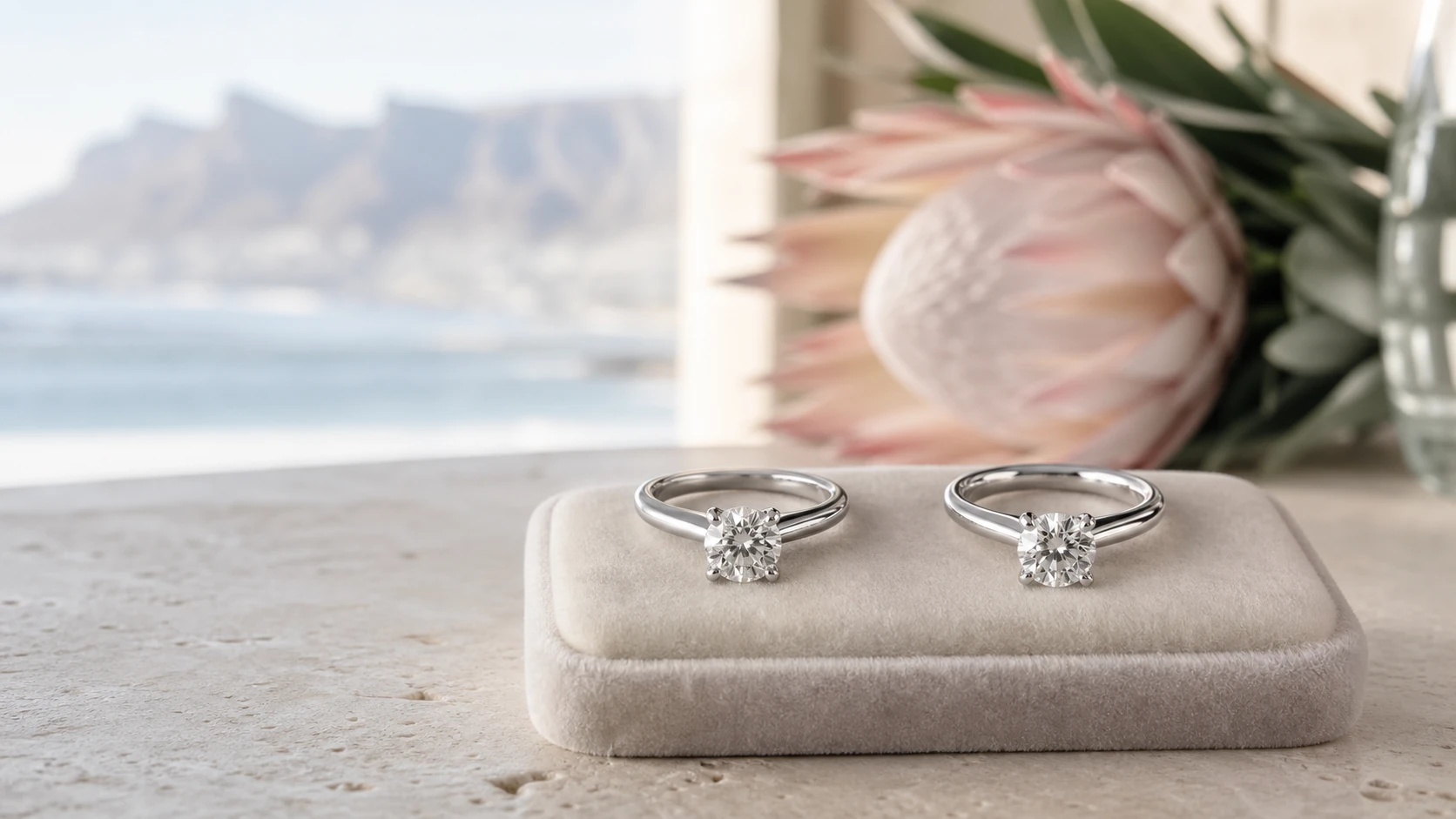
October 2026 spot prices and the inversion
On the morning of 19 October 2026 spot platinum was about $1,657 per troy ounce and gold about $4,184 per troy ounce. The ratio is roughly 2.5 to 1 in favour of gold, which is historically inverted: from the 1980s through 2008, platinum routinely traded at 1.2 to 2.0 times the gold price because of its industrial demand profile (catalytic converters, hydrogen-economy applications, chemical refining) layered on top of its smaller mined supply.
The inversion has been building since approximately 2015, when battery-electric vehicle adoption began reducing forward platinum demand from internal-combustion catalytic converters. Coupled with sustained gold demand from central-bank buying through 2022 to 2025, the spot ratio has moved decisively against platinum. For SA-cast jewellery in 2026, the practical consequence is that platinum is the cheaper raw-metal input for new commissions.
How long the inversion holds is a forecasting question, not a present-tense observation. Hydrogen-economy demand for platinum in proton-exchange membrane (PEM) fuel cells is rising; if it accelerates, platinum spot could re-converge with gold within 3 to 7 years. For an engagement-ring buyer commissioning today, the 2026 spot configuration is what matters.
Per-gram math: raw metal cost
Converting USD per troy ounce to ZAR per gram (1 troy oz = 31.1035 g, rand at R16.45/$, spot at 08:00 on 19 October 2026):
| Metal | USD/oz | ZAR/oz | ZAR/g (pure metal) | ZAR/g of alloy (metal content) |
|---|---|---|---|---|
| Platinum (Pt 950) | $1,657 | R27,258 | R876 | R833 |
| 18ct white gold (Au 750) | $4,184 (Au) | R68,825 (Au) | R2,213 (pure Au) | R1,660 (gold only) |
| 9ct white gold (Au 375) | $4,184 (Au) | R68,825 (Au) | R2,213 (pure Au) | R830 (gold only) |
Three observations from the table. First, a gram of platinum 950 (R833) carries half the precious-metal value of a gram of 18ct white gold (R1,660, before any palladium in the alloy). Platinum is denser, so the same ring weighs roughly a third more in platinum: per ring, platinum’s metal costs about two-thirds of 18ct white gold’s. Second, platinum 950 is nearly pure metal (95 percent platinum); 18ct white gold is 75 percent pure gold with 25 percent palladium / silver / nickel alloy and rhodium plating. Third, 9ct white gold carries about the same metal value per gram as platinum 950 (R830) but is far lighter, so it is the cheapest of the three by metal per ring, which is why 9ct is the budget-band engagement-ring metal in SA. The 9ct vs 18ct trade-off is documented in detail at 18ct vs 9ct gold in South Africa.
The raw-metal calculation does not yet account for fabrication, design complexity, stone setting, or workshop margin. A finished engagement-ring solitaire mounting typically uses 5 to 9 grams of metal depending on band width and head design.
What a mounting costs in metal
A mounting quote is metal, plus casting loss, labour and margin. Take a 6-prong solitaire mounting with a 2.0 mm band and a head sized for a 1.00ct centre stone at about 6 grams in 18ct white gold; the same mounting weighs about 8 grams in platinum 950 because platinum is denser, and about 4.6 grams in 9ct. At spot on 19 October 2026 that is roughly R10,000 of gold in the 18ct mounting, R6,700 of platinum in the platinum one and R3,800 of gold in the 9ct one. These are metal values worked from spot for an assumed weight, not workshop quotes.
Platinum costs more to cast and finish (it needs higher kiln temperatures and more skilled labour per hour), which narrows but does not erase the metal advantage. 9ct white gold carries the least metal of the three, which is why it dominates the under-R15,000 engagement-ring market in SA. The trade-off is durability and resale, covered in detail at 18ct vs 9ct gold in South Africa.
For current platinum pricing on a specific mounting, a Bedfordview wholesale-to-public workshop is the working reference point: these manufacturers quote against live metal spot on appointment, and a mounting quote is typically provided at no charge. Ask two or three workshops for the same specification to triangulate the current rand-per-gram loading.
Durability and maintenance over 20 years
Platinum and 18ct white gold are both well-suited to daily wear, but they age differently under sustained use.
Platinum is softer in surface hardness (Vickers 130 vs 18ct white gold 180) but tougher under impact. When platinum is scratched, the metal displaces rather than chipping off; the scratch shows as a surface dent that can be polished back without losing mass. When white gold is scratched, material is removed; over years of daily wear the band thins, claws weaken, and re-tipping becomes necessary every 8 to 12 years. Re-tipping cost at SA workshops in 2026: R600 to R1,200 per claw, typically four claws per solitaire.
Over a 20-year ownership horizon, a platinum solitaire typically requires one or two professional polish-and-recommission cycles (R900 to R1,800 each) and zero re-tipping. An 18ct white gold solitaire over the same period typically requires four to six rhodium re-platings (R450 to R900 each) and one to two re-tipping cycles (R2,400 to R4,800 each). The maintenance differential favours platinum by approximately R6,000 to R12,000 over the 20-year horizon.
The rhodium re-plating story
White gold is naturally yellowish; the bright-white appearance comes from rhodium electroplating applied at finishing. Rhodium is a hard, bright-white member of the platinum group metals, and the plating is approximately 0.75 to 2.0 microns thick. The plating wears off through daily abrasion, fastest on the inside of the band and at high-contact areas (the undercarriage, the inside of the claws).
Typical re-plating cadence in SA: every 18 to 36 months for an engagement ring worn daily. Some customers re-plate as a regular maintenance schedule; others wait until the yellowish underlying alloy becomes visible. Re-plating cost in 2026: R450 to R900 per ring at a Bedfordview workshop, R900 to R1,500 at a Sandton mall retailer.
Over 20 years that is R3,600 to R10,800 in re-plating cost alone, before considering re-tipping or polishing. Platinum never requires re-plating because the metal itself is naturally white. The maintenance saving is real and compounds over the ownership life.
For buyers who prefer the brighter-white aesthetic of freshly-plated white gold, the maintenance cost is an accepted trade-off. For buyers indifferent between the two whites, platinum eliminates the recurring cost.
What to commission in 2026
For an engagement ring or wedding band commissioned in South Africa in October 2026, this column recommends platinum, because of the spot inversion and the maintenance differential. Both factors favour platinum at present pricing.
Three caveats to that working recommendation:
- Aesthetic preference. Some buyers prefer the slightly brighter, cooler tone of freshly-rhodium-plated white gold to the slightly warmer, marginally darker tone of polished platinum. Both are white metals; the difference is subtle but visible side-by-side. Commission a workshop sample of each before deciding.
- Resale value. 18ct gold has a deeper resale market in SA because gold spot is more frequently quoted and gold buyers are more numerous. Platinum resale typically requires sending to a specialist refiner; the realised value relative to spot is similar but the friction is higher.
- Family ring history. If the wedding-band setup is matching an existing piece (a grandmother’s 18ct ring being passed down, a heritage signet), metal continuity often matters more than the spot-price arithmetic.
For first-time engagement-ring commissioning with no inheritance considerations and no strong aesthetic preference between the two whites: platinum in 2026, at current spot. For wedding-band sets matching existing pieces or for buyers who specifically want the brighter rhodium-plated finish: 18ct white gold remains a working choice.
Full corridor map of SA workshops is at diamond jewellers in JHB; ring sizing chart and resize cost is at ring size chart for SA.
Common questions
Is platinum more expensive than white gold for an engagement ring in SA in 2026?
Not currently, and that is the counter-intuitive 2026 story. On 19 October 2026 platinum spot was about $1,657/oz and gold about $4,184/oz. At R16.45 to the dollar, a gram of platinum 950 carries about R833 of platinum and a gram of 18ct white gold about R1,660 of gold. Platinum is denser, so the same ring weighs roughly a third more in platinum, but its metal still costs about two-thirds of the 18ct white gold equivalent. Fabrication and refining still add cost, but the platinum-is-more-expensive rule of thumb does not hold at current spot prices.
Why is platinum usually more expensive?
Three structural reasons. (1) Density: platinum is roughly 11 percent denser than pure gold (21.45 g/cm³ vs 19.32 g/cm³) and about a third denser than 18ct white gold, so a platinum ring of the same dimensions weighs roughly a third more. (2) Refining: platinum requires higher temperature and more specialised equipment to refine and cast than gold. (3) Fabrication: platinum is harder to work, requires more skilled labour, and tolerates fewer rework cycles. These add 30 to 60 percent to fabrication cost per gram. Under normal spot conditions these factors push the finished platinum ring 30 to 60 percent above 18ct white gold. The current inversion is because platinum spot has fallen relative to gold spot over the past decade.
Is platinum or white gold more durable?
Both are durable to different standards. Platinum is softer in surface hardness (Vickers 130 vs 18ct white gold 180) but tougher under impact and does not lose mass when scratched (the metal displaces rather than chipping off). White gold scratches show as material loss; platinum scratches show as surface dents that can be polished back. Over 20-plus years of daily wear, platinum settings retain mass and hold stones more securely; white gold settings lose mass and require more re-tipping and re-claw work.
Does white gold need re-plating?
Yes. White gold is naturally yellowish; the bright white appearance comes from rhodium electroplating applied at finishing and refreshed every 18 to 36 months at SA workshops. Re-plating cost in 2026: R450 to R900 per ring for a single solitaire, more for complex multi-stone settings. The plating wears fastest on the inside of the band and at high-contact areas (claws, undercarriage). Platinum is naturally white and never requires re-plating, which over 20 years of ownership saves R3,000 to R8,000 in maintenance cost.
What do SA Bedfordview workshops recommend in 2026?
This column’s recommendation for October 2026 is platinum, because of the spot inversion and the maintenance saving. For a customer commissioning a new engagement ring today at a Bedfordview workshop, platinum’s metal costs about two-thirds of 18ct white gold’s for the same ring, and it needs no rhodium re-plating across the ownership life. The conventional "platinum is the premium choice" rule of thumb that justified the higher price has flipped; in 2026 platinum is both the better-performing metal and the cheaper metal at current spot. The arbitrage will narrow as spot prices re-converge.
Can I tell platinum from white gold visually?
Not easily by eye, especially when both are freshly polished or freshly rhodium-plated. Reliable identification methods: (1) the metal stamp on the inside of the band (PT or 950 for platinum, 750 or 18K for 18ct gold, 375 or 9K for 9ct gold); (2) weight in the hand (platinum feels noticeably heavier); (3) acid-test or X-ray fluorescence at a JCSA-registered valuer (R200 to R450 single test). The stamp is the primary identification; never trust visual identification alone for a high-value purchase.