
Guide
How to read South African diamond jeweller reviews (2026)
Star ratings are a weak instrument for jewellery, and they flatten the real differences between SA chain-mall jewellers, independent retailers and the Bedfordview wholesale workshops. This is an editorial guide to what the recurring review themes are actually evidence of, what a score cannot tell you, and what to verify yourself before you buy. No ratings, no rankings, no endorsements.

What this page is
An editorial guide, not a survey. We did not count reviews, score them, or rank anybody, and there is deliberately no star average, review count or sentiment percentage anywhere on this page. Publishing one would imply a precision that a pile of online reviews cannot support, and it would compress a genuine three-way choice into a single misleading number.
What follows comes in three parts: why review scores mislead on jewellery specifically, the sentences that recur in jewellery reviews and what each one is actually evidence of, and how the three SA retail models differ in ways the reviews rarely make explicit. The models are described generically, without naming or recommending any jeweller. The judgment is yours. This page is the reading method, not the verdict.
Why star ratings mislead on jewellery
Review scores work reasonably well for restaurants and couriers, where the purchase repeats often enough for the average to mean something. Jewellery breaks most of those assumptions at once.
- The base rate is tiny. An engagement ring is a once-or-twice-in-a-lifetime purchase, so a jeweller accumulates reviews slowly. A handful of reviews moves the average a long way, which means the score is noisy in exactly the category where you would most want it to be stable.
- Reviews cluster at the extremes. People write when they are delighted or furious. The large middle, where most purchases actually land, stays silent and never enters the average.
- Asking is not the same as earning. A retailer that asks every customer for a review will out-score a workshop that never asks, independent of the work either of them did. The score partly measures who runs a review programme.
- Brand-level scores hide branch-level reality. A national chain score is an average across every branch, every salesperson and several years. You are buying from one branch, from one person, on one day.
- Reviews review the shopping, not the stone. This is the big one. Most reviewers are not equipped to grade a diamond or to benchmark its price, so what they can honestly report is how they were treated. A five-star service experience and a badly bought stone coexist comfortably.
- Reviews age badly against policy changes. An upgrade, exchange or sizing policy can be revised, and the reviews written under the old terms stay visible and keep counting toward the average long after the terms have moved.
The recurring themes, and what they actually mean
These are the sentences you will read again and again once you start going through SA jeweller reviews properly. None of them is attached to a brand here, because the point is what the sentence is evidence of, whoever it was written about.
Lovely staff, no pressure, felt looked after
Real information, but about one branch on one day with one salesperson. It tells you nothing about the stone, the grading or the price, and it does not necessarily transfer to the branch nearest you.
They sized it for free / they charged me to resize it
Sizing policies vary by retailer and are commonly limited rather than unlimited. This theme is usually not a dispute about honesty; it is a buyer who assumed a lifetime benefit meeting a policy that granted one sizing. Settle it in writing before you pay, not after.
The upgrade policy is brilliant / they would not honour my upgrade
Upgrade and exchange programmes are contracts written by the brand, and the flashpoints are almost always the same two. What value gets credited (the price originally paid, or what the stone is worth now), and what the credit can be spent on (typically another purchase from the same brand, which is what makes it a brand programme rather than cash). Ask both questions before you buy, and ask what happens if the terms are revised afterwards.
The website said it was in stock
In multi-branch retail the catalogue and the shop floor are different systems. This is a logistics theme, not an integrity theme. Phone the specific branch and have someone confirm the specific piece is physically there before you travel.
Nobody remembered me on the second visit
Continuity is a function of staff turnover, and a high-value purchase usually runs across several visits. There is nothing to verify here, just something to price in: get the terms in writing rather than relying on a relationship with one person.
It was cheaper elsewhere for exactly the same stone
The most common price theme in every channel, and more often a distribution-model difference than an overcharge. It is also the only theme on this list you can settle objectively rather than argue about: take the carat, colour, clarity, cut and certificate number, and quote the identical specification somewhere else.
The bespoke piece took much longer than promised
Bespoke work queues behind other work, and lead times move with the season. Read this theme for the gap between the promise and the delivery rather than for the length itself. If a date is load-bearing (a proposal, a wedding, an anniversary) get the lead time in writing with that date on it.
It is a signature or proprietary cut
A proprietary cut is a design owned by one brand. That is not a quality claim in either direction, but it does narrow the resale market structurally: a standard round brilliant can be priced by any dealer against published benchmarks, while a branded design is most easily valued by the brand that made it. If you may resell, know which of the two you are buying.
A review alleging the stone was not as described
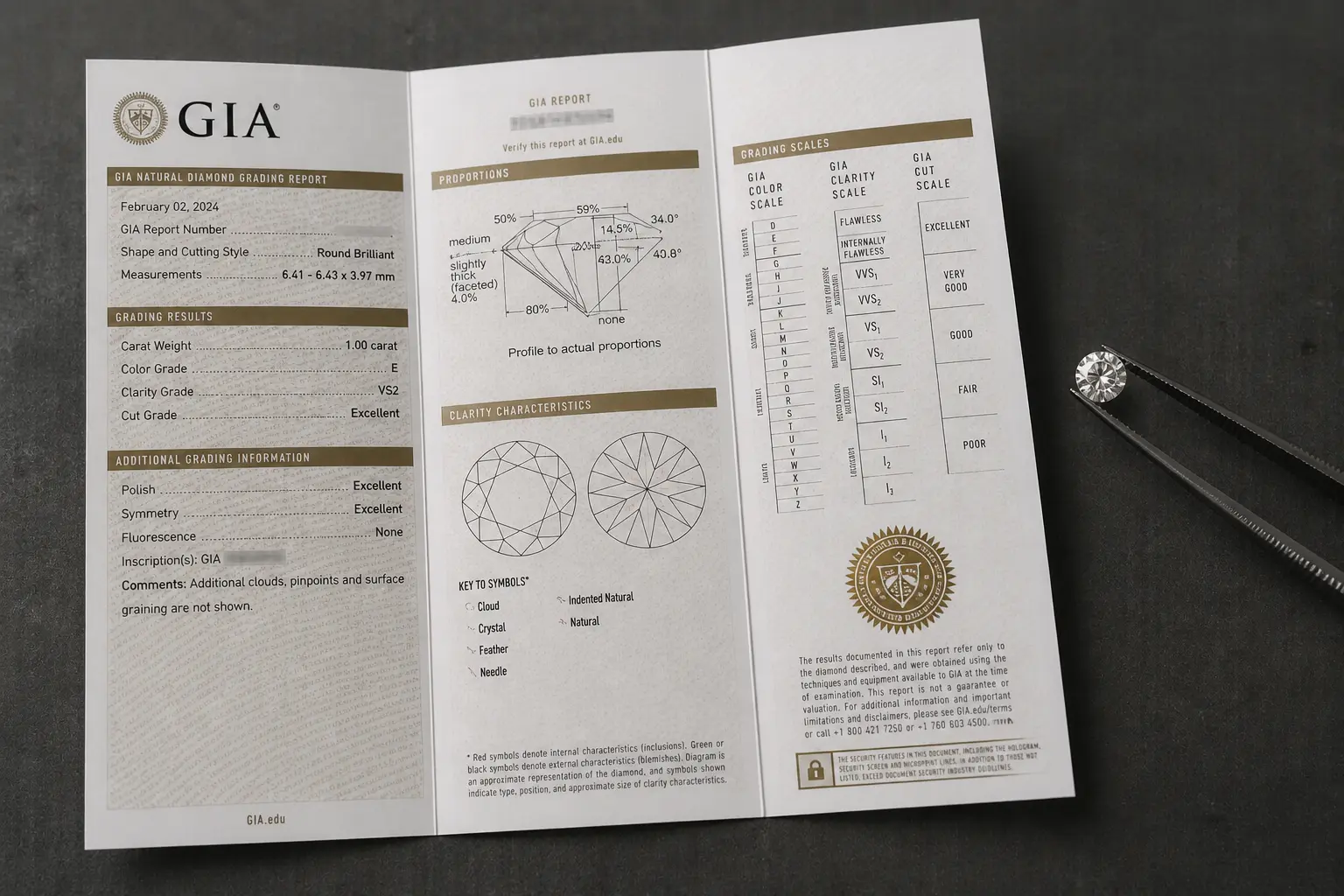
The one theme to take seriously immediately, and also the one that a document settles rather than a debate. Check the report number yourself on the grading laboratory verification page, and check that the report details match the stone described on the invoice.
Where the SA channels actually differ (retail model, not quality)
The reviews rarely make this explicit, which is why buyers so often compare two jewellers that were never really competing for the same job. The three models below sell diamonds in genuinely different ways, and each trade-off is a real one. The label under each heading describes who operates that model, which is a description of retail format and nothing more.
Chain mall retail
- National jewellery chains
- Multi-branch mall retailers
Walk in without an appointment, try on floor stock, pay with store credit or lay-by, and deal with a national brand that has a branch near you and a head office to escalate to. The price carries every step between the cutter and the counter, plus mall rent and a national store and marketing footprint.
What buyers commonly raise
- What the brand upgrade or exchange programme actually credits, and what the credit can be spent on.
- Whether the online catalogue matches the floor stock at the branch the buyer travelled to.
- What happens on the second and third resize, once the first one is used up.
- Continuity, when the salesperson from the first visit has moved on by the third.
The trade-off: Convenience and brand recourse, weighed against price and against how portable the stone is on the open market.
Independent retail
- Prime-location independents
- Single-city ateliers with a workshop
A narrower and more curated range than the chains carry, often with a workshop attached, and usually the same person across your visits. Footprints are small, sometimes a single city, and prime-location rent sits in the price the same way it does at the malls.
What buyers commonly raise
- Stock depth at the top of the range, and lead times when a piece has to be ordered in or made.
- Bespoke lead times measured against the date that actually matters.
- Whether a signature or proprietary design will be straightforward to value later.
- Location, because an independent may simply not have a branch in your city.
The trade-off: Curation, continuity and workshop access, weighed against a smaller footprint and stock depth that varies by branch.
Wholesale-to-public workshop (the Bedfordview corridor)
By appointment. You bring a specification (carat, colour, clarity, cut, fluorescence, certificate) and the workshop sources to it, with fewer steps between the cutter and the buyer than a mall chain has to carry. There is no floor to browse and no brand programme to join.
What buyers commonly raise
- The appointment itself, which is friction for buyers used to walking into a mall on a Saturday.
- Geography, because the corridor is in Johannesburg, which is a flight for Cape Town and Durban buyers.
- The homework, because the model rewards a prepared buyer and arriving without a spec or a budget makes for a long appointment.
The trade-off: Specification control and fewer intermediaries, weighed against no walk-in browsing and the preparation the format assumes.
Four checks before you buy, whatever the channel
- The certificate, in your hand, verified at the lab. GIA, IGI, EGL, SGL or HRD, physically present at the counter rather than promised to follow. Check the report number on the grading laboratory website, not on the printout you were handed.
- The SADPMR licence number on the invoice. Diamond dealing in South Africa is licensed. The number belongs on the paperwork. See the SA licensed dealer verification index.
- The sizing and resizing policy, in writing. Some retailers include later sizings and some charge workshop rates for them. This is cheap to establish before you pay and awkward to argue after.
- The upgrade or trade-in position, in writing. If there is any chance of swapping or selling within five years, establish what value would be credited and what the credit could be spent on.
Where to read the actual reviews
This column does not republish other people’s reviews and does not compress them into a score. Read them at source: Hellopeter for SA consumer complaints and, more usefully, for how the business responded to them; the Google Business Profile for the specific branch you plan to visit rather than for the brand as a whole; and Trustpilot where the retailer keeps a profile. One habit worth forming: read the middle reviews first. One-star and five-star reviews tell you about the incident and the mood. The three-star reviews are usually where the detail and the qualifications live.
Common questions
Does this page rate, rank or score SA jewellers?
No. This page runs no review study, publishes no scores, and ranks nobody. There is no star average, no review count and no sentiment percentage anywhere on it, because we did not conduct a review survey and will not imply that we did. Ranking SA jewellers on a single dimension would also flatten a real three-way choice (chain-mall convenience, independent-retail curation, wholesale-to-public specification) into one misleading number. Our editorial policy is observation rather than endorsement: we publish what a reader can go and verify, not a verdict they have to take on trust. So what you get instead is the reading method: why review scores are a weak instrument for jewellery, what the recurring review themes are actually evidence of, and how the three SA retail models differ. For real reviews of a specific jeweller, read them at source on Hellopeter, on the Google Business Profile for the specific branch, or on Trustpilot, and apply the method here.
Can I trust Hellopeter or Google ratings for a jeweller?
Treat them as evidence about service, not about stones. They are genuinely useful for one thing: seeing how a business behaves when something goes wrong, which is worth knowing before a high-value purchase. Neither can tell you whether a diamond is correctly graded or fairly priced, because most reviewers are not in a position to judge either. A grading certificate answers the first question and a comparison quote answers the second. Also check that the reviews are about the branch you will actually visit, since a national brand aggregates across branches, staff and years.
Which channel should I buy from?
That depends on the piece and on what you want to optimise for. The chain-mall channel optimises for convenience: walk in, try on, use store credit, and lean on a national brand for recourse. The independent-retail channel optimises for curation and continuity: a narrower and more distinctive range, usually with the same person across visits. The wholesale-to-public channel optimises for specification: an appointment, a stone sourced to your brief, and fewer steps between the cutter and the counter. One piece of arithmetic is worth holding onto: a percentage difference between channels is worth more rand at a higher budget, so the more you are spending, the more a comparison quote is worth the hour it costs you. Do not settle it by trusting a channel, or this column. Take the exact specification and quote it in more than one.
Are the chain stores worse than the Bedfordview workshops?
Not worse, different. The chain stores carry stock you can walk in and try on without an appointment; the workshops source to spec on appointment. Where a brand runs its own upgrade or exchange programme, the credited value is typically redeemable only against another purchase from that same brand, which is what makes it a brand programme rather than cash. And a chain retail price has to carry every step between the cutter and the counter, plus mall rent and a national footprint, where a wholesale-to-public workshop carries fewer of those steps. None of that is a quality difference. They are differences in distribution model and shopping format, and the right channel matches the priorities of the buyer rather than a universal ranking.
What should I check before buying from any of these jewellers?
Four checks, whatever the channel. First, the certificate (GIA, IGI, EGL, SGL or HRD) physically present at the counter rather than promised to follow, with the report number checked on the grading laboratory website rather than on the printout in front of you. Second, the SADPMR licence number on the invoice template. Third, the sizing and resizing policy in writing, because some retailers include later sizings and some charge for them. Fourth, the position on upgrade or trade-in value in writing, if there is any chance you will swap or sell within five years. See the SA licensed dealer verification index for the verification protocol, and how to read a diamond invoice for the paperwork itself.
How often is this page updated?
Twice a year, with the next scheduled review in November 2026. The reading method changes slowly. The specifics of any individual jeweller (policy terms, branch footprint, floor staff, lead times) change considerably faster than a column can track them, which is the main reason this page publishes a method rather than per-jeweller findings: a finding would be stale before it was useful, and a stale finding about a named business is worse than no finding at all. Verify current terms with the jeweller directly. If something here is wrong or out of date, email corrections@diamondedit.co.za.