
Guide
Eternity ring in South Africa: anniversary guide
Eternity ring in South Africa, anniversary guide: what to buy at each milestone in 2026 rands, the half vs full debate, and why sizing matters more here.

Where the eternity ring tradition came from
The eternity ring as a recognised anniversary gift category is a relatively modern construction. The phrase “eternity ring” circulated in jewellery trade contexts from the 1920s but the cultural placement of the eternity ring as an anniversary milestone gift dates to a 1960s diamond-industry marketing campaign, run alongside the more famous “diamond is forever” engagement-ring campaign. The eternity ring marketing targeted couples at the 10-year and 25-year anniversaries, framing the continuous diamond band as a symbol of unbroken commitment.
The category reached SA via the diamond industry’s presence in the Johannesburg market through the 1970s and 1980s and is now an established part of SA anniversary gifting in upper-middle and upper-income households. Our column receives 3 to 5 eternity-ring queries per month from SA readers, with frequency peaking in September and February (planning windows for anniversaries clustered around the spring and autumn wedding seasons).
Half-eternity vs full-eternity
The single most-important decision before commissioning any eternity ring. The two styles look superficially similar from the top view but have radically different long-term properties.
Half-eternity ring: diamonds (or other gemstones) set around roughly the top half of the band, typically the upper 50 to 60 percent that is visible when worn. The underside is plain metal (often the same metal as the band shoulders, sometimes with a comfort-fit interior). Practical advantages: the plain metal section gives a bench jeweller access to resize the ring later by cutting and resoldering the band; the smooth underside is more comfortable for daily wear; the ring stacks cleanly with an engagement ring without the underside diamonds rubbing against adjacent bands.
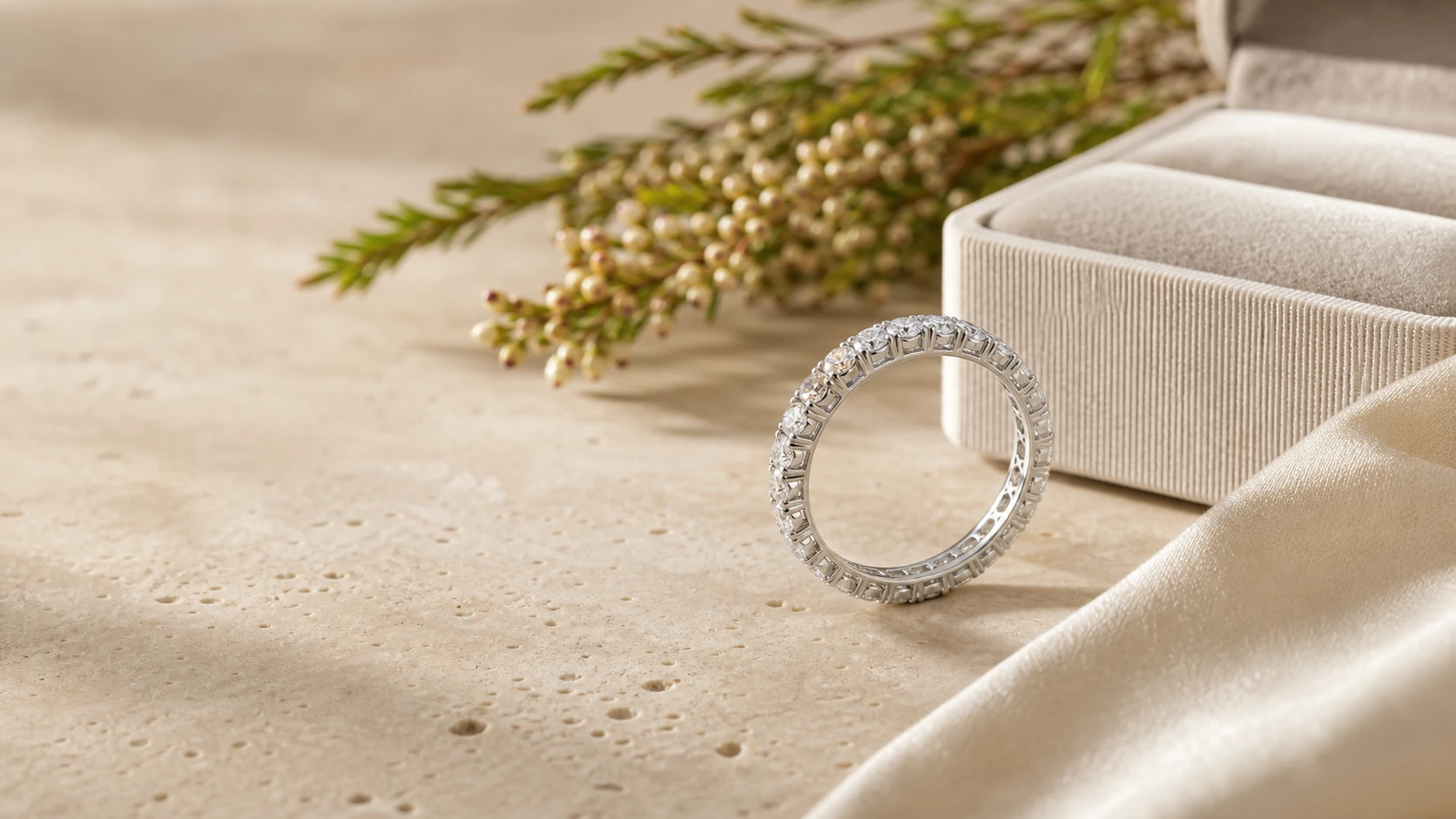
Full-eternity ring: diamonds set continuously around the entire circumference of the band. Visual advantage: the diamonds remain visible from every angle, including when the wearer rotates the hand or when the ring shifts on the finger. Practical disadvantages: cannot be resized in any cost-effective way; the underside diamonds rub against the finger and against adjacent bands, requiring more frequent cleaning and occasional re-tipping of stones; the band thickness must be greater to accommodate the stone-set underside, which can make the ring less comfortable for daily wear.
Working recommendation. For first-time eternity-ring buyers under age 50 (where ring size may still shift due to weight, hormonal changes, or age), half-eternity is the safer default. For 25th-anniversary or later milestones where the wearer’s ring size has stabilised and where the visual statement is the priority, full-eternity is reasonable but only after a proper sizing appointment with a wide sizing-gauge that tests the ring at finger temperature.
Anniversary pricing in May 2026
| Anniversary | Entry | Mid | Upper | Typical style |
|---|---|---|---|---|
| 1st | R5,000 | R9,000 | R15,000 | Slim half-eternity |
| 5th | R10,000 | R18,000 | R30,000 | 5 to 7-stone half-eternity |
| 10th | R25,000 | R45,000 | R75,000 | Full eternity or 3-stone |
| 25th | R50,000 | R100,000 | R200,000+ | Statement diamond or coloured stone |
What works at each milestone
1st anniversary (R5,000 to R15,000). A slim half-eternity in 9kt or 14kt white gold (platinum is unusual at this bracket) with 5 to 9 small diamonds in the 0.02 to 0.05ct each range. Total diamond weight roughly 0.20 to 0.35ct across the band. Channel-set is the practical default. Reads as understated, suits daily wear, and stacks neatly with the wedding band.
5th anniversary (R10,000 to R30,000). A 5 to 7-stone half-eternity with larger individual stones (0.08 to 0.15ct each) or a classic 7-stone half-eternity at finer spec. Platinum becomes the standard metal at this bracket. Total diamond weight roughly 0.50 to 1.00ct. Channel-set or shared-prong both work; shared-prong gives more brilliance, channel-set more durability.
10th anniversary (R25,000 to R75,000). Two competing structures. (1) A full eternity band with 15 to 25 small diamonds (0.05 to 0.10ct each) at platinum specification; total diamond weight 1.00 to 2.50ct. (2) A 3-stone ring with a larger centre diamond (0.50 to 1.00ct) flanked by two smaller side stones; the 3-stone format pulls visual weight comparable to a small engagement ring and has gained share in SA since 2022 as an alternative to the full-eternity format.
25th anniversary (R50,000 to R200,000+). Statement territory. Three working directions: (a) a statement diamond eternity in 1.5 to 3ct total weight with larger individual stones (0.15 to 0.25ct each); (b) a coloured-stone eternity (sapphire, emerald, or ruby) with diamond accents; (c) a single statement diamond solitaire as an upgrade to the original engagement ring (the “upgrade” conversation that some couples have at 25 years). The upper-bracket commissions in this category are increasingly going to bespoke workshops rather than to retail.
The sizing problem nobody mentions
Engagement rings are usually given at a known current ring size; the proposer often steals a current ring from the future fiancée’s jewellery box for sizing, or asks her sister or mother for the size. Eternity rings are different: they are given at anniversary milestones, often 5, 10, or 25 years after the original wedding band was sized, and the wearer’s ring size has frequently shifted.
Causes of ring-size shift over a multi-year horizon: weight change (gain or loss of 5kg can shift ring size by half a size in either direction), hormonal change (pregnancy, perimenopause, menopause all shift finger size, often permanently), age-related changes in finger size (post-50 fingers can either thin or thicken depending on individual physiology), arthritis and knuckle changes (can require a larger size to clear the knuckle even if the finger base is unchanged).
Working protocol for a full-eternity commission. Schedule a sizing-gauge appointment at the workshop where the wearer is present and the ring is sized at finger temperature (cold fingers measure smaller; warm fingers measure larger). Use a wide sizing gauge (the type with 3 to 4mm width) rather than a narrow wire gauge, because full-eternity bands are physically wider than wedding bands and the sizing is different. Confirm the size in writing before the commission proceeds. The cost of a remake if the full-eternity size is wrong is typically 60 to 80 percent of the original commission cost; the cost of a sizing appointment is zero.
Channel-set vs claw-set
Two dominant setting styles in SA in 2026. Each has trade-offs.
Channel-set. The stones sit in a continuous metal channel cut into the band, with no individual prongs. The channel sides protect the stone edges from snagging on clothing or knocking against surfaces. Lower profile, more comfortable for daily wear, easier to clean, slightly less brilliance return because the channel sides shadow the stones from peripheral light. The practical default for active wearers, mothers of young children, and anyone in healthcare or hospitality work where snagging is a risk.
Claw-set (shared-prong). Each stone is held by small claws shared between adjacent stones (typically 4 claws per stone, with each claw shared between two adjacent stones). Higher profile, more brilliance return because the stones are more exposed to light from all angles, but slightly more snagging on clothing, slightly more upkeep (claws need periodic re-tipping every 5 to 10 years), and a slightly higher risk of stone loss if a claw fails. The aesthetic default for buyers prioritising sparkle and the diamond-forward visual.
Where to commission an eternity ring in SA
For a bespoke commission, the working route is a Bedfordview wholesale workshop on appointment. The workshop sources the stones to spec, schedules a sizing-gauge appointment (essential for full-eternity), and turns the commission in 3 to 6 weeks for a half-eternity or 4 to 8 weeks for a full-eternity (the extra time reflects the additional stone-setting work on the full band).
Some cutting houses in the Bedfordview corridor run a wholesale-to-public model on appointment and handle eternity-ring commissions across the half-eternity and full-eternity formats, with the sizing-gauge appointment built into the standard commission protocol.
For pre-set retail eternity bands, mid-tier independent jewellers at Hyde Park Corner and Melrose Arch carry curated selections in the R8,000 to R45,000 bracket; the diamond quality at the independent level is typically VS2 or better with platinum standard. Chain mall jewellers stock entry-bracket half-eternity bands at R3,000 to R12,000 but the diamond quality is typically SI2 or lower, the metal is often 9kt rather than 18kt or platinum, and the setting work is mass-produced rather than hand-finished. For an eternity ring intended for 20+ years of daily wear, the chain-mall bracket is rarely the right choice; the small upfront saving converts into recurring repair and re-tipping costs.
Common questions
What is the difference between a half-eternity and a full-eternity ring?
A half-eternity ring has diamonds (or other gemstones) set around roughly the top half of the band, with the underside plain metal. A full-eternity ring has diamonds set continuously around the entire circumference of the band. The critical practical difference: a half-eternity ring can be resized by a jeweller (the plain metal section gives the bench access to cut and resolder the band); a full-eternity ring cannot be resized without removing and resetting stones, which is rarely cost-effective and risks damaging the smaller stones. Half-eternity also tends to be more comfortable for daily wear because the underside is smooth.
Why does sizing matter more for eternity rings than for engagement rings?
Two reasons. First, the resizing problem above: a full-eternity ring cannot be practically resized, so the size must be right at the original commission. Second, eternity rings are typically given at anniversaries (5th, 10th, 25th), often years or decades after the original wedding band was sized, and the wearer’s ring size may have shifted due to weight change, hormonal change, pregnancy, or age-related changes in finger size. Engagement rings are usually given at a known current ring size; eternity rings are often given based on an outdated wedding-band size that the wearer’s finger no longer matches.
How much should I spend on an eternity ring for our anniversary?
No fixed rule. Working brackets in SA in 2026 (these reflect what readers actually spend, not what they should spend): 1st anniversary R5,000 to R15,000 for a slim half-eternity; 5th anniversary R10,000 to R30,000 for a 5 to 7-stone half-eternity; 10th anniversary R25,000 to R75,000 for a full eternity or a 3-stone ring; 25th anniversary R50,000 to R200,000+ for a statement diamond or coloured-stone eternity band. The bracket scales with household income rather than years married; lower-income households may spend less even at higher milestones, and the gift remains meaningful at any bracket.
Can I add stones to an eternity ring later?
Sometimes. A half-eternity ring can usually have additional stones added at the next milestone anniversary (10th, 25th) by extending the diamond section further around the band; this is a common SA workshop commission and typically costs R3,000 to R8,000 plus the additional stone cost. Converting a half-eternity to a full eternity is sometimes possible but the workshop needs to inspect the band integrity and the original stone-setting style. A full eternity cannot be extended; it is already continuous, and any further enhancement is typically a separate stacked band rather than a modification of the original.
What stone setting is best for an eternity ring?
Two dominant styles in SA in 2026. Channel-set: the stones sit in a continuous metal channel cut into the band, with no individual prongs. Lower profile, more comfortable for daily wear, slightly less brilliance return because the channel sides shadow the stones. Claw-set (sometimes called shared-prong): each stone is held by small claws shared between adjacent stones. Higher profile, more brilliance return because the stones are more exposed to light, but slightly more snagging on clothing and slightly more upkeep. The choice is personal preference and tied to daily-wear style; channel-set is the more practical choice for active wearers.
Where do I commission an eternity ring in SA?
For a bespoke commission, the working route is a Bedfordview wholesale workshop on appointment. The workshop sources the stones to spec (typically 5 to 25 small diamonds depending on band style), confirms ring size with a sizing-gauge appointment (essential for full eternity), and turns the commission in 3 to 6 weeks. Mid-tier independent jewellers at Hyde Park Corner and Melrose Arch carry pre-set eternity bands at the R8,000 to R45,000 bracket. Chain mall jewellers stock entry-bracket half-eternity bands at the R3,000 to R12,000 bracket but the diamond quality is typically SI2 or lower and the setting work is mass-produced.