
Guide
Selling a diamond ring in Johannesburg
Sell a diamond ring in Johannesburg: four working routes, ranked by value-recovery. What each pays, what each costs in time and friction.

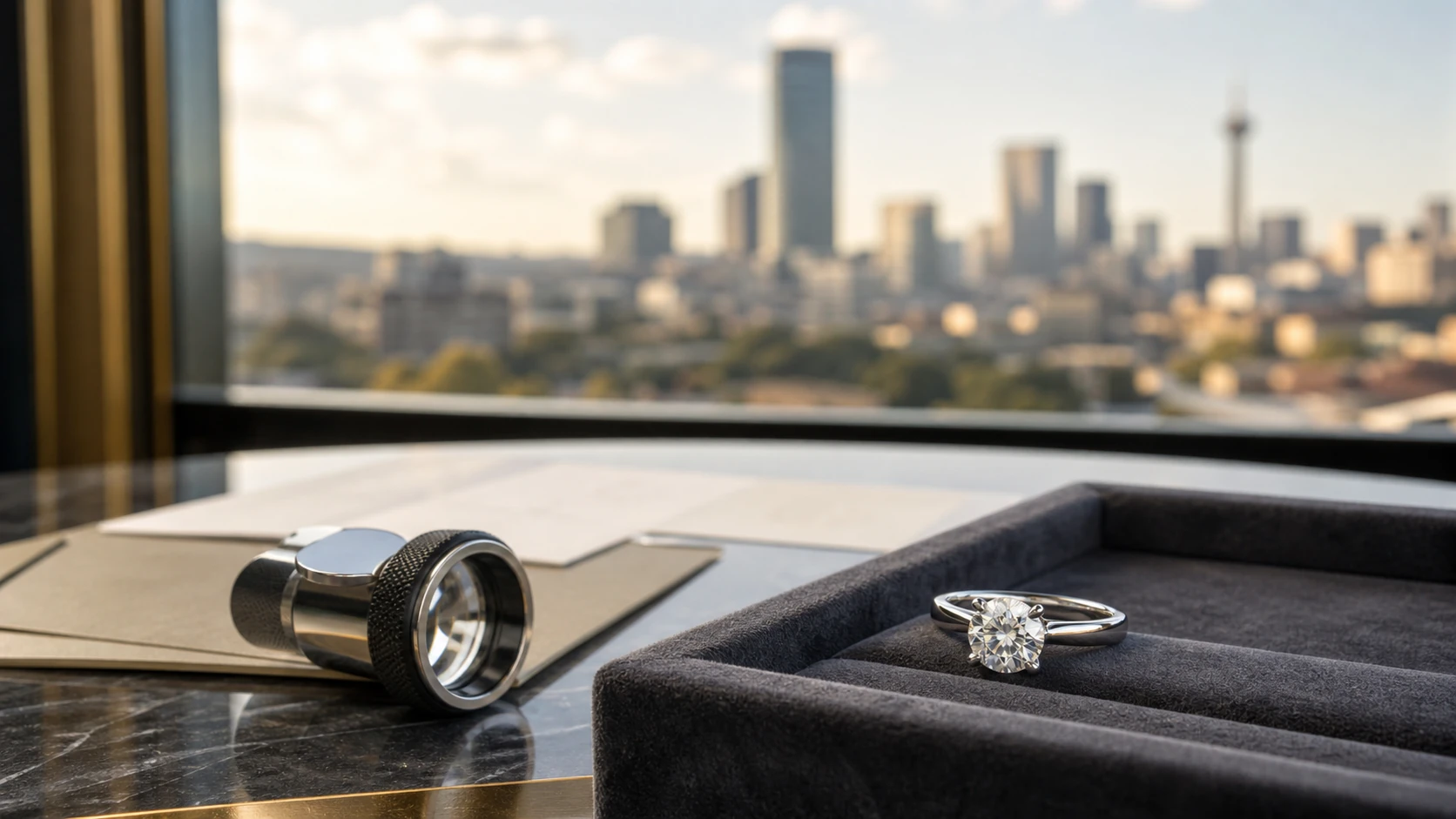
The four routes, ranked
| Route | % of original retail | Time | Best for |
|---|---|---|---|
| Private resale via network referral | 30 to 45% | 4 to 12 weeks | Highest value-recovery, patient sellers |
| Trade-in upgrade at original wholesaler | 40 to 60% of original wholesale price | Immediate | Upgrading to a larger stone, only if originally Bedfordview-purchased |
| Auction (major SA auction house) | 35 to 55% | 6 to 12 weeks | Premium pieces above R150,000 original value |
| CBD same-day cash-buyer | 15 to 35% | Same day | Urgent liquidity, accept lower recovery |
Route 1: Private resale via referral
The highest value-recovery route. Private buyers in SA (typically married couples upgrading, family members buying for a wedding, or investment-grade resale buyers) pay closer to true wholesale-tape value than any commercial channel because they capture the entire wholesale-to-retail spread that the original purchaser paid into.
The friction: finding the private buyer. Referral networks run through jewellers, insurance brokers, divorce attorneys (a substantial portion of the SA diamond resale market is post-divorce), and family connections. A Bedfordview manufacturer with an existing relationship will often facilitate the introduction in exchange for a small commission (typically 3 to 5 percent of sale value) or in exchange for setting the resold stone in a new commission.
Route 2: Trade-in upgrade at original wholesaler
If the original ring was purchased from a Bedfordview wholesale manufacturer, most workshops offer trade-in upgrade credit on the original stone applied against a new commission. Recovery is typically 40 to 60 percent of original wholesale purchase price, applied as immediate credit against a new piece.
The economics favour both sides: the wholesaler retains the customer relationship and gets the original stone back into inventory at a known cost; the buyer captures higher recovery than at any cash-out channel and gets the upgrade they want. Bedfordview wholesale-to-public workshops routinely accept trade-in upgrades on stones they originally supplied.
Route 3: Auction houses
The major SA auction houses, and selective international houses for premium pieces above R500,000, operate periodic jewellery auctions in Johannesburg and Cape Town.
Mechanics: stone is consigned 4 to 8 weeks ahead of auction, photographed and catalogued, displayed at preview viewing, sold via live auction with reserve. Hammer price plus buyer’s premium (15 to 25 percent) typically lands at 35 to 55 percent of independent valuation. Seller pays consignment commission (10 to 20 percent of hammer price) plus catalogue and insurance fees.
Auction works best for pieces above R150,000 original value, where the audience of competing bidders justifies the cataloguing cost. Below R150,000 the auction route is typically inefficient.
Route 4: CBD same-day cash-buyer
The lowest value-recovery, highest speed. Cash-buyer operators in the CBD (predominantly along Kerk Street, Marshalltown, and Pritchard) and selective “diamond exchange” storefronts pay 15 to 35 percent of independent valuation, typically with same-day cash settlement.
The economics: cash-buyer operators take on the full resale risk and the speed-to-cash burden. They typically resell either into the second-hand retail market (at 50 to 80 percent of independent valuation) or into the scrap-metal pipeline for melt-value on the band plus stone-recovery for resetting. Their margin funds the rapid settlement.
Right route if speed of conversion to cash is the priority over value-recovery. Wrong route if there is any time horizon over 1 to 2 weeks.
Before listing or walking in
- Get an independent valuation. A Jewellery Council of South Africa registered valuer assesses the stone against the original certificate, current condition, and replacement-retail market. R450 to R900 typical. Without it you are negotiating blind.
- Locate the original GIA report and the original purchase invoice. Both documents materially improve recovery at every route.
- Have the stone professionally cleaned before showing it. R250 to R500 at any working jeweller. A clean, well-presented stone shows substantially better than one with built-up wear residue.
- Decide your time horizon and minimum acceptable price. Different routes match different combinations.
- For high-value pieces, get two independent valuations from different valuers to triangulate true market.
The valuation question, specifically
Replacement-retail valuation (what an insurer would pay to replace the ring) and resale-market value (what a willing buyer would pay today) are not the same number. The replacement-retail figure is typically 30 to 60 percent higher than the resale-market figure, because insurance pricing assumes purchase through a chain retail channel.
Working principle: insurers care about replacement-retail; sellers should plan against resale-market. A R250,000 ring with a R250,000 insurance valuation typically commands R75,000 to R110,000 at private resale, not R250,000 (which would require a buyer willing to pay full retail in the secondary market, which essentially does not happen).
Common questions
Where can I sell my diamond ring in Johannesburg?
Four working routes ranked by typical value-recovery. (1) Private resale through a network referral: 30 to 45 percent of original retail purchase price, 4 to 12 weeks. (2) Trade-in or upgrade at the original wholesale workshop: 40 to 60 percent of original wholesale purchase, immediate, only if original purchase was from a Bedfordview manufacturer. (3) Auction through a major SA auction house: 35 to 55 percent of independent valuation, 6 to 12 weeks including auction cycle. (4) Scrap or cash-buyer operators in the CBD: 15 to 35 percent of valuation, same-day cash.
How much will I get for my diamond ring in South Africa?
Depends on five factors: (a) original purchase channel (retail vs wholesale), (b) certificate status (GIA vs in-house), (c) carat band (sub-1ct stones recover proportionally less), (d) condition of the stone and setting, (e) selling channel chosen. A 1.00ct GIA G/VS2 originally purchased retail for R250,000 typically recovers R75,000 to R110,000 at private resale, R100,000 to R150,000 as trade-in upgrade credit, R85,000 to R135,000 at auction, and R40,000 to R85,000 at a same-day cash-buyer.
Do I need a valuation before selling my diamond ring?
Yes. An independent valuation by a Jewellery Council of South Africa registered valuer (R450 to R900 typical cost) establishes the actual stone’s current replacement-retail value and serves as a baseline against any offer. Without it, you are negotiating blind. Most buyers will commission their own valuation as part of the purchase process; having yours in hand sets the conversation floor.
Is it safe to sell a diamond ring online in South Africa?
Conditionally. Established online platforms with escrow protection are workable for verified GIA-certified stones. Working safeguards: never ship the ring before payment clears, use a third-party escrow service, document the stone with high-resolution photographs and the GIA report before dispatch, use insured courier with declared-value cover. Private classifieds without escrow (Gumtree, Facebook Marketplace) carry meaningfully higher risk and are typically not the right channel for high-value diamond rings.
Can I sell to a Bedfordview wholesaler in Johannesburg?
Yes if the wholesaler has a relationship with you (typically as the original supplier of the stone). Most Bedfordview manufacturers offer trade-in upgrade credit on stones they originally sold, at 40 to 60 percent of original wholesale purchase price applied against a new commission. Some wholesalers will accept cold-walk-in sales but typically at lower recovery (25 to 40 percent) than for relationship customers, because they take on full resale risk.