
Guide
Tanzanite price per carat in South Africa
Tanzanite price per carat in South Africa: mined only in northern Tanzania, sold at SA airports at 3 to 5 times the source price. What you should actually pay.

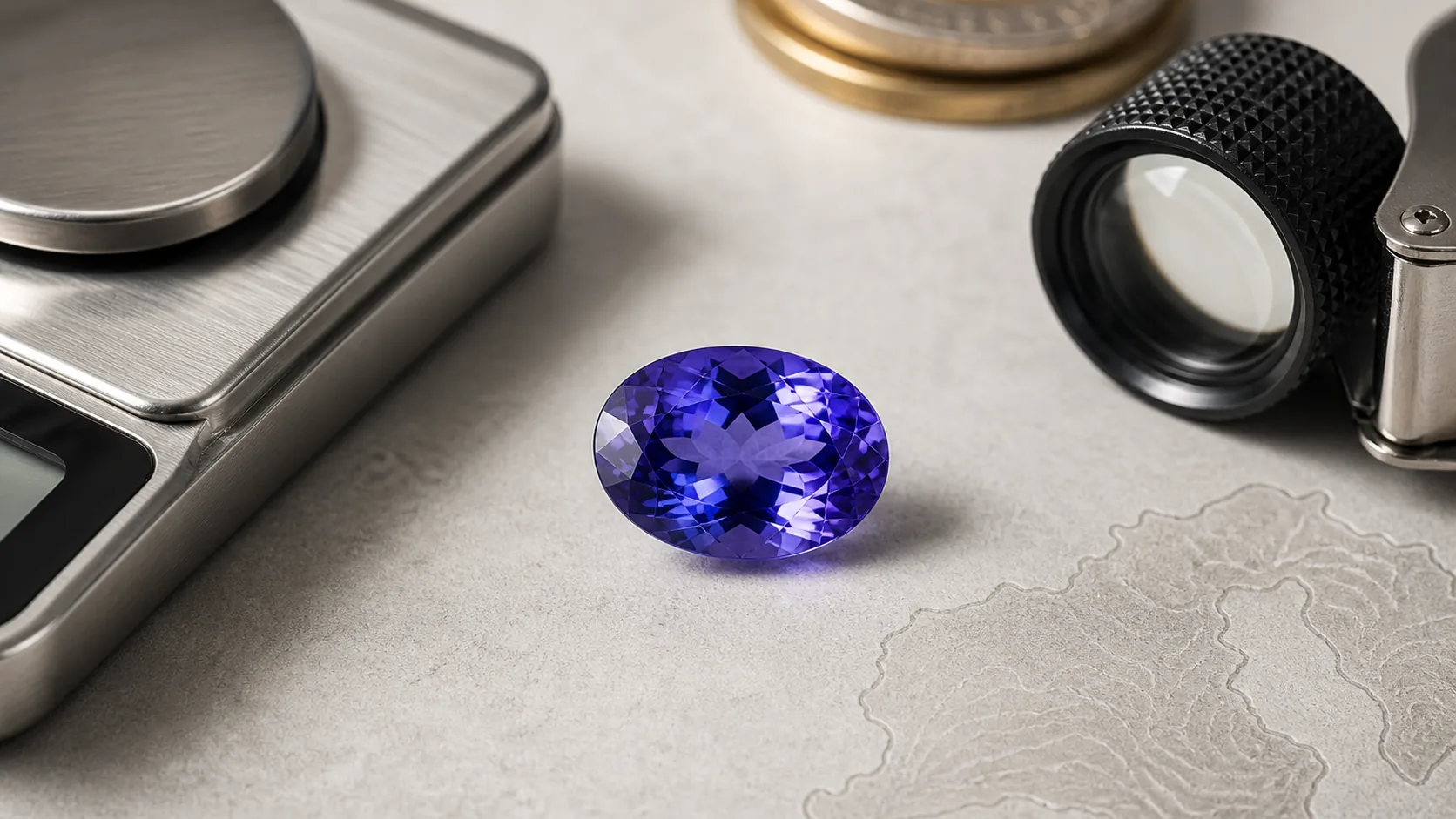
Per-carat ranges by weight and colour grade
| Weight | Bluish Violet (R per ct) | Vivid Violetish Blue (R per ct) | Airport retail premium |
|---|---|---|---|
| 0.50ct | R1,200 to R2,200 | R2,200 to R3,500 | +30 to 45% |
| 1.00ct | R3,500 to R5,500 | R5,500 to R9,500 | +35 to 55% |
| 2.00ct | R12,000 to R18,000 | R18,000 to R32,000 | +40 to 60% |
| 3.00ct | R28,000 to R42,000 | R42,000 to R75,000 | +45 to 60% |
| 5.00ct+ | R65,000 to R110,000 | R110,000 to R220,000 | +45 to 65% |
Per-carat price is non-linear with weight. Tanzanite is rare in clean stones above 3.00ct and the per-carat premium accelerates sharply in the 5.00ct band, mirroring the diamond market. Below 0.50ct the per-carat price collapses because the colour saturation is hard to achieve in small stones.
The airport markup mechanic
OR Tambo, Cape Town, and King Shaka international airports all carry tax-free tanzanite retailers in the international departures lounge. The pitch is consistent: “duty-free pricing”, “mined locally”, “authentic Tanzanian source”. The reality is that the tax-free framing removes only the 15 percent VAT (refundable separately through the VRA process for foreign passport-holders on retail purchases above R250), while the retail markup is set against international tourist comparables rather than local SA street pricing.
A spot survey across three SA airports in April 2026 found 1.00ct Vivid Violetish Blue retailing at R12,500 to R18,000 per carat at airport tax-free desks versus R5,500 to R9,500 per carat at established SA jeweller retail and R3,800 to R6,000 per carat at Bedfordview wholesale. The same stone, same certificate, three radically different prices.
For tourists already in transit, the airport route is the path of least resistance. For SA residents and for tourists with a few days in country, the airport premium is genuinely avoidable.
Where to buy without the tourist premium
Four working SA routes for serious tanzanite purchase, in ascending markup over Arusha source price:
- Bedfordview gem-stone dealers, on appointment. Several established Bedfordview operators carry tanzanite inventory alongside diamond stock, sourced through the same Antwerp-and-Mumbai trading network. Wholesale-tape pricing applies. Lead time same week if in stock; 1 to 3 weeks if sourced from supplier.
- Established CPT gem-stone dealers. Long-established Cape Town operators with serious tanzanite inventory and AGTA certification. Mid-tier markup, walk-in friendly.
- SA branded gemstone retailers (V&A Waterfront, Sandton City, Cape Town International). Branded retail with substantial inventory across colour grades and weights. Higher markup than Bedfordview; lower than airport tax-free.
- Pretoria custom workshops with gem-cutting capability. A handful of PTA workshops cut tanzanite from rough; buyer can specify cut style and proportions. Best route for non-standard custom pieces.
What the certificate tells you
For tanzanite above approximately R5,000 per carat, an AGTA or GIA coloured-stone report is the working standard. The certificate grades the following:
- Body colour: Bluish Violet vs Violetish Blue (the dominant tone) with the secondary modifier.
- Tone: a 1 to 10 scale from very light to very dark. The sweet spot for tanzanite is 5 to 7.
- Saturation: the strength of the colour, scored 1 to 6. Vivid (5 to 6) commands the premium.
- Clarity: tanzanite is a Type II gemstone in the GIA classification (typically eye-clean is achievable).
- Cut quality: proportions, symmetry, finish.
- Treatment status: almost all commercial tanzanite is heat-treated to convert the brown zoisite to blue. The certificate confirms the treatment status.
Untreated natural-colour tanzanite (extremely rare) carries a 100 to 200 percent premium over heat-treated material of the same colour grade. The certificate is the only working verification.
The trapiche premium
Trapiche tanzanite shows a six-spoke pattern radiating from the centre of the cut stone (carbon impurities aligned along the crystal axes during growth). Roughly 1 in 10,000 stones; commands a 200 to 400 percent premium over the equivalent non-trapiche colour grade. Most trapiche material goes to international gem collectors. If a SA retailer offers a trapiche tanzanite, request the AGTA report identifying the trapiche structure before paying the premium.
Setting tanzanite
Tanzanite is a 6.5 to 7 on the Mohs hardness scale (softer than quartz, far softer than diamond at 10). Daily-wear engagement-ring use is not recommended; the stone chips and abrades visibly within 3 to 5 years of constant wear. Tanzanite is better suited to pendant, earring, and occasional-wear cocktail-ring use, where the hardness limitation is not a daily liability.
For setting work, the established SA jewellery workshops handle tanzanite competently. Custom-setting commission runs approximately R8,000 to R25,000 for a platinum pendant mount, R6,000 to R18,000 for white-gold earrings. Bezel settings protect the stone better than prong settings for daily wear.
(Note for buyers also commissioning diamond pieces alongside tanzanite: a Bedfordview wholesale-to-public workshop is the working route for the diamond work specifically. Tanzanite sourcing is a separate channel.)
Common questions
Why is tanzanite so much cheaper in Tanzania than in South Africa?
The Merelani Hills mine (the only commercial tanzanite source on earth) sits roughly 350 kilometres from the SA border. Arusha-based traders sell rough and faceted tanzanite at the source price plus a small margin. SA dealers add import freight, customs duty, VAT, insurance, retail overhead, and a tourist-market premium. The SA airport tax-free outlets layer a further 30 to 60 percent premium on top of established SA retail prices. Comparing like with like (cut quality, certificate, colour grade), Arusha source pricing typically runs at 25 to 35 percent of the SA airport retail.
What is the difference between Vivid Violetish Blue and Bluish Violet tanzanite?
These are the two principal colour designations on a tanzanite report. Vivid Violetish Blue (often abbreviated “vB” or “V/B”) shows a dominant blue body with a violet secondary tone, and commands the highest premium. Bluish Violet (“B/V”) shows a dominant violet body with a blue secondary tone, more common in the rough, lower premium. The per-carat price gap at gem-quality is typically 30 to 50 percent in favour of Vivid Violetish Blue. The AGTA report grades both the body colour and the tone-saturation on a defined scale; the absence of a grading report on a tanzanite purchase above approximately R5,000 per carat is a working red flag.
Is tanzanite a good investment?
Mixed evidence. The supply story is genuinely constrained (one commercial mine; the Tanzanian government estimates depletion within 25 to 50 years) which has driven long-term per-carat appreciation for top-grade material. The retail story is more complicated. Most retail tanzanite sells at a substantial premium to the secondary market, and the resale price recovery for a tanzanite purchased at SA airport retail typically runs 15 to 30 percent of the purchase price within five years. Tanzanite is a beautiful gemstone with a strong supply-side narrative; treating an airport-purchased tanzanite as an investment vehicle is not supported by the resale data.
Which SA jewellers carry serious tanzanite inventory?
SA branded gemstone retailers at the V&A Waterfront and Sandton City, established CPT gem-stone dealers, several established Bedfordview gem-stone dealers, and the Pretoria-based custom workshops with gem-cutting capability all maintain serious tanzanite inventory. The airport tax-free retailers carry stock but at the highest markup band. For buyers seeking a specific colour grade and certificate, the working route is an appointment with a Bedfordview or CPT gem-stone dealer rather than a walk-in airport purchase.
Should I get a certificate for a tanzanite purchase?
Yes, above approximately R5,000 per carat. The AGTA (American Gem Trade Association) Coloured Gemstone Report is the international standard for tanzanite, grading the body colour, tone, saturation, clarity, cut, and noting any treatments. The GIA also issues coloured gemstone reports for tanzanite. The certificate matters because tanzanite is almost always heat-treated (the heat treatment converts the brown vanadium-bearing zoisite into the characteristic blue-violet), and the certificate confirms the treatment status and the colour grade that drives 60 to 80 percent of the per-carat price.
What is a trapiche tanzanite?
A rare phenomenal variety of tanzanite showing a six-spoke pattern radiating from the centre of the cut stone, caused by carbon impurities aligned along the crystal axes during growth. Trapiche tanzanite is extremely rare (perhaps 1 in 10,000 stones) and commands a 200 to 400 percent premium over the equivalent non-trapiche colour grade. Most trapiche tanzanite goes to international gem collectors rather than SA retail; encountering one in a walk-in retail context in SA is unusual.