
Guide
Emerald-cut diamond ring in South Africa
Emerald-cut diamond ring in South Africa: the hall of mirrors cut, why clarity beats colour, and the SI1 vs VS2 visual test that decides the budget.

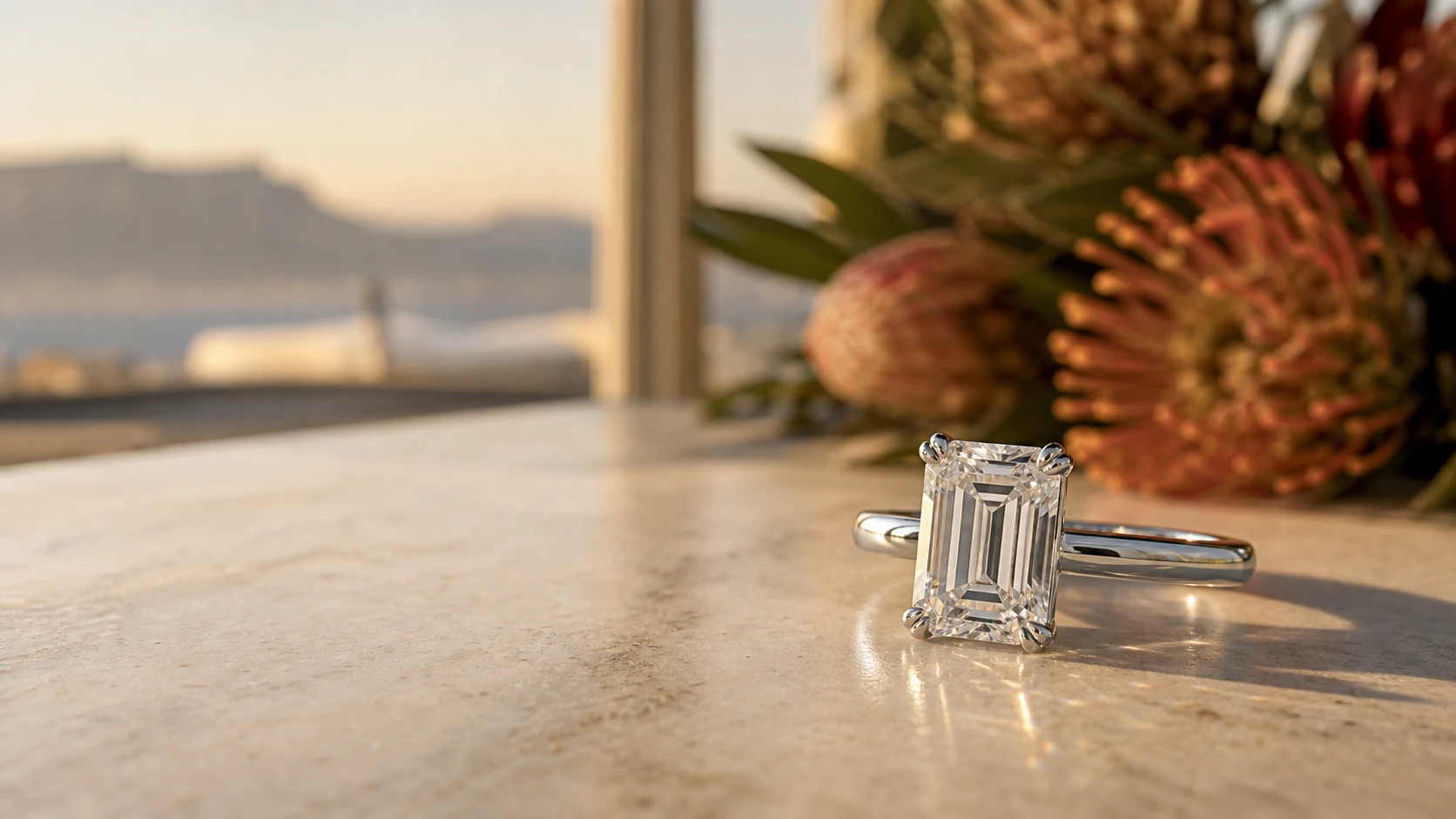
Emerald-cut pricing in May 2026
| Weight | Round wholesale (R) | Emerald wholesale (R) | Saving |
|---|---|---|---|
| 0.70ct | R45,000 | R34,000 | 24% |
| 1.00ct | R90,000 | R68,000 | 24% |
| 1.50ct | R190,000 | R145,000 | 24% |
| 2.00ct | R345,000 | R255,000 | 26% |
Note the colour and clarity spec in the table caption: H/VS1 rather than the G/VS2 baseline used in our round-brilliant pricing tables. The substitution reflects the real working buy: emerald cut buyers typically upgrade clarity from VS2 to VS1 (because clarity matters more here) and downgrade colour from G to H (because colour matters less). The net effect is that emerald cut is still meaningfully cheaper than round at the comparable visual quality, just less dramatically cheaper than the headline 24 to 26 percent suggests if buyers held all four Cs constant.
Why clarity beats colour in an emerald cut
The geometry tells the story. A round-brilliant cut has 58 facets arranged to maximise scintillation: small pinpoint sparkles that distract the eye from inclusions and from trace colour. The brilliant pavilion facets concentrate light return through the table, which reveals any warmth in the colour.
An emerald cut has fewer facets (typically 50 to 58 depending on the cutter), and the facets are long parallel rectangles arranged in concentric tiers like steps descending into the pavilion. The visual effect under good lighting is broad rectangular flashes rather than pinpoint sparkles. There is no scintillation to mask inclusions, so any flaw in the stone’s interior becomes visible against the glassy step-cut background. The long pavilion facets also distribute light return less concentratedly through the table, which masks trace colour warmth more effectively than the brilliant cut.
Working consequences for the buyer. Clarity: upgrade to VS1 from the round-brilliant baseline of VS2. The price premium for VS1 over VS2 (typically 8 to 15 percent) is meaningfully cheaper than the cost of buying a cleaner stone later. Colour: downgrade to H (or I if budget-constrained) from the G baseline. The price saving on H over G (typically 15 to 20 percent) offsets the clarity upgrade and the buyer ends up at roughly the same total cost as a round-brilliant at G/VS2 specification.
The SI1 vs VS2 visual test
Two stones at the appointment, both H colour, both 1.00ct, both Excellent cut. Stone A: SI1 clarity with a small inclusion shown on the GIA plot diagram at the upper-third of the table. Stone B: VS2 clarity with the inclusion at the pavilion bezel facet (not visible through the table).
Under 10x loupe Stone A’s inclusion is immediately visible as a small black point in the upper-third of the table. Stone B’s inclusion at the pavilion bezel facet is barely visible even under loupe; you have to know where to look. At conversational distance (30 to 50cm) Stone A’s inclusion is faintly visible to a trained eye if the stone is tilted; Stone B looks clean to any observer.
The price difference at SA wholesale in May 2026 for these two stones: approximately R6,500 for the VS2 over the SI1. The visual difference: meaningful. The buy decision is almost always VS2 in emerald cut, even for buyers who would happily buy SI1 in a round-brilliant. This is the central lesson of the emerald cut and a correction we make often.
The 1.40 ratio
Length-to-width ratio is the architectural variable. Buyer preference range in SA in 2026: 1.30 to 1.50. The 1.40 ratio is the working sweet-spot and matches the Art Deco-era proportions that define the classic emerald cut (classic pieces from the 1920s and 1930s typically sit in the 1.35 to 1.45 band).
- 1.00 to 1.10: commercially classified as Asscher cut, not emerald cut. Square step-cut with different visual proportions.
- 1.10 to 1.30: short emerald cut, sometimes called a “square emerald”. Minority preference.
- 1.30 to 1.40: classic Art Deco emerald cut. Most-requested.
- 1.40 to 1.50: balanced classic emerald cut. Equally well-regarded.
- 1.50 to 1.70: elongated emerald cut, “baguette-style” proportion. Visually striking on long fingers, the hall-of-mirrors effect can fragment into thin parallel bands.
- 1.70+: uncommon as engagement-ring centre; the stone reads as a baguette accent rather than a centre.
The long pavilion and the face-up size advantage
The emerald cut has a shallower depth-to-diameter ratio than a brilliant cut, because the step-cut geometry does not require the deep pavilion that a brilliant cut uses to maximise light return. Working consequence: the carat weight spreads across a larger face-up surface area. A 1.00ct emerald cut reads as approximately 1.15 to 1.20ct visible compared to a 1.00ct round-brilliant.
The trade-off: less brilliance return. A round-brilliant at Excellent cut returns roughly 60 to 65 percent of incoming light back to the eye through the table. An emerald cut at Excellent step-cut returns roughly 45 to 55 percent. The visual difference is not less light per se, but less concentrated light: the emerald cut produces broad rectangular flashes rather than pinpoint sparkles, and the overall appearance is glassier and less “showy” than the round-brilliant.
For buyers who prefer architectural and understated to fiery and bright, the emerald cut is the correct shape. For buyers who want maximum sparkle, the round-brilliant remains the working answer.
Where to commission an emerald cut engagement ring in SA
For a bespoke commission with VS1 clarity, H colour, and Art Deco-proportion 1.40 ratio, the working route is a Bedfordview wholesale workshop on appointment. The workshop sources 3 to 6 candidate emerald cut stones matching spec, presents them for side-by-side clarity inspection (this matters more for emerald cut than for any other shape), and the buyer’s visual choice drives the final selection. Lead time 3 to 6 weeks for the full commission, including CAD design of the mounting.
Bedfordview workshops running the wholesale-to-public model carry emerald cut inventory with bench-side clarity inspection and Art Deco-style mounting design.
For walk-in retail emerald cut selection in SA, the mid-tier independent jewellers at Hyde Park Corner and Melrose Arch occasionally carry a small selection but emerald cut is less common in pre-set retail because the clarity floor (VS1 minimum) raises the per-piece capital tie-up beyond the typical chain mall display. Chain mall jewellers in Sandton City rarely stock emerald cut outside the bridal-season window.
Common questions
Why is the emerald cut called the “hall of mirrors”?
The emerald cut is a step-cut shape with rectangular facets arranged in concentric tiers around the table, like steps descending into the pavilion. When viewed face-up under good lighting, the long parallel facets reflect light in broad rectangular flashes rather than the small pinpoint sparkles of a brilliant cut. The visual effect is glassy, architectural, and reminiscent of looking into a hall lined with mirrors. The cut originated in the 1500s for emeralds (which are brittle and benefit from the step-cut geometry) and was formally codified as a diamond cut in the Art Deco period of the 1920s.
Why does clarity matter more for emerald-cut diamonds?
The long step-cut facets and the large open table act as a window into the stone. Inclusions that would be masked by the facet activity of a brilliant cut become eye-visible in an emerald cut, because there is no scintillation to distract the eye. The working clarity floor for an emerald cut engagement ring is VS2 at minimum, ideally VS1. SI1 in an emerald cut requires bench-side inspection of the GIA plot diagram (the inclusion location matters). Below SI1 the inclusions are almost always eye-visible at conversational distance and the stone is not commercially suitable as a centre stone for a daily-wear engagement ring.
What colour grade is acceptable for an emerald cut?
Colour matters less than for round-brilliant. H or even I colour reads as visually white face-up in an emerald cut, because the step-cut geometry concentrates light return through broad parallel flashes rather than through the brilliant pavilion facets that reveal trace warmth. Buyers can save meaningfully (typically 15 to 25 percent of stone price) by choosing H over G colour without visible compromise. I colour is the practical floor for buyers prioritising face-up white appearance; below I the warmth becomes visible especially in yellow-gold mountings.
What is the ideal length-to-width ratio for an emerald cut?
Buyer preference range in SA in 2026: 1.30 to 1.50. The 1.40 ratio is the working sweet-spot and matches the Art Deco-era proportions that define the classic emerald cut. Below 1.30 the stone reads as square (and is commercially classified as Asscher cut, a related but distinct step-cut). Above 1.50 the stone becomes elongated and the “hall of mirrors” effect can fragment into thin parallel bands rather than balanced rectangles.
Are emerald-cut diamonds cheaper than round?
Yes, typically the cheapest of the common fancy shapes. An emerald cut at the same 4Cs as a round-brilliant sits 20 to 25 percent cheaper per carat at the SA wholesale floor. The savings reflect both manufacturing yield (the step-cut wastes less rough) and demand (emerald cut sits at roughly 5 to 7 percent of SA engagement-ring centre stones in 2026, less than oval or princess). The catch is the clarity floor: an emerald cut at VS1 may not be meaningfully cheaper than a round at VS2 when buyers upgrade clarity to compensate for the cut’s inclusion visibility.
Does an emerald cut look bigger than a round at the same carat?
Yes. The elongated rectangular shape and the long pavilion (the step-cut requires less pavilion depth than a brilliant cut) spreads the carat weight across a larger face-up surface. A 1.00ct emerald cut reads as approximately 1.15 to 1.20ct visible compared to a 1.00ct round-brilliant. The long pavilion is the trade-off: the stone appears larger but the depth-to-diameter ratio is shallower, which means the stone has less brilliance return than a properly-cut round.