
Guide
Princess-cut diamond ring in South Africa
Princess-cut diamond ring in South Africa: the value-shape, the corner-chip risk, and the V-prong setting that keeps the stone safe.

Princess pricing in May 2026
| Weight | Round wholesale (R) | Princess wholesale (R) | Saving |
|---|---|---|---|
| 0.70ct | R45,000 | R33,000 | 27% |
| 1.00ct | R90,000 | R67,000 | 26% |
| 1.50ct | R190,000 | R140,000 | 26% |
| 2.00ct | R345,000 | R250,000 | 28% |
Per-carat the saving is consistent at roughly 26 to 28 percent across the engagement-ring weight band. The savings are less than marquise (33 to 36 percent) but more than emerald cut (20 to 25 percent), placing princess as the middle-discount option among the common fancy shapes. The compounding caveat: princess looks smaller face-up than round at the same carat weight, so the effective real-value advantage is closer to 15 to 20 percent rather than the headline 26 to 28 percent if face-up size matters to the buyer.
The corner-chip risk
The four pointed corners of a princess-cut diamond carry the thinnest material on the stone. Direct knocks against doorframes, kitchen cupboards, gym equipment, or even sharp gestures with the hand can chip a corner. A chipped princess corner is a recutting and recertifying event that typically costs 20 to 30 percent of the stone’s original purchase price and the recut stone loses 8 to 15 percent of its weight (more than oval or pear, because the recut must restore the squared corner).
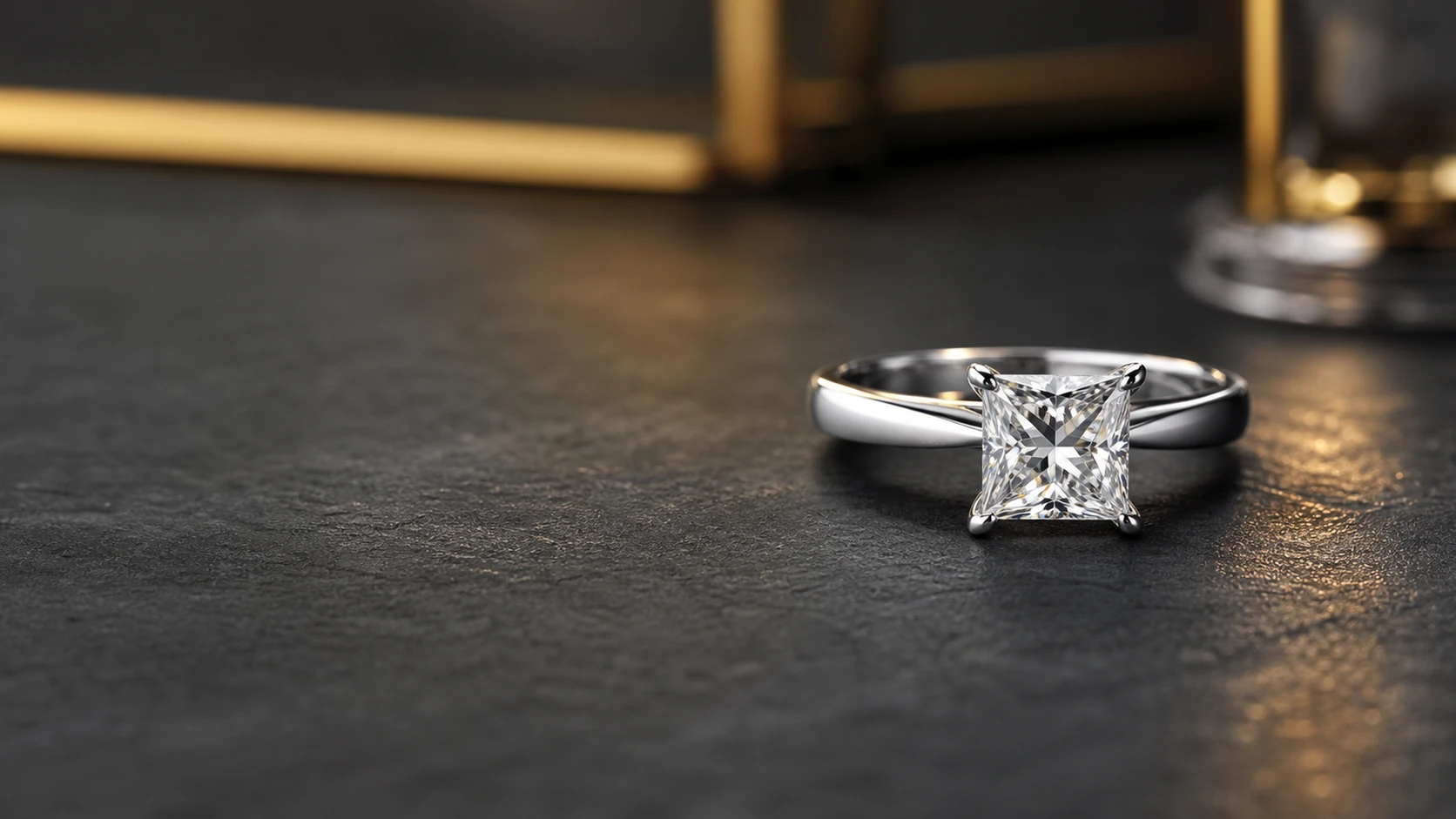
The risk is meaningful for daily-wear engagement rings and is the single most common regret reason on princess buys. The working protection is corner-prong setting: a metal prong placed directly on each corner to absorb impact. The prongs are most commonly V-prongs (a metal V wrapping the corner) or chevron-prongs (a slightly elongated V matching the corner angle). Four corner prongs is the standard secure mounting.
Settings to avoid: tension settings (the stone is held by metal pressure alone, with no prong protection); four-side bezel settings (the bezel rim is rarely thick enough at the corner to absorb impact); and minimalist two-prong settings that protect only two of the four corners. The chain-mall pre-set market often shows tension settings for princess because the visual is modern and clean, but the chip rate over a 10-year wear horizon is high.
Why a princess looks smaller than a round at the same carat
The mathematics. Carat weight measures mass (0.20 grams per carat); face-up size measures surface area visible from above. A round-brilliant cut spreads the carat weight across a circular surface with most of the volume in the crown and table. A princess-cut places more of the carat weight in the depth of the pavilion (the squared shape requires more material below the table to maintain the corners) and less in the surface area.
Working visual conversion: a 1.00ct princess reads as approximately 0.85 to 0.90ct visible compared to a 1.00ct round-brilliant at comparable cut quality. A 1.20ct princess reads as visually equivalent to a 1.00ct round. Buyers comparing princess vs round on face-up size should add roughly 15 to 18 percent to the target carat weight on the princess side.
The square ratio
Buyer preference is overwhelmingly for square princess at length-to-width ratio 1.00 to 1.05. Roughly 80 percent of bespoke princess commissions in the Bedfordview corridor are in this band.
- 1.00 to 1.05: classic square princess. Most-requested.
- 1.05 to 1.15: slightly elongated princess, minority preference for buyers wanting a rectangular look.
- 1.15 to 1.20: elongated princess; the stone starts reading as a radiant cut rather than a princess.
- 1.20+: not commercially classified as princess; sold as radiant cut.
Clarity matters more than buyers expect
The princess cut has a relatively transparent table facet (the flat top surface) and the corners are particularly visible at conversational distance. Inclusions in the centre or near the corners can become eye-visible faster than in a brilliant-cut round, which has more facet activity to mask inclusions.
Working clarity floor: VS2 at the centre, ideally VS1 if budget allows. SI1 with strategic inclusion placement (away from centre and away from corners) can work but requires bench-side stone-by-stone inspection of the GIA plot diagram. SI2 and lower is typically pulled for the chain-mall pre-set market and is not recommended for bespoke certified commissions.
Colour is more forgiving. H or I colour reads as visually white face-up because the squared shape concentrates light return through the brilliant pavilion facets, which mask trace warmth more effectively than the long facets of an emerald cut. Buyers can save meaningfully (typically 15 to 20 percent of stone price) by choosing H over G colour without visible compromise.
Where to commission a princess engagement ring in SA
For a bespoke commission with certified princess at VS2 or better and corner-prong setting, the working route is a Bedfordview wholesale workshop on appointment. The workshop sources 3 to 6 candidate princess stones matching spec, presents them for side-by-side comparison (corner symmetry, inclusion placement, face-up brightness), and the buyer’s visual choice drives the final selection. Lead time 3 to 6 weeks for the full commission, including CAD design of the corner-prong mounting.
Bedfordview wholesale-to-public workshops run this model on appointment and typically carry princess inventory with standard V-prong corner-protection mounting design. Confirm the corner-prong protection is specified before commissioning.
For walk-in retail princess selection, the branded mall-chain jewellers at Sandton City and other malls carry pre-set princess rings at the entry bracket, but stone certification is often in-house rather than GIA and the corner-prong protection is not always present. Mid-tier independent jewellers at Hyde Park Corner occasionally maintain a small certified princess selection.
Common questions
Why are princess-cut diamonds cheaper than round?
Two reasons. Manufacturing yield: a princess cut wastes less rough than a round-brilliant in the cutting process (princess yield is roughly 60 to 80 percent vs round at 40 to 50 percent), so the per-carat finished price is lower. Demand: round still dominates SA engagement-ring centre stones at 55 to 65 percent of the market, princess sits at roughly 8 to 10 percent in 2026, and the price premium reflects the demand gap. A princess at the same 4Cs as a round typically sits 20 to 30 percent cheaper per carat at the SA wholesale floor.
Do princess-cut diamonds chip easily?
The corners do. The four pointed corners of a princess carry the thinnest material and are the most chip-vulnerable points on the stone. The working protection is corner-prong setting: a metal prong placed directly on each corner to absorb impact (often a V-prong or chevron-prong), with the prongs fabricated in platinum or 18kt gold rather than the softer 9kt or 14kt. Four corner prongs is the standard secure mounting for a princess. Avoid tension settings (the stone is held by metal pressure alone, with no prong protection at the corners) and avoid four-side bezel settings that leave the corners exposed under the bezel rim.
What is the ideal length-to-width ratio for a princess-cut diamond?
Square princess (1.00 to 1.05) is the dominant SA buyer preference and accounts for roughly 80 percent of bespoke princess commissions in the Bedfordview corridor. The 1.00 to 1.05 ratio reads as visually square at conversational distance while allowing a small manufacturing tolerance. Elongated princess (1.05 to 1.20) is a minority preference, occasionally requested for buyers wanting a slightly rectangular look. Above 1.20 the stone reads as a radiant cut rather than a princess.
Does a princess look bigger than a round at the same carat?
No. A princess at the same carat weight as a round-brilliant has a smaller face-up appearance, because the square shape places more of the carat weight in the depth of the pavilion rather than spreading the surface area visible from above. A 1.00ct princess reads as approximately 0.85 to 0.90ct visible compared to a 1.00ct round of comparable cut quality. The princess advantage is per-rand value (cheaper at the same carat), not per-carat visual size.
What clarity grade should I buy for a princess-cut diamond?
VS2 minimum at the centre, ideally VS1 if budget allows. The princess cut has a relatively transparent table facet (the flat top surface) and the corners are particularly visible, so inclusions in the centre or near the corners can become eye-visible faster than in a brilliant-cut round. SI1 with strategic inclusion placement (away from centre and corners) can work but requires bench-side stone-by-stone inspection. Below SI1 the visual risk grows; the wholesale floor typically pulls SI2 and lower for the chain-mall pre-set market rather than for bespoke certified commissions.
Are princess-cut engagement rings still in style?
Less dominant than in the 2000s. Princess peaked in SA at roughly 18 to 22 percent of engagement-ring centre stones in 2005 to 2008, declined steadily through the 2010s as round and oval gained share, and sits at roughly 8 to 10 percent in 2026. The shape remains popular for buyers who want a geometric, modern look at lower cost than round-brilliant, but the cultural moment has shifted toward elongated fancy shapes (oval, pear, marquise). Princess is value-leader rather than trend-leader in 2026.