
Guide
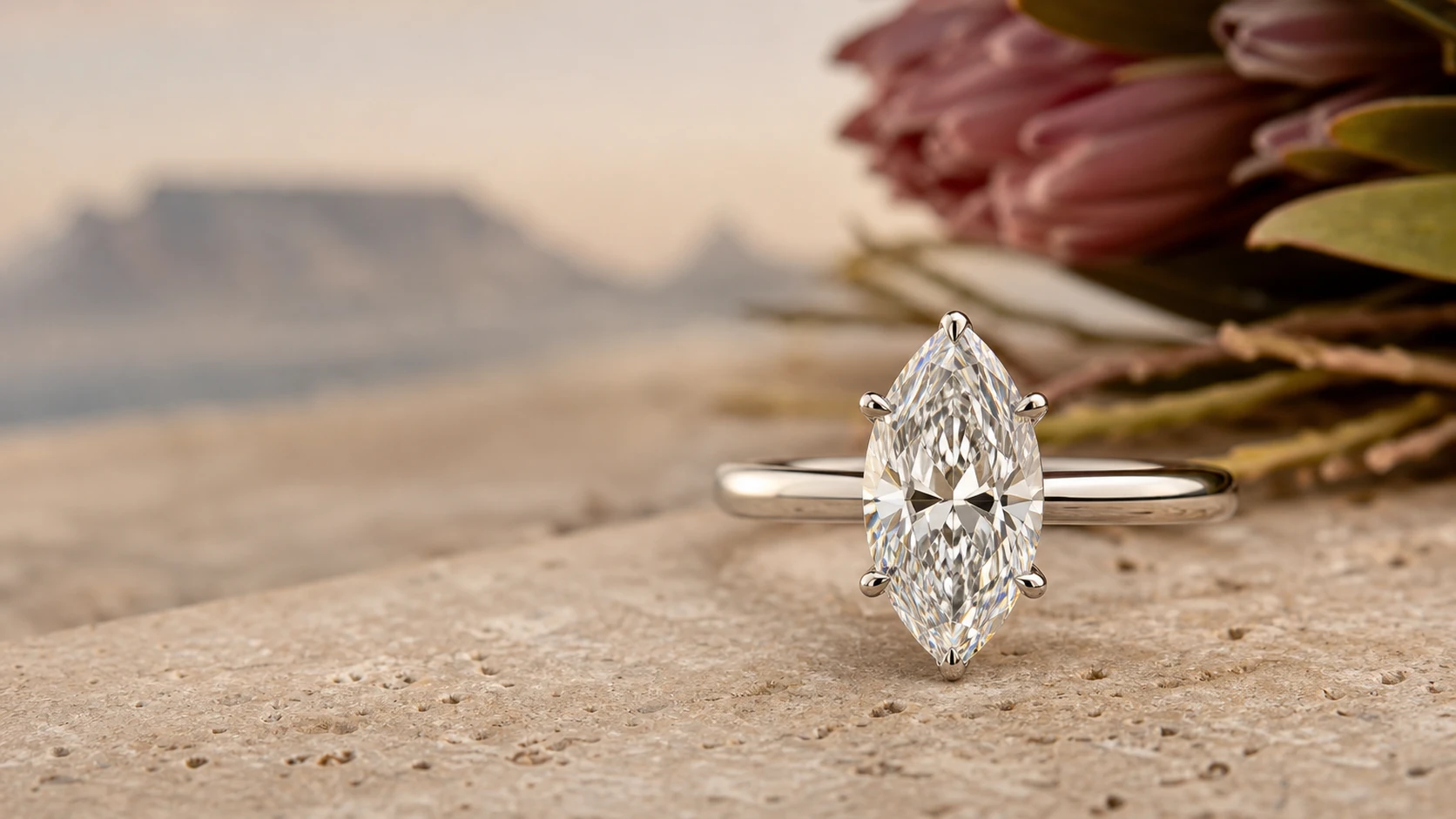
Marquise diamond ring in South Africa
Marquise diamond ring in South Africa: the shape that looks biggest per carat, the bowtie that ruins 60 percent of stones, and the V-prong nobody mentions.

Marquise pricing in May 2026
| Weight | Round wholesale (R) | Marquise wholesale (R) | Saving |
|---|---|---|---|
| 0.70ct | R45,000 | R29,000 | 36% |
| 1.00ct | R90,000 | R60,000 | 33% |
| 1.50ct | R190,000 | R125,000 | 34% |
| 2.00ct | R345,000 | R225,000 | 35% |
Per-carat the saving is the largest of any common fancy shape (marquise typically outpaces oval, pear, and emerald cut on percentage discount). The compounding effect: a 1.20ct marquise costs less than a 0.85ct round at the same 4Cs and reads as visibly larger on the finger. The catch is yield rate at the bench: roughly 60 percent of marquise stones at the wholesale floor have a bowtie severe enough to compromise sparkle, so the effective discount on a clean stone is more like 20 to 25 percent rather than the headline 33 to 36 percent.
The bowtie that ruins 60 percent of marquise stones
All marquise-cut diamonds have some degree of bowtie effect: a dark shadow visible across the centre when viewed face-up. The bowtie is caused by light leaking through the pavilion (the underside of the stone) rather than reflecting back to the eye. The shape geometry of the marquise (elongated with two opposing points) makes the bowtie more pronounced than on an oval, where the curved sides catch more peripheral light.
By our reading of bench-side comparisons across the Bedfordview wholesale corridor in 2025 and 2026, roughly 60 percent of marquise stones display a bowtie severe enough to compromise sparkle. A well-cut marquise has a barely-perceptible central darkening; a poorly-cut marquise shows a clear black band spanning the centre that does not soften with tilt.
The bowtie is not graded on the GIA certificate. Two marquise stones with identical certificate 4Cs (carat, colour, clarity, cut) can have radically different bowtie severity. The only working check is visual inspection under a 10x loupe at the appointment, ideally in indirect natural daylight (window light, not direct sun) as well as under jewellery-shop lighting.
The three checks to spot a bowtie
- Loupe in daylight. 10x loupe, indirect window light, view straight down through the table facet. A well-cut marquise shows a barely-perceptible central darkening, almost a soft grey wash. A poorly-cut marquise shows a clear black bowtie spanning the centre.
- Tilt test. Hold the stone in tweezers and tilt 15 to 20 degrees in both directions. The bowtie on a well-cut stone softens or shifts position; on a poorly-cut stone the bowtie stays locked as a dark band.
- Tray comparison. Compare 3 to 6 candidate marquise stones of similar weight side by side. The contrast makes the bowtie obvious. A single stone presented alone gives no benchmark.
This is why bespoke commission at a Bedfordview wholesale workshop matters more for marquise than for any other shape. The workshop pulls a tray of candidate marquise stones at the target spec, the buyer compares face-up presence side-by-side, and the worst-bowtie examples are filtered out before the design phase. A chain-mall storefront with a single pre-set marquise offers no such comparison, and the failure rate at the chain-mall level is high.
The 1.95 ratio
Length-to-width ratio is the second non-certificate variable. Buyer preference range in SA in 2026: 1.85 to 2.10. The 1.95 ratio is the working sweet-spot: elongated enough to claim the marquise shape advantage and the finger-lengthening optical effect, not so elongated that the bowtie or the “needle” look kicks in.
- 1.70 to 1.85: reads as short and stubby; marquise shape advantage muted.
- 1.85 to 1.95: balanced marquise, slightly conservative.
- 1.95 to 2.05: classic balanced marquise. Most-requested at SA bespoke workshops.
- 2.05 to 2.15: elongated marquise; visually striking, tips slightly more chip-vulnerable.
- 2.15+: needle-shaped marquise; uncommon as engagement-ring centre, tips chip-vulnerable.
The V-prong that protects the tips
The two pointed ends of a marquise carry the thinnest material on any common engagement-ring shape. Direct knocks against doorframes, kitchen cupboards, or gym equipment can chip the tips. A chipped marquise tip is a recutting and rerecertifying event that typically costs 15 to 25 percent of the stone’s original purchase price to remediate, and the recut stone loses 5 to 10 percent of its weight.
The working protection is a V-prong setting at both tips: a metal V that wraps the pointed end and absorbs impact, with the prong itself made of platinum or 18kt gold rather than the softer 9kt or 14kt. Two V-prongs plus four shoulder prongs (one at each shoulder of the marquise) is the standard secure mounting. Avoid bezel-only settings (the bezel rim is rarely thick enough at the tip to provide impact absorption), and avoid four-prong settings without dedicated tip protection.
Where to commission a marquise engagement ring in SA
For a bespoke commission with bench-side bowtie comparison and V-prong setting, the working route is a Bedfordview wholesale workshop on appointment. The workshop sources 3 to 6 candidate marquise stones matching spec, presents them for side-by-side bowtie inspection, and the buyer’s visual choice (rather than the certificate alone) drives the final selection. Lead time 3 to 6 weeks for the full commission, including CAD design of the V-prong mounting.
Several cutting houses in the Bedfordview corridor run the wholesale-to-public model, carrying inventory across the marquise shape range with bench-side tray comparison.
For walk-in retail marquise selection in SA, the mid-tier independent jewellers at Hyde Park Corner and Melrose Arch occasionally maintain a small marquise selection but the bowtie inspection routine is rarely offered. Chain mall jewellers (Sandton City concentration) carry pre-set marquise rings but selection is constrained to whatever inventory the chain has cleared, and the bowtie failure rate at the chain level is high enough to warrant scepticism.
Common questions
Why are marquise diamonds cheaper than round?
Two reasons. Manufacturing yield: a marquise cut wastes less rough than a round-brilliant in the cutting process, so the per-carat finished price is lower for the same starting rough. Demand: round remains the dominant engagement-ring shape in SA at 55 to 65 percent of centre stones, and the price premium reflects that demand. A marquise at the same 4Cs as a round typically sits 30 to 35 percent cheaper per carat at the wholesale floor.
What is the bowtie effect on a marquise diamond?
A bowtie is a dark shadow visible across the centre of a marquise (or oval, or pear) when viewed face-up, caused by light leaking through the pavilion rather than reflecting back to the eye. All marquise diamonds have some degree of bowtie. By our reading of bench-side comparisons, roughly 60 percent of marquise stones in the SA wholesale corridor have a pronounced bowtie severe enough to compromise sparkle. The bowtie is not graded on the GIA certificate, so visual inspection under a 10x loupe in natural daylight is the only working check.
How do I spot a bowtie before buying a marquise?
Three checks at the appointment. (1) View the stone face-up under 10x loupe in indirect natural daylight (window light, not direct sun). A well-cut marquise shows a barely-perceptible central darkening; a poorly-cut marquise shows a clear black bowtie spanning the centre. (2) Tilt the stone 15 to 20 degrees in both directions; the bowtie should soften or shift, not stay locked as a black band. (3) Compare side-by-side with a second marquise of similar weight; the contrast makes the bowtie obvious. Insist on tray comparison of 3 to 6 candidate stones rather than committing to a single example.
What length-to-width ratio is best for a marquise?
Buyer preference range in SA in 2026: 1.85 to 2.10. Below 1.85 the marquise reads as too short and loses the elongating effect on the finger. Above 2.10 the stone starts to feel uncomfortably long and the tips become more chip-vulnerable. The 1.95 to 2.05 band is the working sweet-spot and matches the proportions of the most-recognised celebrity marquise pieces.
Do marquise diamonds chip easily?
The tips do. The two pointed ends of a marquise carry the thinnest material and are the most chip-vulnerable points on any common engagement-ring shape. The working protection is a V-prong setting at both tips (a metal V that wraps the pointed end and absorbs impact). Two V-prongs plus four shoulder prongs is the standard secure mounting for a marquise. Avoid bezel-only settings that leave the tips exposed under the bezel rim, and avoid four-prong settings without dedicated tip protection.
Are marquise rings trendy in South Africa?
Gaining share from a small base. Marquise was roughly 2 percent of SA engagement-ring centre stones in 2018 and has grown to roughly 4 to 5 percent in 2026, driven partly by celebrity engagement choices and partly by the buyer appetite for distinctive non-round shapes. Still niche, but the bespoke commissions for marquise have roughly doubled in the SA wholesale corridor over the past three years.