Guide
Pear-shaped engagement ring in South Africa
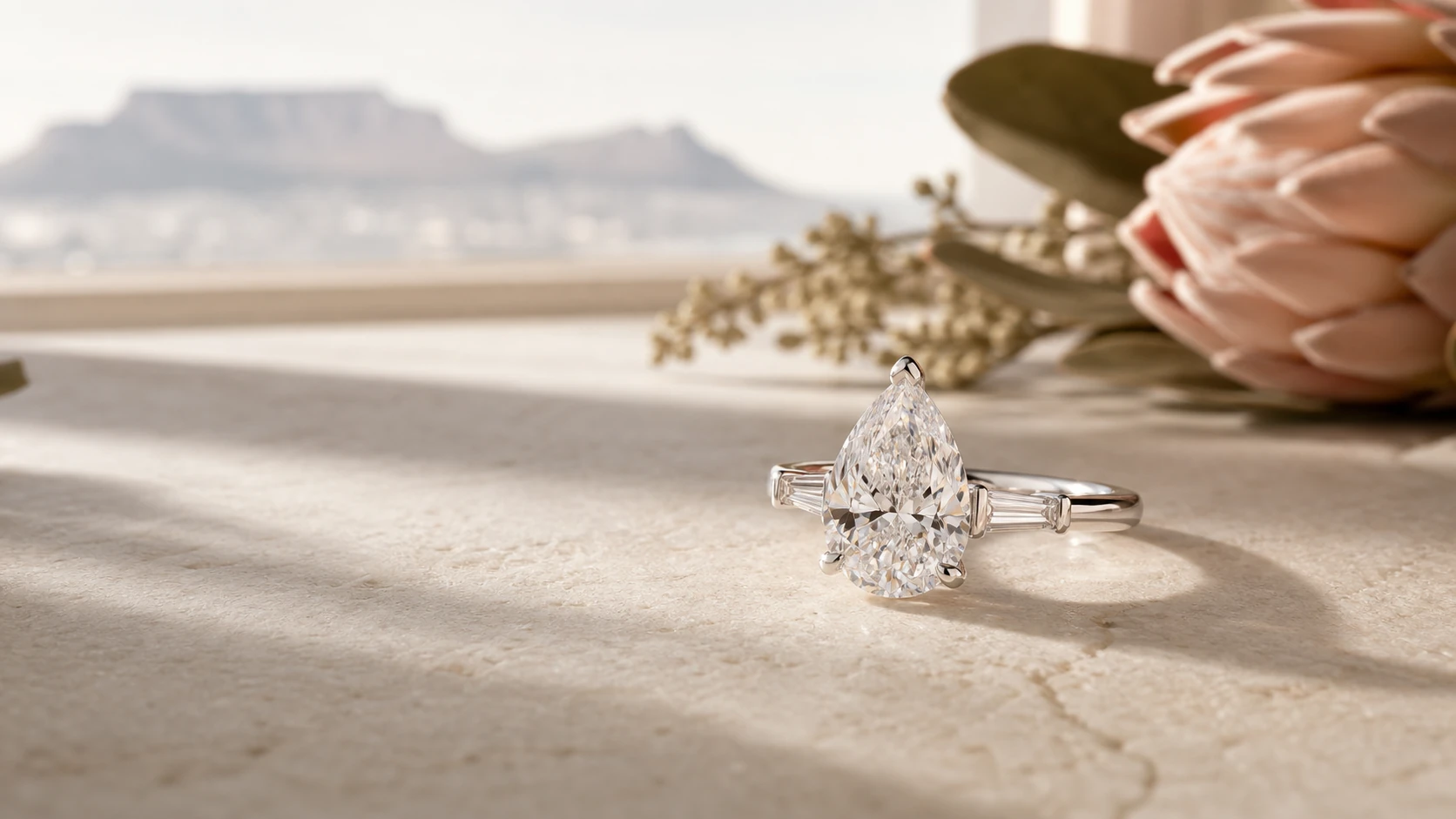
Pear-shaped engagement ring in South Africa: why the pear is having a 2026 moment, which way it should point, and the V-prong nobody mentions.

Pear pricing in May 2026
| Weight | Round wholesale (R) | Pear wholesale (R) | Saving |
|---|---|---|---|
| 0.70ct | R45,000 | R32,000 | 29% |
| 1.00ct | R90,000 | R65,000 | 28% |
| 1.50ct | R190,000 | R135,000 | 29% |
| 2.00ct | R345,000 | R240,000 | 30% |
Per-carat the saving is consistent at roughly 28 to 30 percent across the engagement-ring weight band, slightly less than marquise (33 to 36 percent) but more than emerald cut (typically 20 to 25 percent). The compounding effect: a 1.30ct pear costs less than a 1.00ct round at the same 4Cs and reads as visibly larger on the finger.
The 2026 moment
The pear has gained measurable share in SA over the past three years. Catalogue data from our column’s informal tracking of bespoke commissions across the Bedfordview corridor: pear was roughly 3 percent of engagement-ring centre stones in 2018, sat at 4 to 5 percent through 2020 to 2022, and has reached 6 to 8 percent in 2026.
The driver is photographed celebrity wear. Ariana Grande’s engagement ring (a pear with elongated ratio, north-south orientation, point-toward-fingertip) drew sustained Instagram and Pinterest coverage from 2020 forward. Sophie Turner, Emily Ratajkowski, and Cardi B wear pear engagement pieces that circulate as reference images at SA bespoke appointments. The trend pre-dates the celebrity wave: pear was a recognised engagement-ring shape since the 1950s and was favoured by Elizabeth Taylor in her 1969 acquisition of the 69.42ct Taylor-Burton diamond.
Which way should the pear point
The dominant convention is point toward the fingertip, away from the wearer’s wrist. Three reasons.
- Visual elongation. The pear point at the fingertip end gives the finger a longer, more tapered visual line, reading as more elegant in photographs and at conversational distance.
- Knuckle proportion. The wider rounded end of the pear sits closer to the knuckle, where the wider proportion balances with the finger’s natural taper.
- Celebrity reference. Every widely-photographed celebrity pear engagement piece in the past decade has used point-toward-fingertip orientation. SA buyers arriving with reference photos almost always default to this orientation.
Point-toward-wrist is occasionally requested as a personal-preference variation and the workshop will execute either, but commission discussions default to point-toward-fingertip unless the buyer explicitly directs otherwise. The decision is irreversible once the setting is fabricated; the prong placement is asymmetric and committing to one orientation cannot be flipped without a full remount.
The bowtie inspection
All pear-cut diamonds have some degree of bowtie effect: a dark shadow visible across the centre when viewed face-up. The bowtie is caused by light leaking through the pavilion. By our reading of bench-side comparisons across the Bedfordview wholesale corridor, roughly 40 to 50 percent of pear stones display a bowtie severe enough to compromise sparkle. Less severe than marquise (60 percent), more than oval (30 percent), and far more than round (essentially zero).
The bowtie is not graded on the GIA certificate. Two pear stones with identical certificate 4Cs can have radically different bowtie severity. The only working check is visual inspection under a 10x loupe at the appointment, ideally in indirect natural daylight.
Inspection routine at the appointment: view the stone face-up under 10x loupe in window light; tilt the stone 15 to 20 degrees in both directions; compare 3 to 6 candidate stones side-by-side. A well-cut pear shows a barely-perceptible central darkening that softens with tilt; a poorly-cut pear shows a clear black band that stays locked. Insist on tray comparison rather than committing to a single example.
The 1.60 ratio
Length-to-width ratio is the second non-certificate variable. Buyer preference range in SA in 2026: 1.50 to 1.75. The 1.55 to 1.65 band is the working sweet-spot.
- 1.40 to 1.50: reads as too round; pear distinctiveness muted.
- 1.50 to 1.55: classic balanced pear, slightly conservative.
- 1.55 to 1.65: classic celebrity-reference pear. Most-requested.
- 1.65 to 1.75: elongated pear, visually striking, tip slightly more chip-vulnerable.
- 1.75+: needle pear; uncommon, tip chip-vulnerable.
The V-prong tip protection
The single pointed tip of a pear is the chip-vulnerable point. A chipped pear tip is a recutting and recertifying event that typically costs 15 to 25 percent of the stone’s original purchase price and the recut stone loses 5 to 10 percent of its weight. The risk is real and the protection is straightforward.
Working protection: a V-prong setting at the tip (a metal V that wraps the pointed end and absorbs impact), with the prong itself fabricated in platinum or 18kt gold rather than the softer 9kt or 14kt. The V-prong plus four to five additional prongs around the curve and shoulder is the standard secure mounting. Avoid bezel-only settings (bezel rim rarely thick enough at the tip), and avoid simple four-prong settings without dedicated tip protection.
Where to commission a pear engagement ring in SA
For a bespoke commission with bowtie comparison and V-prong setting, the working route is a Bedfordview wholesale workshop on appointment. The workshop sources 3 to 6 candidate pear stones matching spec, presents them for side-by-side bowtie inspection, and the buyer’s visual choice drives the final selection. Lead time 3 to 6 weeks.
Several cutting houses in the Bedfordview corridor run the wholesale-to-public model, carrying pear inventory with bench-side tray comparison and V-prong-standard mounting design.
For walk-in retail pear selection, the mid-tier independent jewellers at Hyde Park Corner and Melrose Arch occasionally carry a small selection. Chain mall jewellers (Sandton City concentration) carry pre-set pears mainly in the wedding-season window (October through February); selection is constrained to whatever is in current inventory.
Common questions
Which way should a pear-shaped engagement ring point?
The dominant SA convention (and the international default) is point toward the fingertip, away from the wearer’s wrist. The orientation visually elongates the finger, lets the wider rounded end sit closer to the knuckle (where it reads as more proportionate), and matches the photographed celebrity wear that drives the trend. Point-toward-wrist is occasionally requested as a personal-preference variation but is the minority orientation; commission discussions in SA bespoke workshops default to point-toward-fingertip unless the buyer explicitly directs otherwise.
What is the bowtie effect on a pear-shaped diamond?
A bowtie is a dark shadow visible across the centre of a pear (or oval, or marquise) when viewed face-up, caused by light leaking through the pavilion rather than reflecting back to the eye. All pears have some degree of bowtie. By our reading of bench-side comparisons, roughly 40 to 50 percent of pear stones at the SA wholesale floor have a bowtie severe enough to compromise sparkle (less than marquise, more than oval). The bowtie is not graded on the GIA certificate, so visual inspection under a 10x loupe in natural daylight is the only working check.
What length-to-width ratio is best for a pear-shaped diamond?
Buyer preference range in SA in 2026: 1.50 to 1.75. The 1.55 to 1.65 band is the working sweet-spot and matches the proportions of the most-photographed celebrity pears (Ariana Grande and Sophie Turner both wear pear rings in the 1.60 to 1.70 range, by visual estimate). Below 1.50 the pear reads as too round and loses the distinctive shape; above 1.75 the stone becomes elongated and the tip becomes more chip-vulnerable.
Do pear-shaped diamonds chip?
The single pointed tip carries the thinnest material on the stone and is the chip-vulnerable point. The working protection is a V-prong setting at the tip (a metal V that wraps the pointed end and absorbs impact). A V-prong at the tip plus four to five additional prongs around the curve and shoulder is the standard secure mounting. Chip risk is lower than marquise (which has two tips) but higher than round or oval (which have no tips at all). The V-prong is non-negotiable on a pear engagement ring; flag any setting that omits it.
Are pear-shaped engagement rings cheaper than round?
Yes. A pear-cut diamond at the same 4Cs as a round-brilliant typically sits 25 to 30 percent cheaper at the SA wholesale floor. The two reasons: manufacturing yield (pear wastes less rough than round in the cutting process) and demand (round still dominates SA engagement-ring centre stones at 55 to 65 percent of the market, and pear sits at roughly 6 to 8 percent in 2026, gaining share from a small base).
Where do I commission a pear-shaped engagement ring in SA?
For a bespoke commission with bowtie inspection and V-prong setting, the working route is a Bedfordview wholesale workshop on appointment. The workshop sources 3 to 6 candidate pear stones matching spec, presents them for side-by-side bowtie inspection, and the buyer’s visual choice (rather than the certificate alone) drives the final selection. Lead time 3 to 6 weeks for the full commission. For pre-set retail, the mid-tier independent jewellers at Hyde Park Corner and Melrose Arch occasionally carry a small selection, but the chain mall storefronts at Sandton City rarely stock pears outside the wedding-season window.